This video provides an overview of the Matrix Fundamental Mechanics Materials Kit, demonstrating how students perform practical experiments to investigate the mechanical properties of engineering materials. Designed for classroom and laboratory environments, the kit allows learners to build experiments using the portable work panel while following the included curriculum workbook.

The featured experiment investigates how an aluminum beam deflects under increasing loads. Students measure the beam's dimensions, apply incremental weights, and use a precision dial gauge to record deflection. The collected data is then plotted on a graph, helping students understand the relationship between load and beam deflection while reinforcing important concepts in material science and mechanics.

What You'll Learn

  • How to perform beam deflection experiments using the Materials Kit
  • Measuring beam dimensions for engineering calculations
  • Recording beam deflection with a precision dial gauge
  • Applying incremental loads and collecting experimental data
  • Plotting deflection versus load graphs for analysis
  • Understanding stress, strain, and elastic behavior
  • Exploring Young's modulus and other material properties
  • Developing practical laboratory and engineering analysis skills

Topics Covered by the Materials Kit

The Fundamental Mechanics Materials Kit supports a wide range of experiments covering beam deflection, stress and strain, torsion, elastic constants, Young's modulus, and other core principles of mechanics of materials. The included curriculum provides approximately 10 hours of guided laboratory activities that combine theory with practical investigation, making it ideal for engineering, technology, and STEM education programs.

The Matrix Fundamental Mechanics Dynamics Kit introduces students to the core principles of dynamics through a series of engaging, hands-on laboratory experiments. Designed for engineering, physics, and STEM education, the kit uses a portable work panel and a guided curriculum to help learners investigate the behavior of moving systems and connect theoretical concepts to practical applications.

In this video, students complete a flywheel experiment from the included curriculum to measure the effects of applied loads on rotational motion. By recording experimental data, calculating torque and angular acceleration, and analyzing graphical results, learners gain valuable insight into rotational dynamics while developing essential laboratory and engineering analysis skills.

Key Engineering Concepts

  • How to perform flywheel experiments using the Dynamics Kit
  • Investigating the relationship between torque and angular acceleration
  • Measuring rotational motion using experimental techniques
  • Recording, averaging, and analyzing laboratory data
  • Plotting and interpreting engineering graphs
  • Exploring pulleys, mechanisms, and energy conservation
  • Investigating static and sliding friction
  • Developing practical laboratory and engineering problem-solving skills

Topics Covered by the Dynamics Kit

The Fundamental Mechanics Dynamics Kit supports approximately 10 hours of guided laboratory activities covering flywheels, pulleys, static and sliding friction, mechanical mechanisms, and energy conservation. Each experiment encourages students to collect real experimental data, compare observations with engineering theory, and build a strong foundation in dynamics and mechanical engineering principles.

Mastrex Logo

Affordable Industrial Metal Additive Manufacturing

Mastrex is redefining what organizations can expect from industrial metal additive manufacturing. Built around the philosophy of "Affordable by Design," Mastrex develops laser powder bed fusion (LPBF) metal 3D printing systems that make professional metal additive manufacturing more accessible to educational institutions, research organizations, and manufacturers.

By reducing the barriers traditionally associated with metal additive manufacturing, Mastrex enables more organizations to bring advanced design, prototyping, tooling, and production capabilities in-house while maintaining the performance and precision expected from industrial metal 3D printing systems.

Metal additive manufacturing has traditionally required significant capital investment, limiting adoption for many organizations. Mastrex changes that by engineering systems that deliver industrial capabilities with a lower total cost of ownership, helping more institutions prepare students and professionals for the future of manufacturing.

Why Choose Mastrex?

  • Affordable industrial metal 3D printing systems
  • Laser Powder Bed Fusion (LPBF) technology
  • Professional-quality metal part production
  • Supports research, education, and industrial applications
  • Reduced total cost of ownership
  • Designed for ease of operation and accessibility
  • Ideal for workforce development and advanced manufacturing programs

Mastrex systems support a wide range of applications across engineering, manufacturing, healthcare, aerospace, defense, automotive, tooling, and research environments. From rapid prototyping to functional metal components, organizations can accelerate innovation while exposing students and engineers to the technologies used throughout modern industry.

Common Applications

  • Engineering prototypes
  • Functional metal components
  • Research and material development
  • Tooling and fixtures
  • Medical and dental applications
  • Aerospace components
  • Manufacturing process development

Preparing the Next Generation of Advanced Manufacturing Professionals

As industries increasingly adopt metal additive manufacturing, educational institutions must provide students with experience using the same technologies found in today's advanced manufacturing facilities. Mastrex helps bridge the gap between classroom learning and real-world production by making industrial metal additive manufacturing more attainable for workforce development programs.

Mastrex LPBF Metal 3D Printing Systems

  • Cover of the Matrix TSL FAA Federal Aviation Administration Qualifications Unit Mapping Guide

Explore how Matrix TSL aviation training solutions align with key knowledge and skill areas within the FAA Aviation Mechanic General, Airframe, and Powerplant Airman Certification Standards. This downloadable guide maps hands-on training equipment to topics including electrical and electronic fundamentals, aircraft materials, fluid systems, aviation physics, flight controls, instrumentation, communication and navigation, aircraft electrical systems, rotorcraft fundamentals, and engine electrical systems.

Use the guide to identify training solutions that can help reinforce both theoretical understanding and practical technical skills in aviation maintenance and aerospace education programs. Download the FAA Curriculum Mapping Guide to explore the Matrix TSL systems associated with individual FAA knowledge and skills objectives and begin planning a more hands-on aviation training program.

See how hands-on training can help students connect engineering theory with practical, real-world applications. This video provides an overview of the training equipment and demonstrates how learners can explore key concepts through practical experimentation.

By giving students the opportunity to work directly with real equipment, educators can reinforce classroom instruction while developing problem-solving, analytical, and technical skills. Watch the video to see the system in action and discover how it can support your engineering or technical education program.

  • Explore hands-on engineering concepts
  • Connect classroom theory with practical experimentation
  • Develop technical and problem-solving skills
  • Support engineering and technical education programs
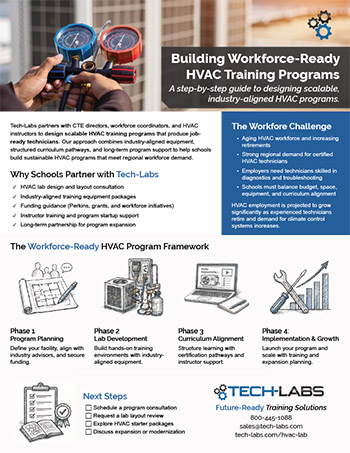
  • Cover of Workforce-Ready HVAC Training Programs Brochure

Tech-Labs’ guide, Building Workforce-Ready HVAC Training Programs, outlines a four-phase framework for creating scalable, industry-aligned HVAC programs. It covers program planning, hands-on lab development, curriculum and certification alignment, instructor support, implementation, and future growth.

The guide also examines workforce challenges such as technician shortages, retirements, and rising demand for diagnostic and troubleshooting skills. Readers will learn how schools can balance facility space, equipment, funding, and curriculum needs to prepare job-ready HVAC technicians.

  • Cover: Mastrex Metal 3D Printers Catalog

Explore the complete Mastrex line of Laser Powder Bed Fusion (LPBF) metal 3D printers, from compact systems for education, research, and prototyping to large-format machines engineered for industrial production. This catalog compares the MX100, MX120, MX150, MX220, MX300, MX400, and MX800, including build capacities, laser configurations, material compatibility, and applications.

Mastrex metal additive manufacturing systems support materials such as titanium alloys, stainless steel, aluminum, cobalt-chromium, and copper alloys. The catalog also covers available powder materials, service, installation, training, warranty, and technical support.

  • Cover: Mastrex MX100 Metal 3D Printer Catalog

The Mastrex MX-100 is a compact LPBF metal 3D printer designed for education, research, prototyping, and small-batch production. Its desktop-friendly footprint makes industrial-grade metal additive manufacturing more accessible while supporting detailed parts, tight tolerances, and high-quality surface finishes.

This catalog includes the MX-100’s 4-inch-diameter by 3.15-inch build volume, 300-watt laser, supported materials, layer-height range, machine dimensions, and operating requirements. It also covers compatible metal powders and Mastrex installation, training, warranty, and support.

  • Cover: Mastrex MX-120 Metal 3D Printer Catalog

The Mastrex MX120 provides a larger build area than the MX100 while maintaining a compact footprint and accessible workflow. Designed for engineers, researchers, educators, and manufacturers, it supports precision metal printing for prototypes, functional components, applied research, and limited production.

The catalog details the MX120’s 4.72-inch-diameter by 4-inch build volume, 300-watt laser, supported materials, machine dimensions, and electrical requirements. It also includes information on metal powders, installation, training, warranty coverage, and ongoing technical support.

  • Cover: Mastrex MX-150 Metal 3D Printer Catalog

The Mastrex MX-150 combines increased build capacity with an industrial LPBF platform suitable for laboratories, workshops, and production environments. Its 5.91 x 5.91 x 4.72-inch build volume supports larger components, multiple parts per cycle, rapid design iteration, and short production runs.

This catalog outlines the MX-150’s 500-watt laser, layer-height capabilities, supported metal alloys, printing speed, dimensions, weight, and electrical requirements. It also includes material options and information about installation, training, warranty coverage, and support.

Pages

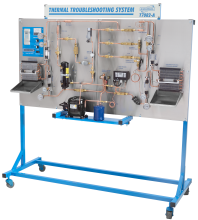
  • Amatrol T7082 Air Conditioning and Heat Pump Operations Learning System
    Item Number:
    T7082
    Teach air-conditioning and heat-pump operation with Amatrol’s T7082 HVAC/R trainer featuring a working refrigeration circuit and hands-on curriculum.
    09/11/2026 - 9:39am
  • Amatrol T7082A Air Conditioning and Heat Pump Troubleshooting Learning System
    Item Number:
    T7082A
    Teach systematic HVAC/R diagnostics with Amatrol’s T7082A air-conditioning and heat-pump trainer featuring FaultPro and 24 realistic faults.
    09/11/2026 - 9:40am
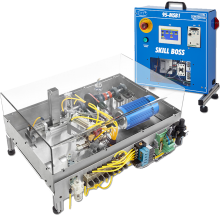
  • CPT Training with MSSC standards
    Item Number:
    95-MSB1
    Amatrol's Skill Boss Manufacturing is a hands-on training and assessment tool for CPT+ certification that meets MSSC standards easily integrates into manufacturing programs.
    08/29/2025 - 8:46am
  • Amatrol 87-TMS Smart Factory Tabletop Mechatronics — Bench-Top Industry 4.0 Trainer
    Item Number:
    87-TMS
    Train future technicians with Amatrol’s Tabletop Smart Factory and Cobot-Integrated Mechatronics systems—hands-on, compact training with real industrial components, Rockwell Automation integration, and FANUC CRX collaborative robotics.
    10/07/2025 - 8:05am
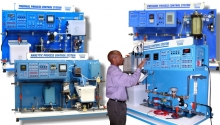
  • Amatrol Advance Manufacturing Trainers
    Each Advanced Manufacturing topic incorporates the skill development needed for modern industry. From operation to complex troubleshooting, Amatrol’s learning systems deliver job-ready skills.
    09/17/2020 - 8:06am
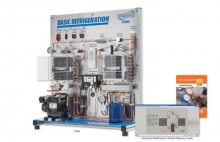
  • Amatrol HVAC Trainer | T7045
    Item Number:
    T7045
    Amatrol’s Basic Refrigeration training system (T7045) offers hands-on learning of a working refrigeration system in a compact tabletop unit.
    09/11/2026 - 8:38am
  • Amatrol T7200 refrigeration installation training workstation with compressor, evaporators, and copper tubing components
    Item Number:
    T7200
    Teach hands-on HVAC/R installation, copper tubing, brazing, refrigerant-line routing and leak testing with the Amatrol T7200 learning system.
    09/11/2026 - 9:40am
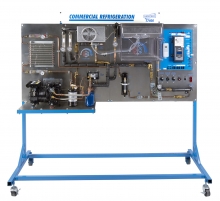
  • Amatrol Commercial Refrigeration (T7400)
    Item Number:
    T7400
    Teach commercial refrigeration with Amatrol’s T7400, featuring smart controls, multi-evaporator systems, and hands-on FaultPro troubleshooting.
    09/11/2026 - 9:40am
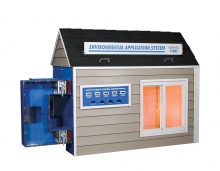
  • HVAC Training Equipment
    Item Number:
    T7083
    Teach residential HVAC performance with Amatrol's T7083. Explore heat loads, insulation, humidity, airflow, and heat-pump sizing in a model house.
    09/11/2026 - 9:40am
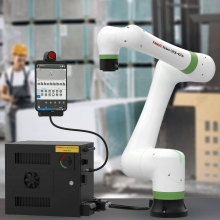
  • FANUC CRX Robot Price List
    Item Number:
    CRX Collaborative Robots: 3iA–30iA
    Explore FANUC CRX collaborative robots for education, workforce training and university research, including six models, intuitive programming, ROS 2 and Python.
    09/05/2026 - 6:06am

Pages