
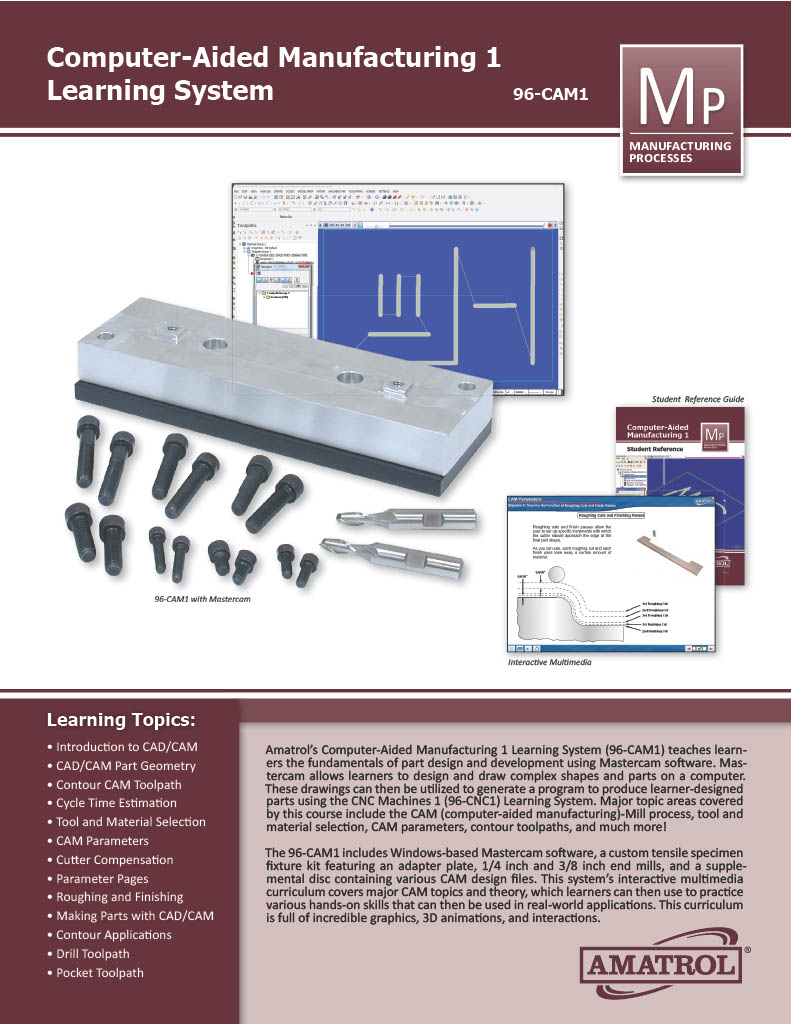
Explore TacMed's Simulation™ MATTi™ Medical Simulator, a modular whole-body female medical simulator designed to revolutionize medical training. Discover unparalleled realism, versatility, and effectiveness in simulation technology. Prepare healthcare professionals for real-world scenarios with MATTi™ today.
Pump Maintenance & Troubleshooting Skills
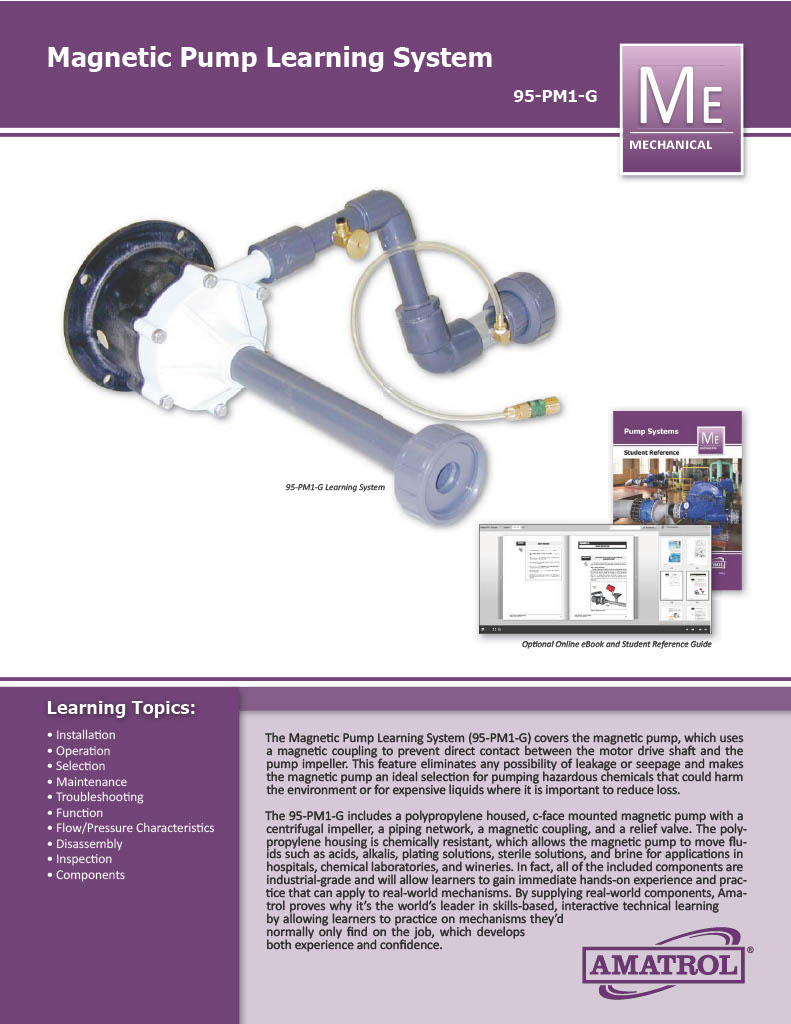
The Magnetic Pump Learning System (95-PM1-G) covers the magnetic pump, which uses a magnetic coupling to prevent direct contact between the motor drive shaft and the pump impeller. This feature eliminates any possibility of leakage or seepage and makes the magnetic pump an ideal selection for pumping hazardous chemicals that could harm the environment or for expensive liquids where it is important to reduce loss. This industrial pumps training system explains the function, operation, installation, disassembly, inspection, and maintenance of a magnetic pump.
Additional topics include: how to properly align the magnetic coupling; how to troubleshoot problems; how to select the correct magnetic pump for an application; how to determine a pump’s flow/pressure characteristics; and how each component of the pump factors into the overall operation.
Pump Maintenance Skills
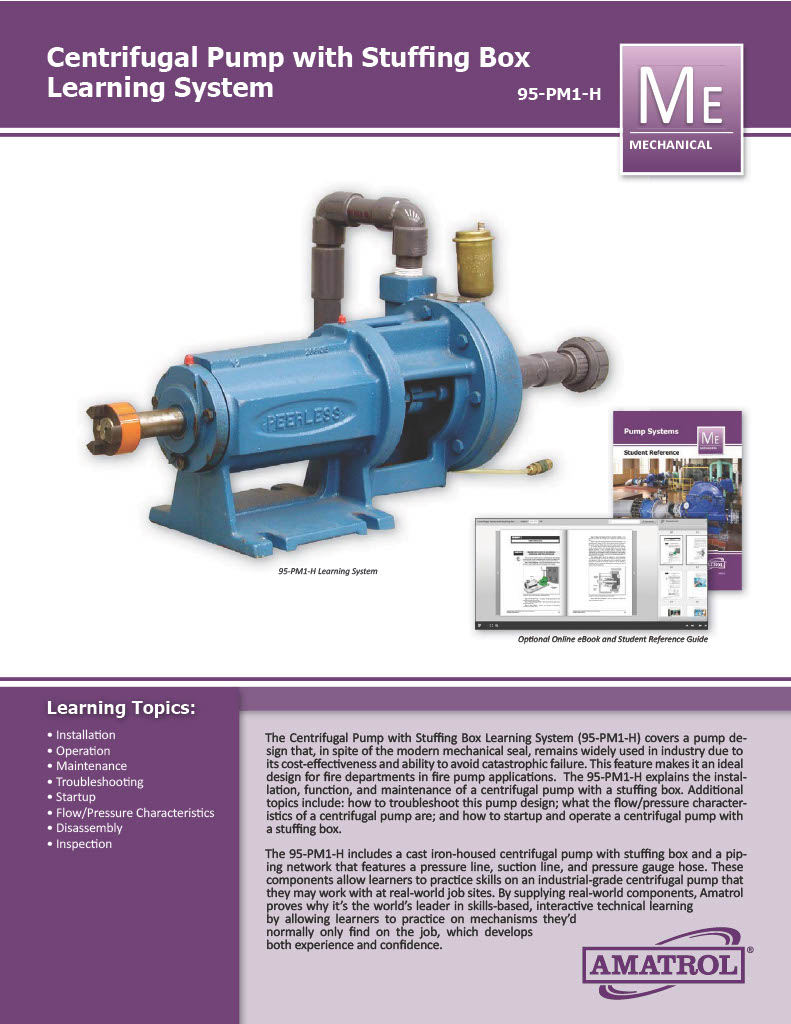
The Centrifugal Pump with Stuffing Box Learning System (95-PM1H) covers a pump design that, in spite of the modern mechanical seal, remains widely used in industry due to its cost-effectiveness and ability to avoid catastrophic failure. This feature makes it an ideal design for fire departments in fire pump applications. This industrial pumps training system explains the installation, function, and maintenance of a centrifugal pump with a stuffing box.
Additional topics include: how to troubleshoot this pump design; what the flow/pressure characteristics of a centrifugal pump are; and how to startup and operate a centrifugal pump with a stuffing box.
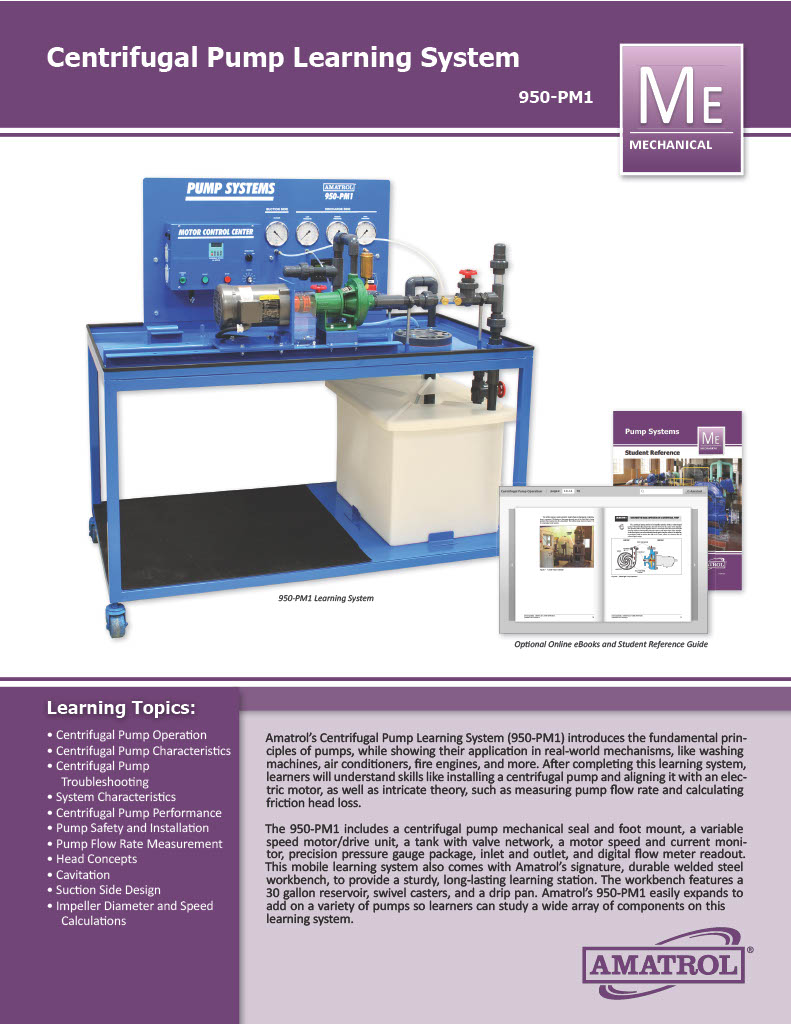
The model 950-PM1 Centrifugal Pumps Training System teaches skills related to centrifugal pumps training, which are used in almost every industry to transfer non-hydraulic fluids of various types from one place to another. Students learn a comprehensive set of industry-relevant skills including how to operate, install, maintain, troubleshoot, analyze performance, and select centrifugal pumps as well as system design.
The model 950-PM1 includes a centrifugal pump, mobile test workstation, student learning materials for both theory and lab, and teacher’s guide. This centrifugal pumps operation and maintenance training system uses industrial quality components such as a cast iron centrifugal pump to help students become better prepared for what they will encounter on the job.
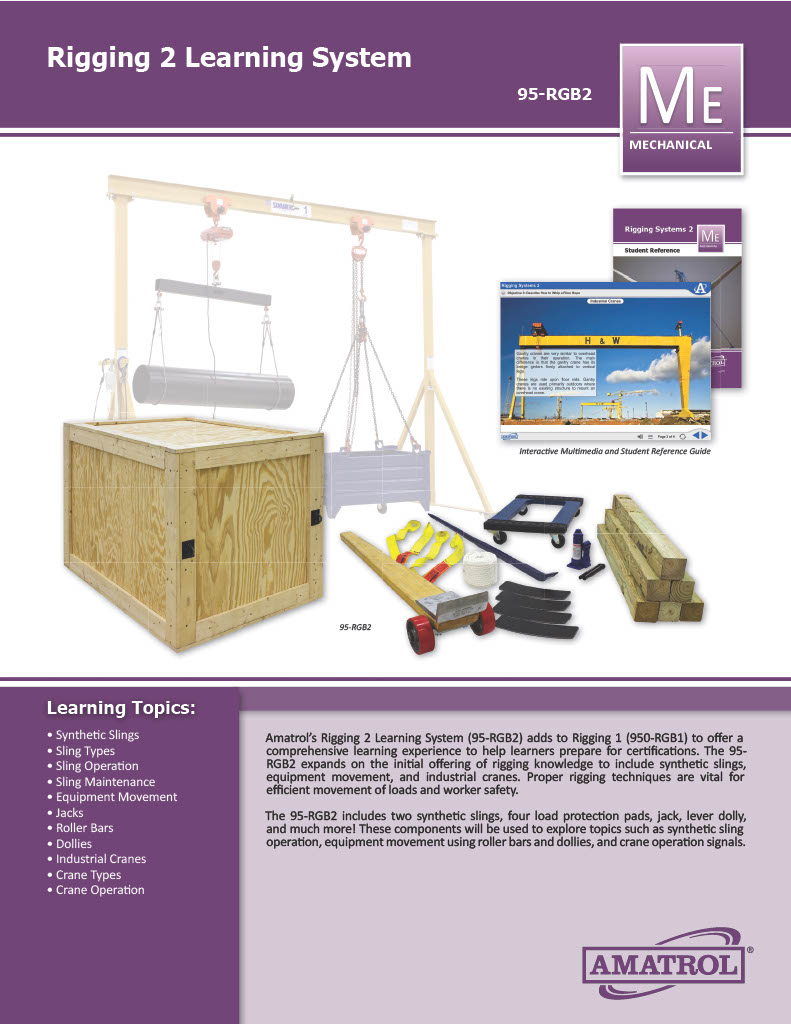
Amatrol’s Rigging 2 Learning System (95-RGB2) adds to the first Rigging training system (950-RGB1) to offer a comprehensive learning experience, to teach rigging safety training and industrial crane operation skills, and to help learners prepare for certifications. This hands-on Rigging training system expands on the initial offering of rigging knowledge to include synthetic slings, equipment movement, and industrial cranes. Proper rigging techniques are vital for efficient movement of loads and workers safety.
This Crane Operation training course includes two synthetic slings, four load protection pads, jack, lever dolly, and much more! These components will be used to explore topics such as synthetic sling operation, equipment movement using roller bars and dollies, and crane operation signals. In addition to equipment and printed curriculum, this industrial system offers a student reference guide, instructor’s manual, installation guide, and an optional online rigging training course.
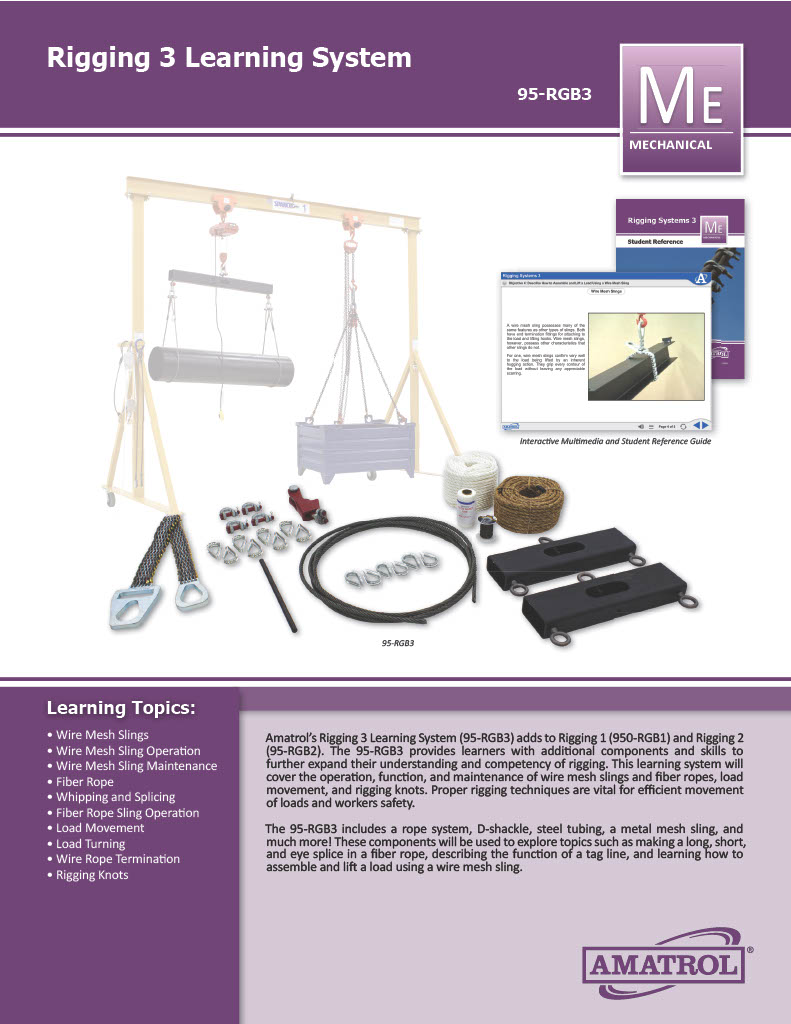
Amatrol’s Rigging 3 Learning System (95-RGB3) adds to the initial hands-on rigging training systems (950-RGB1 and 95-RGB2) by including hands-on wire mesh sling skills, rigging knots training, and rigging safety skills. This advanced rigging training system provides learners with additional components and skills to further expand their understanding and competency of rigging. Proper rigging techniques are vital for efficient movement of loads and workers safety.
This advanced rigging training system includes a rope system, D-shackle, steel tubing, a metal mesh sling, and much more! These components will be used to explore topics such as making a long, short, and eye splice in a fiber rope, describing the function of a tag line, and learning how to assemble and lift a load using a wire mesh sling. In addition to equipment and printed curriculum, this system offers a student reference guide, instructor’s manual, installation guide, and an optional online eBook.
Amatrol’s Solar Site Analysis Training System (95-SA1) teaches learners both the theoretical knowledge and hands-on skills they will need to analyze and choose suitable locations for solar arrays and components. Learners begin by studying how to conduct a preliminary site assessment, including applicable codes, jurisdictional authorities, permits, and licenses required for solar energy system installations.
Learners will also use real-world equipment, like the Solar Pathfinder sun path calculator, to perform and interpret a shading analysis in order to determine suitable locations for electrical photovoltaic and solar thermal components. The included multimedia curriculum also teaches other relevant skills, such as developing site layout drawings.
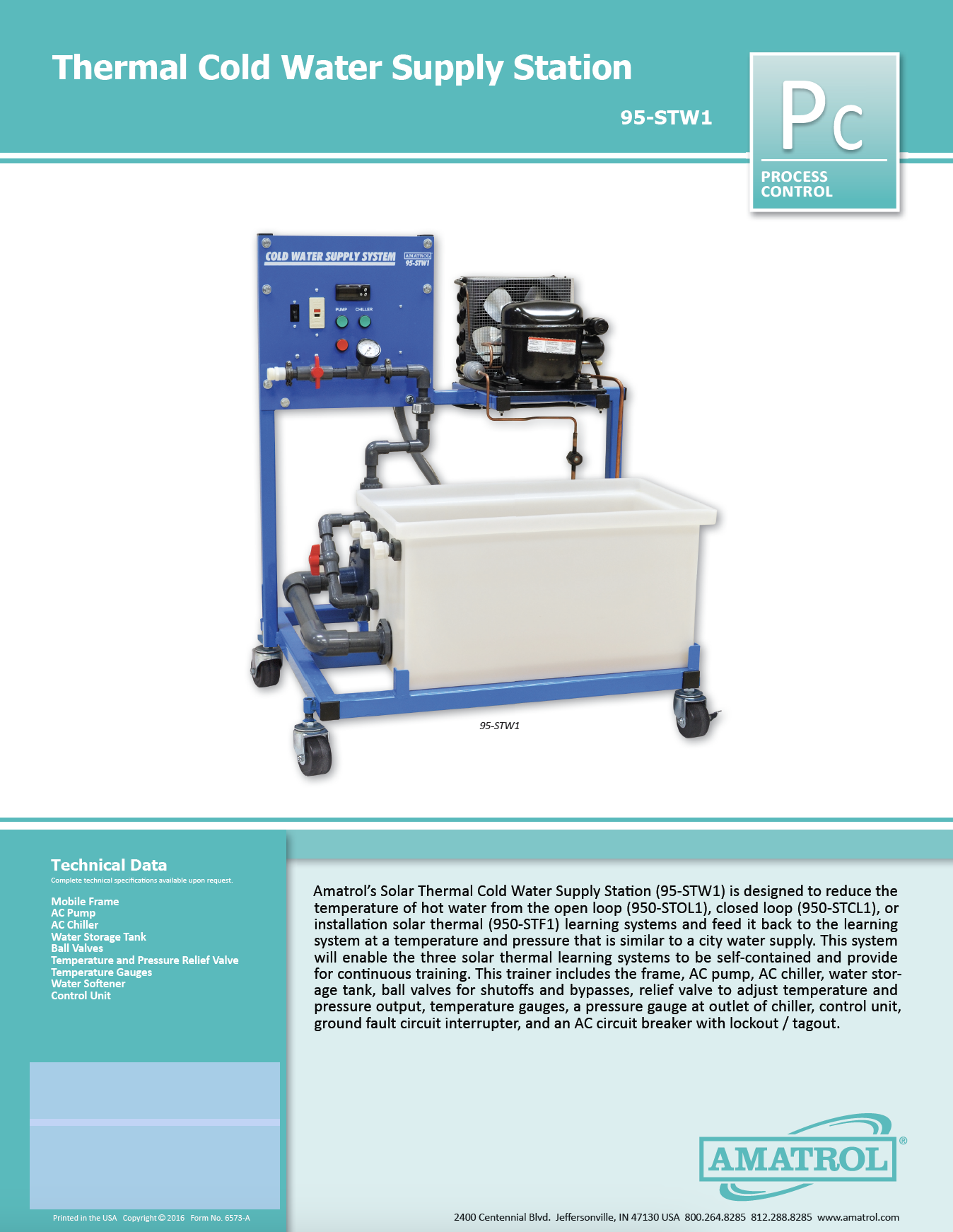
The Solar Thermal Cold Water Supply Station training is designed to reduce the temperature of hot water from the open loop (950-STOL1), closed loop (950-STCL1), or installation solar thermal (950-STF1) learning systems and feed it back to the learning system at a temperature and pressure that is similar to a city water supply. This system will enable the three solar thermal learning systems to be self-contained.
The Solar Thermal Cold Water Supply Station training includes the frame, AC pump, AC chiller, water storage tank, ball valves for shutoffs and bypasses, relief valve to adjust temperature and pressure output, temperature gauges, a pressure gauge at outlet of chiller, control unit, ground fault circuit interrupter, and an AC circuit breaker with lockout / tagout.
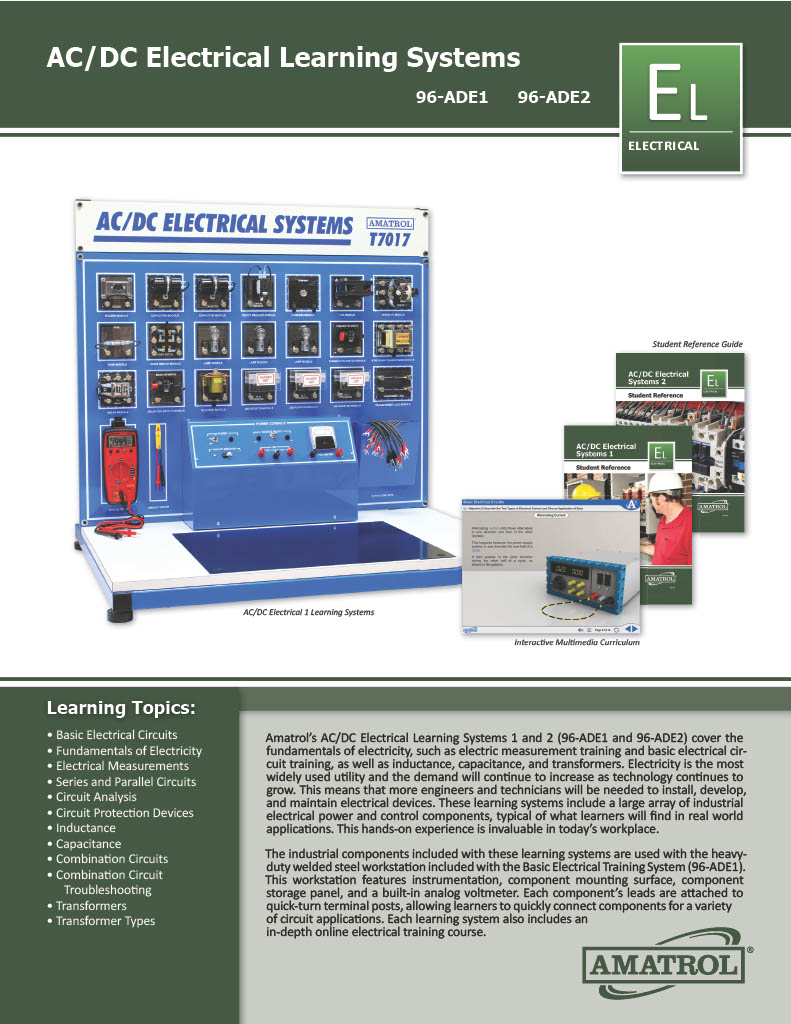
Amatrol's AC/DC Electrical Learning Systems 1 and 2 (96-ADE1 and 96-ADE2) cover the fundamentals of electricity, such as electric measurement training and basic electrical cir-cult training, as well as Inductance, capacitance, and transformers. Electricity Is the most widely used utility and the demand will continue to increase as technology continues to grow. This means that more engineers and technicians will be needed to Install, develop, and maintain electrical devices. These learning systems include a large array of Industrial electrical power and control components, typical of what learners will find In real world applications. This hands-on experience Is Invaluable In today's workplace.
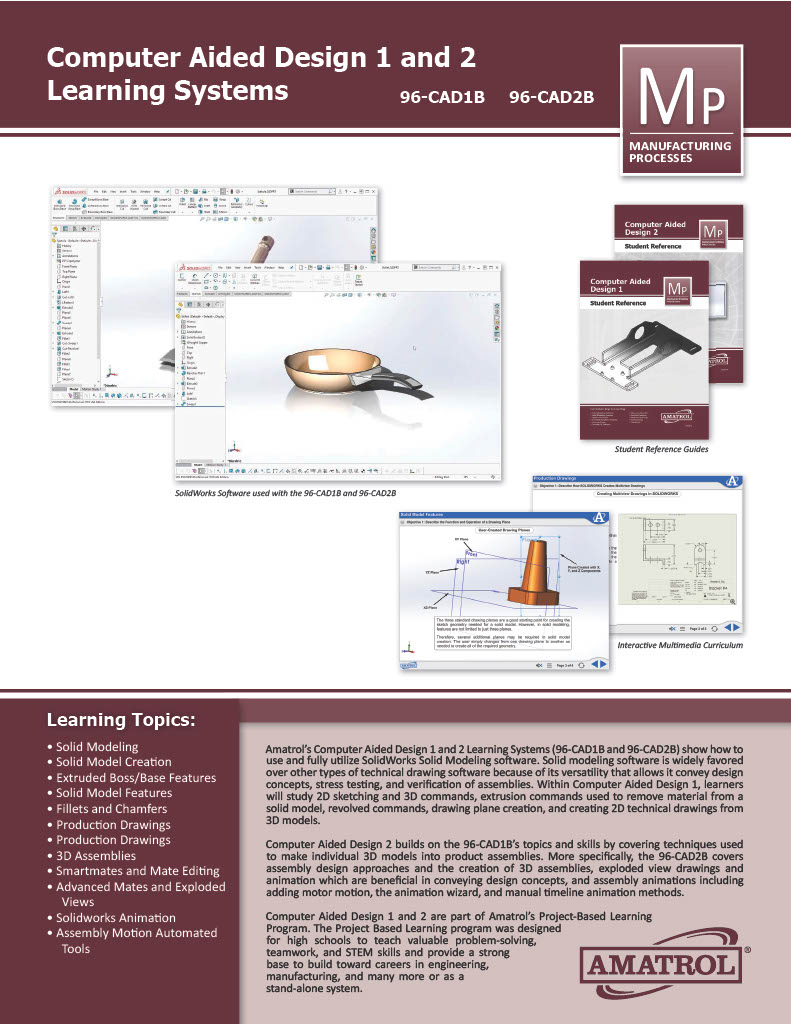
Amatrol's Computer Aided Design (CAD) 1 – SolidWorks learning system introduces solid modeling by describing the function of solid modeling software and the features of solid modeling. Solid model creation is taught by having the learner use sketch commands and tools to create a sketch and extruded boss/base features to create a solid model. Solid model features such as drawing planes; extruding cut features, fillets and chamfers; and revolved features are explored. Also included are topics such as multi-view drawings, dimensioning, and title blocks.
Amatrol’s Computer-Aided Manufacturing (CAM) 1 Learning System (96-CAM1) teaches learners the fundamentals of part design and development using Mastercam software. Mastercam allows learners to design and draw complex shapes and parts on a computer. These drawings can then be utilized to generate a program to produce learner-designed parts using the CNC Machines 1 Learning System (96-CNC1). Major topic areas covered by this course include the CAM mill process, tool and material selection, CAM parameters, contour toolpaths, and much more!
The 96-CAM1 training system includes Windows-based Mastercam software, a custom tensile specimen fixture kit featuring an adapter plate, 1/4-inch and 3/8-inch end mills, and a supplemental disc containing various CAM design files. This system’s interactive eLearning curriculum covers major CAM topics and theory, which learners can then use to practice various hands-on skills that can then be used in real-world applications. This curriculum is full of incredible graphics, 3D animations, and interactions.
Pages
-
 Item Number:MATTI-BLAST-FMM-1
 -
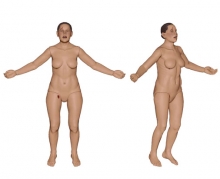
 Item Number:27-MEA1Amatrol’s Mechanical Drives 1 Assessment Workstation (27-MEA1) features a compact workstation designed to effectively assess hands-on mechanical skills with both belt and chain drives.
 -
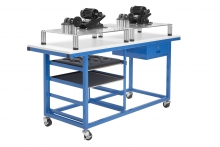
 Item Number:970-ME1Amatrol’s Mechanical Drives 1 Learning System (970-ME1) covers installation, operation, motor drive alignment, and various motor drive systems applications.
 -
 Item Number:950-MPF1Hands-on mechanical fabrication assembly training with Amatrol’s 950-MPF1. Teach essential industrial hand and power tool skills with safety-focused curriculum and optional interactive eLearning.
 -
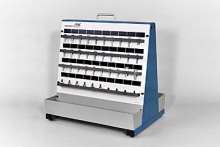 Item Number:805-PACDAC Worldwide’s Mechanical Fasteners Sample Board (805-PAC) is a hands-on teaching aid designed specifically to supplement training in industrial fastener identification, measurement, selection, and design.
 -
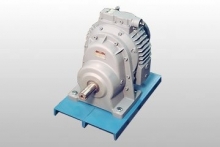 Item Number:205-190DAC Worldwide’s Mechanical Speed Variator Dissectible (205-190) provides students with realistic training that will build industrial skills hands-on.
 -
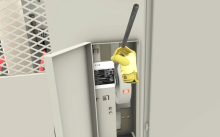 Interactive VR training for medium voltage switch operation, inspection, and maintenance—designed to strengthen electrical safety, reduce hazards, and support CTE and workforce programs.
 -
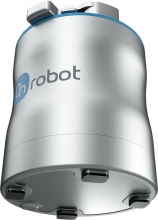 Item Number:MG10OnRobot's MG10 is a versatile, easy-to-use magnetic gripper for material handling, assembly and machine tending applications in manufacturing, automotive and aerospace environments.
 -
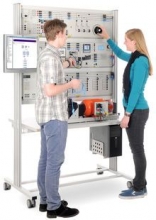 Item Number:EMG 1 / EMG 2A stand-alone power network is a type of power supply network which is closed and has no active lines coupling it to other parts of the electrical power supply grid. A stand-alone network is markedly smaller than a combined electricity grid and does not usually incorporate high-voltage power lines. For this type of network, there are two distinct modes of operation, stand-alone mode, and isolated parallel or generator-to-generator operation.
 -
 MIMBUS Discover is a turnkey VR solution for career exploration. Engage students with 16+ immersive modules across skilled trades while tracking performance in real-time with VULCAN. Ideal for CTE, K-12, and workforce programs.