
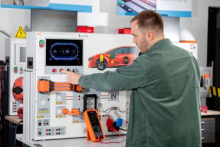
Train students and technicians in diagnosing and repairing high-voltage hybrid and electric vehicles safely. The LN CarTrain ASE L3 Trainer integrates real 400V HV components, interactive software, and fault simulations for hands-on, standards-based learning.
The Vortex® Backhoe Simulator Training Pack is part of CM Labs’ catalog of Vortex construction training packs. It’s the only training solution on the market capable of simulating a backhoe’s backlash and instability. Thanks to this capability, it is ideal for teaching novices critical transferable skills, such as how to leverage the flexibility of this machine and control its center of gravity for efficiency on the job site.
Construction equipment training is now more accessible, flexible, and portable than ever. Meet the Vortex Edge Plus, a flexible training simulator designed for maximum portability and a simple setup. This solution makes it easy to recruit, train and assess operators anywhere.
All components, from the industrial-grade pedals used in actual equipment to the operator controls, monitor, steering wheel, and workstation-class laptop, can be easily transported and installed within minutes.
The Vortex Edge Plus is a complete and affordable training tool that can run CM Lab’s entire fleet of earthmoving, lifting, and forestry equipment training packs. It also connects to an optional Instructor Operating Station for instructor-led training, scoring, and reporting.
The Straddle Carrier Simulation allows operators to get hands-on experience with the equipment at any time, regardless of weather conditions or machine availability. Combined with CM Labs' Smart Training Technology, trainees can reach proficiency without risking the safety or efficiency of the ports' day-to-day terminal activities.
CM Labs' Smart Training Technology excels at replicating true-to-life physical and mechanical specifications, delivering an authentic operator experience.
CM Labs' Empty Container Handler Simulator (ECH) is the only simulator training solution on the market that allows operators to experience the effects of unbalanced loads and other causes of machine instability.
Allow your instructors to control and assess operator training from their seats. CM Labs’ Instructor Operating Station provides a real-time 3D view of the virtual worksite from any vantage point. It allows instructors to do everything from launching exercises, manipulating the weather, customizing scores, and more.
The Vortex® Tower Crane Training Pack is part of the Vortex Training suite for construction cranes and heavy equipment. From hook and load management to complex blind lifts, operators who train with Vortex simulators develop the skills, coordination, and worksite awareness they need to master safe lift operations.
Key features & benefits
With the Tower Crane Training Pack, operators gain valuable experience in safe lifting operations, with no wear and tear to the crane, and no risk to themselves or others. Operators build real skills faster than traditional training alone and learning organizations save instructor time and reduce equipment costs.
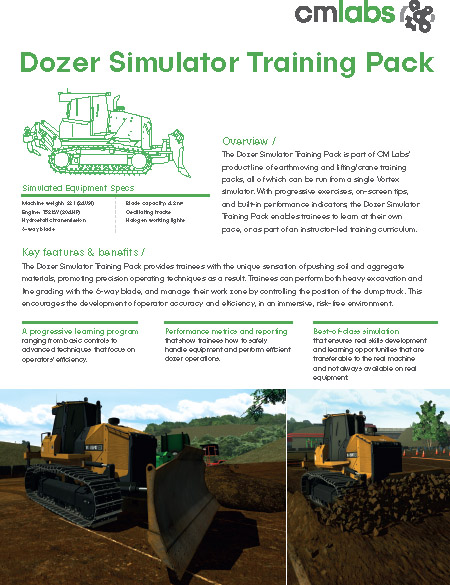
The Dozer Simulator Training Pack is part of CM Labs’ product line of earthmoving and lifting/crane training packs, all of which can be run from a single Vortex simulator. With progressive exercises, on-screen tips, and built-in performance indicators, the Dozer Simulator Training Pack enables trainees to learn at their own pace, or as part of an instructor-led training curriculum.
Key features & benefits
The Dozer Simulator Training Pack gives trainees the unique sensation of pushing soil and aggregate materials, promoting precision operating techniques. Trainees can perform both heavy excavation and fi ne grading with the 6-way blade and manage their work zone by controlling the position of the dump truck. This encourages the development of operator accuracy and effi ciency, in an immersive, risk-free environment.
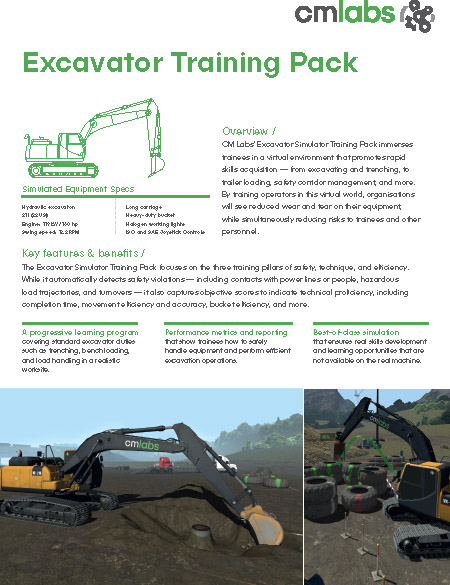
CM Labs’ Excavator Simulator Training Pack immerses trainees in a virtual environment that promotes rapid skills acquisition — from excavating and trenching to trailer loading, safety corridor management, and more. By training operators in this virtual world, organizations will see reduced wear and tear on their equipment while reducing risks to trainees and other personnel.
Key features & benefits
The Excavator Simulator Training Pack focuses on the three training pillars of safety, technique, and efficiency. While it automatically detects safety violations — including contacts with power lines or people, hazardous load trajectories, and turnovers — it also captures objective scores to indicate technical proficiency, including completion time, movement efficiency and accuracy, bucket efficiency, and more.
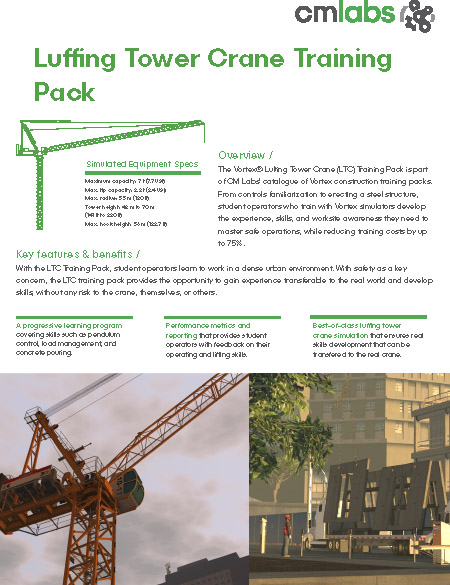
The Vortex® Luffing Tower Crane (LTC) Training Pack is part of CM Labs’ catalog of Vortex construction training packs. From controls familiarization to erecting a steel structure, student operators who train with Vortex simulators develop the experience, skills, and worksite awareness they need to master safe operations while reducing training costs by up to 75%.
Key features & benefits
With the LTC Training Pack, student operators learn to work in a dense urban environment. With safety as a key concern, the LTC training pack provides the opportunity to gain experience transferable to the real world and develop skills, without any risk to the crane, themselves, or others.
CM Labs’ Motor Grader Training Pack is today's most advanced grader simulation. From controls familiarisation and grader positioning to windrow management, material spreading, and V-ditch creation, operators who train on Vortex® simulators develop the aptitude and skills they need to master efficient motor grader operations.
Key features & benefits
CM Labs’ Motor Grader Training Pack is a complete learning solution for grader operations. It gives trainees the distinctive feeling of pushing soil, essential for an immersive motor grader training experience. It is also the only training solution on the market that allows trainees to learn how to operate a high-precision blade and manage real-life advanced effects such as side-draft, which require specific skills. The training pack also incorporates self-guided learning features, including previews of each training exercise, and best-practice hints.
Pages
-
 Item Number:CO3223-6X7
 -
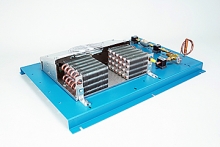 Item Number:373-991DAC Worldwide’s Ceiling Unit Cooler System Cutaway is a professionally-crafted, sectioned example of a refrigeration system fragment, including ceiling unit cooler with associated components, as used in commercial refrigeration systems relating to food preservation applications.
 -
 Item Number:950-CL1Amatrol’s Central Lubrication Learning System (950-CL1) is for hands-on training in operating, maintaining, and troubleshooting piston distributor and series/progressive valve lubrication systems—plus oils, greases, and lubricant management.
 -
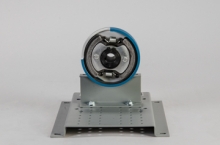 Item Number:200-2204DAC Worldwide’s Centrifugal Clutch Cutaway (200-2204) depicts a modified industrial centrifugal clutch for mechanical drive training in a classroom or laboratory. This sectioned mechanical power transmission component uses centrifugal force to connect two concentric shafts by throwing a centrifugal shoe outwards at a right angle to the primary shaft axis, which allows for shift during start-up.
 -
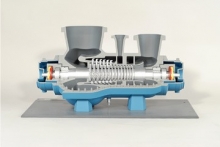 Item Number:211CThe design of the Centrifugal Compressor Model is based upon common industrial centrifugal compressors.
 -
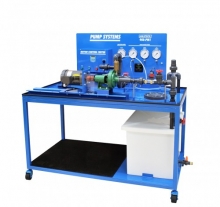 Item Number:950-PM1The model 950-PM1 Pumps Learning System teaches skills related to centrifugal pumps, which are used in almost every industry to transfer non-hydraulic fluids of various types from one place to another. Students learn a comprehensive set of industry-relevant skills including how to operate, install, maintain, troubleshoot, analyze performance, and select centrifugal pumps as well as system design.
 -
 The CFT program was created in partnership with the Material Handling Equipment Distributors Association (MHEDA) to provide skills to entry-level forklift technicians, enhancing their performance in the world of material handling. The CFT prepares individuals to repair and maintain technical systems utilizing key engineering principles that underpin most forklift vehicles.
 -
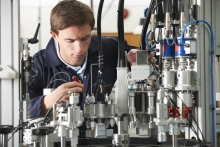 Item Number:C-101 / C-102 / C-103 / C-104SACA’s Associate certifications are introductory Industry 4.0 certifications appropriate for operators and other individuals seeking to become familiar with Industry 4.0 factory floor automation equipment and processes.
 -
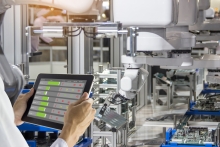 SACA’s Certified Industry 4.0 Professional certification is an engineering certification that focuses on the analysis, design, and optimization of Industry 4.0 systems. It prepares engineers to succeed in positions in modern production environments that use Industry 4.0 technologies.
 -
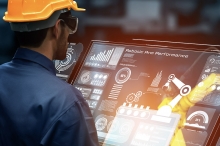 SACA’s Specialist certifications certify Industry 4.0 technical skills in operations, troubleshooting, programming, maintenance, and systems integration. Each certification is keyed to a skilled occupation.