LinkedIn
X
Facebook
YouTube
Contact Tech-Labs
Search

Electrical Machines
Connect Electrical Theory to Real-World Machine Performance
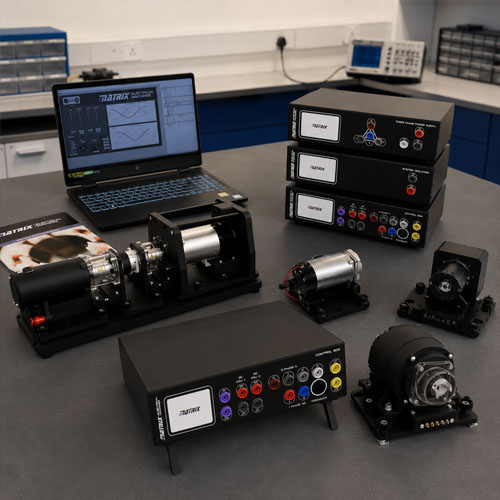
The Matrix TSL Electrical Machines Training System provides a modern, hands-on approach to teaching electrical machine principles, motor control, power conversion, and drivetrain technologies. Designed for electrical, mechanical, automotive, aerospace, and advanced manufacturing programs, the system allows learners to safely explore the operation and performance of a wide variety of electrical machines and associated mechanical systems within a compact training environment.
This comprehensive learning platform goes beyond studying individual motors by enabling students to investigate complete electromechanical systems. Learners can analyze the relationships between power sources, drives, control systems, mechanical loads, and energy conversion while developing practical troubleshooting and testing skills. Intelligent hardware recognition and integrated software tools simplify setup and allow instructors to focus on teaching core concepts rather than equipment configuration.
With a modular architecture that supports a broad range of machine types, power systems, and drivetrain components, the Electrical Machines Training System can be configured to support introductory education, advanced engineering studies, and workforce development programs. The flexible design allows institutions to expand capabilities over time while maintaining a consistent learning platform across multiple courses and disciplines.
- Electrical machine principles and operation
- Motor control and drive technologies
- Power conversion and energy transfer
- Mechanical drivetrain analysis
- Speed, torque, and efficiency testing
- Electromechanical system integration
- Industrial and automotive drive systems
- Performance measurement and diagnostics
- Electrical and mechanical engineering applications
The Electrical Machines Training System enables students to study the interaction between electrical power, control systems, and mechanical loads. By working with complete electromechanical systems rather than isolated components, learners gain a deeper understanding of how machines operate in real-world industrial and transportation applications.
The system's modular design allows programs to tailor training to specific learning objectives while maintaining a common instructional platform. Additional machine types, power sources, and mechanical components can be incorporated as curriculum requirements evolve, helping protect long-term investments in training equipment.
Integrated software tools provide advanced control, monitoring, and analysis capabilities that help students visualize machine performance and operating characteristics. Intelligent hardware identification streamlines setup and configuration, reducing complexity and allowing more time for instruction and experimentation.
Students can explore concepts that apply across numerous industries, including manufacturing, automation, transportation, aerospace, renewable energy, and electric vehicle technologies. The platform supports both foundational education and advanced engineering studies by connecting theoretical concepts with practical hands-on experience.
More Information
Manufacturer: