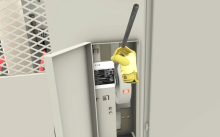
Interactive VR training for medium voltage switch operation, inspection, and maintenance—designed to strengthen electrical safety, reduce hazards, and support CTE and workforce programs.
This video demonstrates the Matrix Torsion of Rods experiment in manual mode, where students investigate how different materials respond to applied torque. Following the included curriculum workbook, learners compare the torsional characteristics of brass, aluminum, and steel rods while collecting experimental data for analysis.
During the investigation, students install each rod, measure its dimensions, and gradually increase the angle of twist while recording the torque required at each increment. The experiment is repeated for each material, allowing students to compare torque-versus-angle relationships and better understand material properties, torsional stiffness, and structural behavior through practical experimentation.
What You'll Learn
- How to set up the Torsion of Rods experiment in manual mode
- Comparing the torsional behavior of brass, aluminum, and steel rods
- Measuring torque and angle of twist using integrated LCD displays
- Recording experimental measurements for multiple materials
- Investigating the relationship between torque and angular displacement
- Repeating experiments to compare material properties
- Plotting torque versus angle graphs for analysis
- Reinforcing engineering concepts through hands-on laboratory investigations
Why Study Torsion?
Torsional loading is an important consideration in the design of shafts, drive systems, fasteners, and structural components. This experiment gives students practical experience measuring the effects of torque on different materials, helping them connect engineering theory with real-world mechanical behavior and material performance.
This video demonstrates the Matrix Bending Stress experiment using data acquisition mode, allowing students to investigate how bending loads create stress within a beam. Using the included curriculum workbook, learners configure strain gauges, collect real-time measurement data, and perform engineering analysis to validate theoretical calculations.
Students begin by configuring a quarter-bridge Wheatstone bridge circuit using strain gauges and precision resistors before applying incremental loads to the beam. As each load is added, measurements are captured through the integrated data acquisition system and exported for analysis. The resulting data allows students to calculate bending stress, compare theoretical and experimental results, and gain practical experience with strain measurement techniques used throughout structural and mechanical engineering.
What You'll Learn
- How to configure a quarter-bridge Wheatstone bridge using strain gauges
- Setting up the Bending Stress experiment using data acquisition
- Applying incremental loads to investigate bending stress
- Collecting real-time strain measurements using integrated sensors
- Measuring beam dimensions for engineering calculations
- Exporting experimental data for post-laboratory analysis
- Comparing theoretical bending stress calculations with measured results
- Developing practical skills in experimental stress analysis
Why Study Bending Stress?
Measuring bending stress is fundamental to understanding how structural components perform under load. This experiment introduces students to strain gauge technology, Wheatstone bridge circuits, and modern data acquisition methods while reinforcing core concepts in mechanics of materials, structural analysis, and engineering design.
This video provides an overview of the Matrix Fundamental Mechanics Materials Kit, demonstrating how students perform practical experiments to investigate the mechanical properties of engineering materials. Designed for classroom and laboratory environments, the kit allows learners to build experiments using the portable work panel while following the included curriculum workbook.
The featured experiment investigates how an aluminum beam deflects under increasing loads. Students measure the beam's dimensions, apply incremental weights, and use a precision dial gauge to record deflection. The collected data is then plotted on a graph, helping students understand the relationship between load and beam deflection while reinforcing important concepts in material science and mechanics.
What You'll Learn
- How to perform beam deflection experiments using the Materials Kit
- Measuring beam dimensions for engineering calculations
- Recording beam deflection with a precision dial gauge
- Applying incremental loads and collecting experimental data
- Plotting deflection versus load graphs for analysis
- Understanding stress, strain, and elastic behavior
- Exploring Young's modulus and other material properties
- Developing practical laboratory and engineering analysis skills
Topics Covered by the Materials Kit
The Fundamental Mechanics Materials Kit supports a wide range of experiments covering beam deflection, stress and strain, torsion, elastic constants, Young's modulus, and other core principles of mechanics of materials. The included curriculum provides approximately 10 hours of guided laboratory activities that combine theory with practical investigation, making it ideal for engineering, technology, and STEM education programs.
Pages
-
-
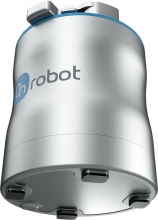 Item Number:MG10OnRobot's MG10 is a versatile, easy-to-use magnetic gripper for material handling, assembly and machine tending applications in manufacturing, automotive and aerospace environments.
 -
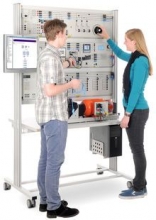 Item Number:EMG 1 / EMG 2A stand-alone power network is a type of power supply network which is closed and has no active lines coupling it to other parts of the electrical power supply grid. A stand-alone network is markedly smaller than a combined electricity grid and does not usually incorporate high-voltage power lines. For this type of network, there are two distinct modes of operation, stand-alone mode, and isolated parallel or generator-to-generator operation.
 -
 MIMBUS Discover is a turnkey VR solution for career exploration. Engage students with 16+ immersive modules across skilled trades while tracking performance in real-time with VULCAN. Ideal for CTE, K-12, and workforce programs.
 -
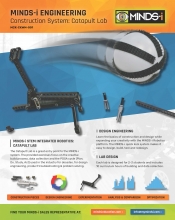 Item Number:MCK-CKWM-001The Catapult Lab is a great entry point to the MINDS-i system. The provided exercises focus on the creative build process, data collection and the PDSA cycle (Plan, Do, Study, Act) used in the industry for decades, for design engineering, product troubleshooting & problem-solving.
 -
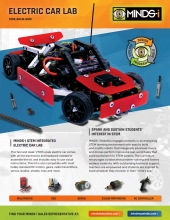 Item Number:MCK-ECLB-2WDThis fast and sleek 1/10th scale electric car comes with all the electronics and hardware needed to assemble the kit and includes easy to use visual instructions. This kit is also compatible with most hobby standard DC motors, gears, radio transmitters, servos, bodies, wheels, tires, and more.
 -
 Item Number:MCK-107P-001Prepare students for FAA Part 107 knowledge areas with the MINDS-i FAA 107 Certification Prep Course. Explore regulations, airspace, weather, safety, and UAV operations in a 45-hour program.
 -
 Item Number:CPK-W4X4-001Explore the Minds-i Search and Rescue Competition Kit, created for SkillsUSA robotics events. Learn how students can build, program, and remotely operate robots to tackle real-world rescue challenges.
 -
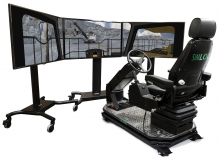 Item Number:MTModern mining equipment is increasingly complex, costly, and difficult to operate productively. As a result, proper operator training has become everyone's business. The fact is, it takes training to spot a truck and position it for loading under a full bucket. It also takes training to back up a truck just using mirrors under that bucket. Otherwise, your mining operations will suffer from lower productivity, higher fuel costs, increased tire wear, and more equipment maintenance and repair.
 -
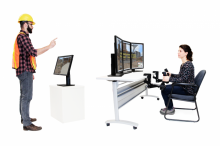 Item Number:MCRASimlog’s Advanced Edition puts you at the controls of a modern rough-terrain mobile crane equipped with telescoping boom and jib, and a variety of hook-blocks with best-in-class simulation graphics and physics, slings that go “slack”, and a boom that deflects. And now there’s wind, with parameters to define the direction, strength, and gusting.