


Amatrol's 870 Mechatronics Learning System teaches students a broad array of job-ready skills in integrating technologies. Students work together in a team environment to make the whole process work. Seven stations make up a complete flexible manufacturing system. Each station is a small mechatronics system in itself with multiple, integrated technologies that can be used stand-alone or in various combinations, creating unlimited project capability. The Learning System is compact, enabling it to fit into almost any teaching facility.
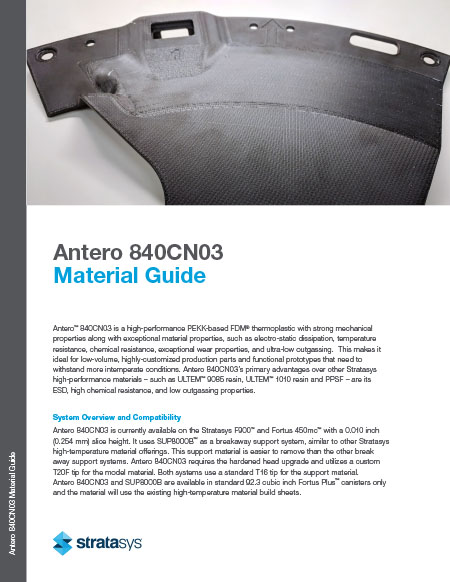
Antero™ 840CN03 is a PEKK-based FDM thermoplastic combining the excellent physical and mechanical qualities of PEKK with electrostatic dissipative (ESD) properties. The material is filled 3% by weight with carbon nanotubes.
As a high-performance polymer, Antero 840CN03 exhibits exceptional chemical and wear resistance, ultra-low outgassing properties and consistent ESD performance. ESD values range from 104 – 109 ohms per square inch. This makes the material particularly suitable for space and industrial applications where these qualities are critical.
Antero™ 840CN03 is a high-performance PEKK-based FDM® thermoplastic with strong mechanical properties and exceptional material properties, such as electro-static dissipation, temperature resistance, chemical resistance, exceptional wear properties, and ultra-low outgassing. This makes it ideal for low-volume, highly-customized production parts and functional prototypes that must withstand more intemperate conditions. Antero 840CN03’s primary advantages over other Stratasys high-performance materials – such as ULTEM™ 9085 resin, ULTEM™ 1010 resin, and PPSF – are its ESD, high chemical resistance, and low outgassing properties.
System Overview and Compatibility
Antero 840CN03 is available on the Stratasys F900™ and Fortus 450mc™ with a 0.010 inch (0.254 mm) slice height. It uses SUP8000B™ as a breakaway support system, similar to other Stratasys high-temperature material offerings. This support material is easier to remove than the other breakaway support systems. Antero 840CN03 requires the hardened head upgrade and utilizes a custom T20F tip for the model material. Both systems use a standard T16 tip for the support material.
Antero 840CN03 and SUP8000B are available in standard 92.3 cubic inch Fortus Plus™ canisters only, and the material will use the existing high-temperature material build sheets.
Antero™ 800NA is a PEKK-based FDM® thermoplastic. It combines FDM’s design freedom and ease of use with the excellent strength, toughness, and wear-resistant properties of PEKK material.
Antero 800NA exhibits high heat resistance, chemical resistance, low outgassing, and dimensional stability, particularly in large parts.
Appropriate applications include aircraft components exposed to jet fuel, oil, and hydraulic fluid, spacecraft parts that demand low outgassing, and chemical-resistant industrial parts. Using Antero 800NA with FDM technology avoids the waste associated with subtractive manufacturing of high-cost bulk PEKK material.
Antero 800NA is available on Fortus 450mc™ and F900™ 3D Printers and is compatible with breakaway support material SUP8000B™.
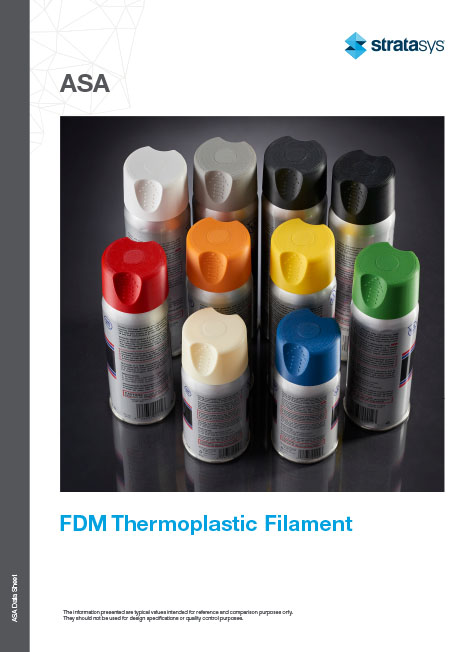
ASA (acrylonitrile styrene acrylate) FDM® filament is a broad-use commodity thermoplastic. It is similar to ABS (acrylonitrile butadiene styrene) but exhibits better UV resistance, mechanical properties, and aesthetics than ABS.
ASA suits most general-purpose 3D printing applications involving prototyping, jigs and fixtures, and low-volume production parts. ASA filament is available in the most colors of any FDM material.
Offering a variety of production-grade thermoplastics, FDM® technology creates parts that are highly accurate, tough, and suitable for both functional prototyping and end-use parts. ABS is the most common material used as it boasts good mechanical properties and high name recognition. Compared with ASA, ABS may be more familiar because of its popularity in mass production.
ASA is another popular all-purpose material for jigs and fixtures, manufacturing aids, prototyping and limited-run end-use parts. ASA matches or exceeds the mechanical properties of standard ABS and has greater heat resistance. Moreover, ASA demonstrates exceptional UV stability and, with its matte finish, offers the best aesthetics of any FDM thermoplastic. It’s especially suited for end-use parts in outdoor commercial and infrastructure applications, and its wide array of color options surpasses that of ABS.
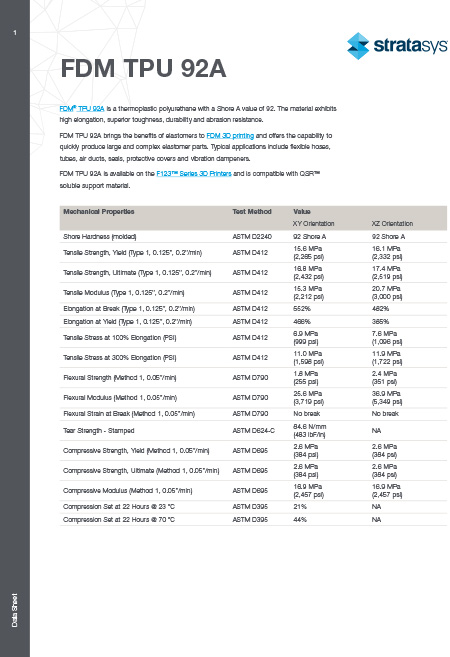
FDM® TPU 92A is a thermoplastic polyurethane with a Shore A value of 92. The material exhibits high elongation, superior toughness, durability, and abrasion resistance.
FDM TPU 92A brings the benefits of elastomers to FDM 3D printing and can quickly produce large and complex elastomer parts. Typical applications include flexible hoses, tubes, air ducts, seals, protective covers, and vibration dampeners.
FDM TPU 92A is available on the F123™ Series 3D Printers and is compatible with QSR™ soluble support material.
Produce Large and Complex Elastomer Parts
Create accurate elastomer parts quickly and efficiently with the ease and reliability of professional FDM 3D printing. The durable elasticity of FDM TPU 92A material makes it a good choice for a variety of applications, including flexible hoses, tubes, air ducts and vibration dampeners.
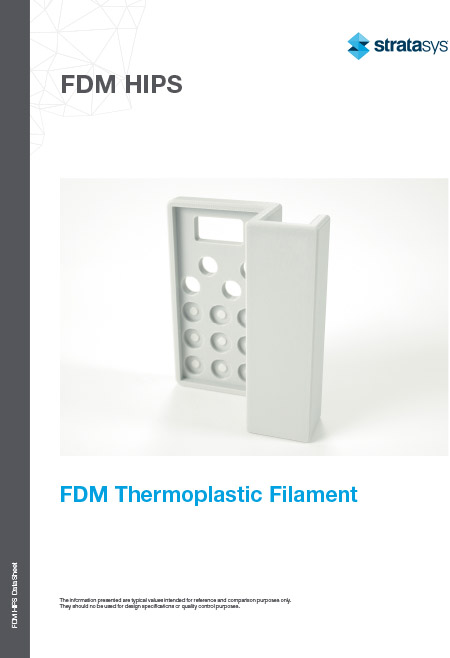
FDM® HIPS (high-impact polystyrene) is a low-cost, general-use 3D printing thermoplastic. It offers similarities to ABS but has high impact resistance making it suitable for printing lower-requirement jigs, fixtures, and prototypes at a reduced cost.
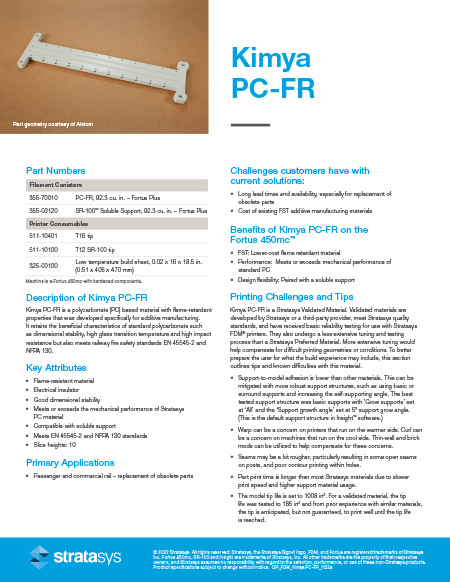
Kimya PC-FR is a polycarbonate FDM® 3D printing filament with flame-retardant properties developed specifically for additive manufacturing. It retains the beneficial characteristics of standard polycarbonate, such as dimensional stability, high glass transition temperature, and high impact resistance.
Kimya PC-FR is a polycarbonate (PC) based material with flame-retardant properties developed specifically for additive manufacturing. It retains the beneficial characteristics of standard polycarbonate such as dimensional stability, high glass transition temperature, and high impact resistance.
Key Attributes
- Flame-resistant material
- Electrical insulator
- Good dimensional stability
- Meets or exceeds the mechanical performance of Stratasys PC material
- Compatible with soluble support
- Meets EN 45545-2 and NFPA 130 standards
- Slice heights: 10
Pages
-
-
 Item Number:990-MES1Learners will acquire skills such as how to measure length, accurate measurement of inside and outside dimensions, measuring both in U.S. Customary and S.I. Metric units, and collecting measurement data. The 990-MES1 contains precisely-machined and numbered parts that challenge the learner to make accurate measurements. Understanding how to perform accurate measurements is relevant to technical careers such as quality control inspector, machinist, manufacturing engineer, operations manager, and production technician. The 990-MES1’s compact size and durable case also provide for safe storage when available training space must be used to teach other topics.
 -
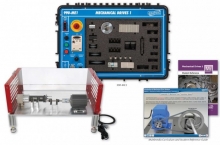 Item Number:990-ME1Amatrol’s Portable Mechanical Drives 1 Learning System (990-ME1) covers the fundamentals of mechanical transmission systems and applications, such as how to: operate, install, analyze performance, and design basic mechanical transmission systems using chains, vbelts, spur gears, bearings, and couplings. These fundamentals can be applied to a variety of applications within the automotive, agricultural, and power industries.
 -
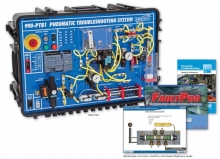 Item Number:990-PTB1Amatrol’s 990-PTB1 Portable Pneumatics Troubleshooting Learning System teaches hands-on skills with industry-standard components, interactive curriculum, and FaultPro software for real-world troubleshooting practice.
 -
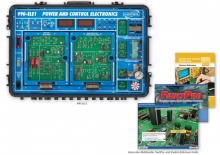 Item Number:990-ELE1Amatrol’s Portable Power and Control Electronics Learning System (990-ELE1) covers how to operate, adjust, and troubleshoot electronic components, circuits, and systems used in machine applications. The portable learning system allows for on-the-go exploration of the fundamental concepts of industrial power and control electronics, such as measuring temperature, speed, and analog signals. The 990-ELE1 provides skills and topics that will be invaluable in industries like manufacturing, transportation, energy, and construction.
 -
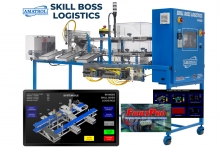 Item Number:95-MSB3The Amatrol Skill Boss Logistics offers a performance-based assessment for evaluating the skills and competencies of future supply chain automation technicians.
 -
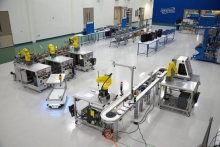 The Smart Factory is a fully connected and flexible manufacturing system that connects its physical systems, operational information, and human assets to control manufacturing, maintenance, inventory, and supply chain operations.
 -
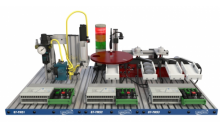 Item Number:870-PTAB82Amatrol’s Tabletop Mechatronics is a portable, durable, affordable learning system that forms a fully automated line to teach real-world mechatronics skills. This learning system features a pick-and-place, gauging, and inventory station, all of which fit on a standard tabletop!
 -
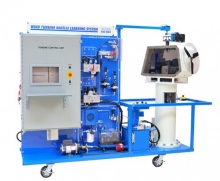 Item Number:950-TNC1Master wind turbine troubleshooting with Amatrol’s 950-TNC1 Turbine Nacelle Learning System. Train on real-world components, simulate faults, and prepare learners for advanced wind energy careers.
 -
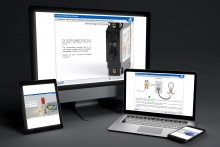 Amatrol’s virtual trainers replicate physical systems in such detail that students can build skills even when they don’t have access to actual equipment.