
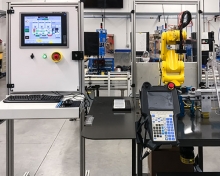
Connected Smart Manufacturing System (CSM™) integrates FANUC robotics, CNC machining, Rockwell PLC/HMI control, and APT integration training to teach Industry 4.0 manufacturing, automation, and troubleshooting skills.
Every company knows how important it is to be compliant with OSHA protocols. Still, most are not aware of how to efficiently train their employees to follow these guidelines across various disciplines.
Traditional safety training can require costly outside instructors, time off the job, and pricey specialized equipment. Virtual reality, however, can help quickly familiarize novice and seasoned employees with updated safety protocols while saving time, money, and energy for both employer and employee.
Employees trained in these realistic, virtual environments will be familiarized with extreme heights, live wires, complex machinery, and more, helping them build muscle memory and retain pertinent information vital to on-the-job success. Using virtual reality as a training and assessment tool can give management a new perspective on improving their safety training.
System Overview and Compatibility
ABS-CF10 is currently available on the F123™ Series machines with 0.007 inch (0.178 mm), 0.010 inch (0.254 mm), and 0.013 inch (0.33 mm) layer heights. It requires a dedicated ABS-CF10 extrusion head, denoted with a dark green case, for all layer heights for the model material. It is compatible with QSR Support™ as a soluble support system and requires a standard F370™ extrusion head for all layer heights for the support material. This system uses the standard F123 Series build tray. ABS-CF10 and QSR are available in a standard F123 90-cubic-inch spool.
Stratasys ABS-CF10 combines standard ABS (acrylonitrile butadiene styrene) material with 10% chopped carbon fiber by weight.
The result is a low moisture-sensitive FDM® thermoplastic 50% stiffer and 15% stronger than standard ABS 3D printing material.
Typical applications include manufacturing tools, jigs, fixtures and end effectors that benefit from the combination of increased stiffness and reduced weight.
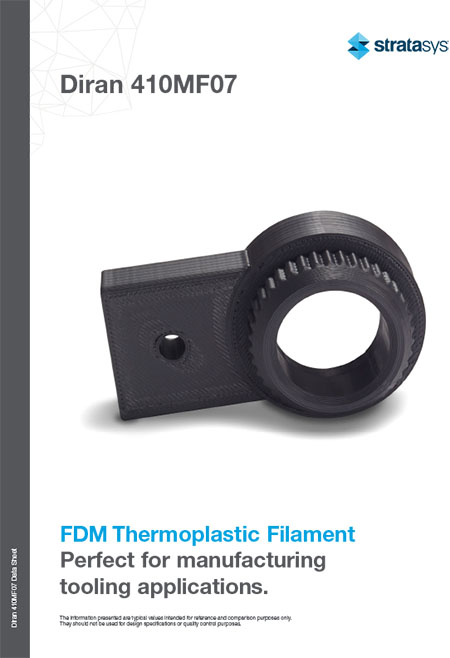
Diran™ 410MF07 is a nylon-based thermoplastic FDM® material, mineral-filled 7% by weight. It demonstrates very good toughness and impact strength combined with resistance to hydrocarbon-based chemicals. Its smooth, lubricious surface quality offers low sliding resistance.
Typical applications include jigs, fixtures and other forms of general manufacturing tooling, and is particularly effective for applications needing a non-marring interface between the tool and the workpiece.
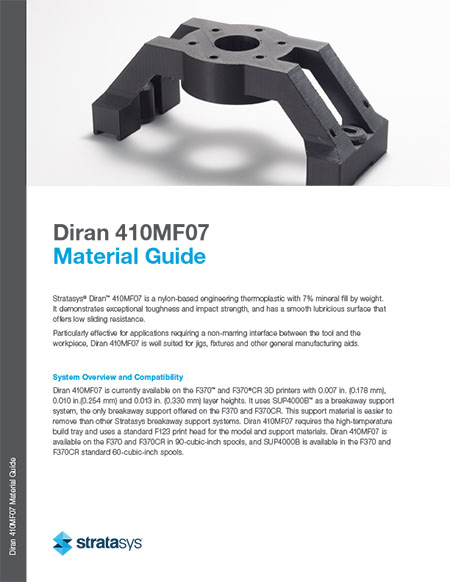
Stratasys® Diran™ 410MF07 is a nylon-based engineering thermoplastic with 7% mineral fill by weight. It demonstrates exceptional toughness and impact strength and has a smooth lubricious surface with low sliding resistance.
Particularly effective for applications requiring a non-marring interface between the tool and the workpiece, Diran 410MF07 is well suited for jigs, fixtures, and other general manufacturing aids.
System Overview and Compatibility
Diran 410MF07 is currently available on the F370™ and F370®CR 3D printers with 0.007 in. (0.178 mm), 0.010 in.(0.254 mm) and 0.013 in. (0.330 mm) layer heights. It uses SUP4000B™ as a breakaway support system, the only breakaway support offered on the F370 and F370CR. This support material is easier to remove than other Stratasys breakaway support systems. Diran 410MF07 requires the high-temperature build tray and uses a standard F123 print head for the model and support materials. Diran 410MF07 is available on the F370 and F370CR in 90-cubic-inch spools, and SUP4000B is available in the F370 and F370CR standard 60-cubic-inch spools.
Overview of Stratasys FDM 3D Printers and Materials
FDM® (fused deposition modeling) 3D printers offer unparalleled versatility to turn your CAD files into durable parts. These parts are tough enough to be used as advanced conceptual models, functional prototypes, manufacturing tools, and production parts. Engineers can produce various products just by loading different files and materials. No traditional machining process can do that.
Handling & Finishing ABS-ESD7 Parts
Overview
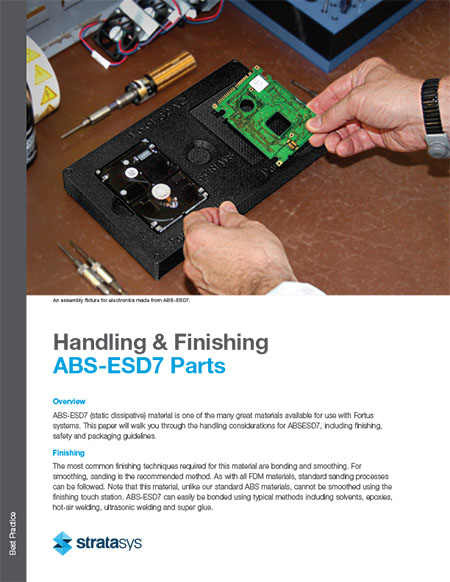
ABS-ESD7 (static dissipative) material is among the many great materials available for the Fortus systems. This paper will walk you through the handling considerations for ABSESD7, including finishing, safety, and packaging guidelines.
Finishing
This material's most common finishing techniques are bonding and smoothing. For smoothing, sanding is the recommended method. As with all FDM materials, standard sanding processes can be followed. Unlike our standard ABS materials, note that this material cannot be smoothed using the finishing touch station. ABS-ESD7 can easily bond through typical methods, including solvents, epoxies, hot-air welding, ultrasonic welding, and superglue.
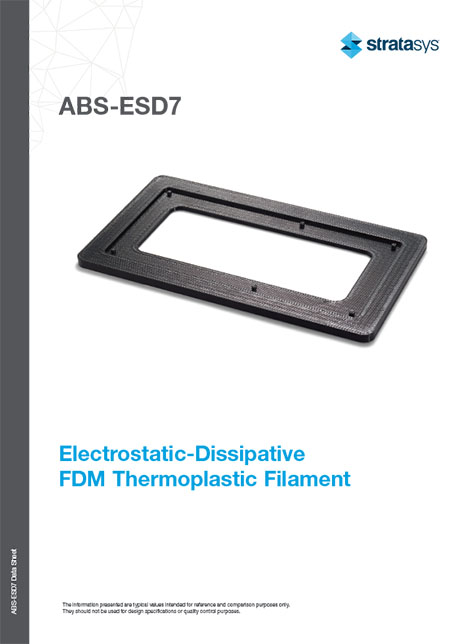
ABS-ESD7™ (acrylonitrile butadiene styrene-electrostatic dissipative) is an ABS thermoplastic with static dissipative properties suited for static discharge-sensitive applications. ABS-ESD7 prevents static electricity buildup, so it will not produce a discharge or attract other materials like powders, dust, and fine particles.
The material is ideal for jigs and fixtures used to fabricate and assemble electronic components and associated production line and conveyor parts. It is also useful for producing functional prototypes, enclosures, and packaging.
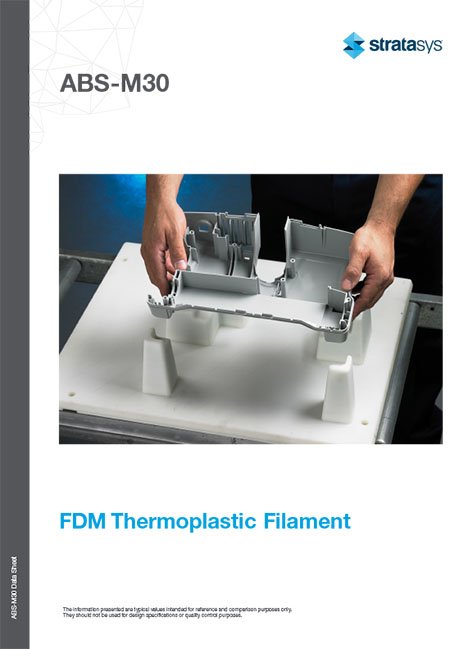
ABS-M30™ filament combines the design freedom of FDM® technology with the versatility and capability of ABS (acrylonitrile butadiene styrene). ABS is characterized by its strength and toughness, while being lightweight and resilient, suitable for most general-purpose 3D printing use cases.
ABS-M30i is a high-strength material well-suited for the medical, pharmaceutical and food packaging industries. Parts manufactured with ABS-M30i material are biocompatible (ISO 10993)* and can be gamma or EtO sterilized. In addition, ABS M30i has passed ISO 18562 testing for gas and airway parts for use in respiratory and ventilation medical devices. When combined with Fortus® 3D Printers, ABS-M30i gives you biocompatible parts with excellent mechanical properties well suited for conceptual modeling, functional prototyping, manufacturing tools and production parts.
Pages
-
 Item Number:CSM
 -
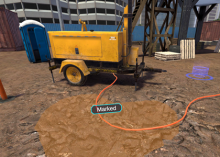 The Construction Electrical Hazard awareness simulation is ideal for future employees and supervisors who work in or around active construction sites. The primary goal of this course is to teach workers safe work procedures to follow while working around electrical hazards in a construction environment.
 -
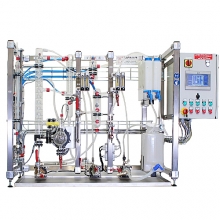 Item Number:DVI/100, DVI/300Explore the Pignat DVI/100 Continuous Distillation unit – a compact, glass-based educational system for studying thermal separation and column hydrodynamics in chemical engineering programs.
 -
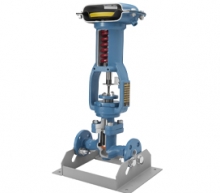 Item Number:255DAC Worldwide’s Control Valve Cutaway, .75"-1.5" (255) supports realistic classroom training in the operation, construction, and maintenance of a pneumatically-operated control valve used in industrial process systems. The complete internal configuration of the valve’s actuator and body is exposed and showcased through carefully-planned sectioning and color-coding.
 -
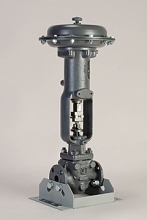 Item Number:255KDAC Worldwide's dissectible (255K) is a realistic, hands-on valve sample that supports realistic classroom training in the disassembly, inspection, and reassembly of a full-size industrial diaphragm-actuated control valve.
 -
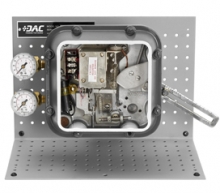 Item Number:273-810DAC Worldwide’s Control Valve Positioner Cutaway (273-810) is a detailed, sectioned, professionally-crafted control valve positioner cutaway that depicts a common control valve positioner.
 -
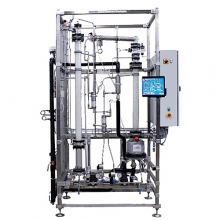 Item Number:ABR/3000The regeneration process is observed on the second column, which is continuously fed. An energy‐saving heat exchanger is placed between the two columns to optimize energy usage. With this unit, students are able to study various control loops, determine mass balance, and process efficiency. The unit also includes a LabView monitoring system.
 -
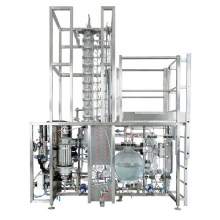 Item Number:OTP-DCPignat's Controlled Distillation Unit (OTP-DC) is an automated, controlled, continuous distillation pilot plant. This industrial-scale unit allows students to study unit operations, maintenance, and process supervision.
 -
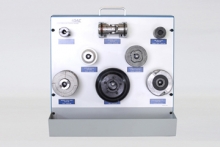 Item Number:839-PACDAC Worldwide’s Coupling Sample Board (839-PAC) is an introductory hands-on teaching aid designed to supplement courses in coupling selection and maintenance. It includes samples of eight industrial-quality couplings for users to learn to identify.
 -
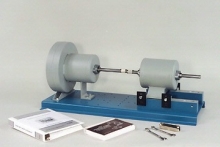 Item Number:208-PACDAC Worldwide’s Coupling/Shaft Alignment Plus (208-PAC) is a heavy-duty, precision learning aid that allows for convenient, realistic training in shaft alignment. When paired with a variety of hands-on exercises, the training system creates a complete performance-based course in the maintenance of shaft alignment.