

SACA’s Certified Industry 4.0 Professional certification is an engineering certification that focuses on the analysis, design, and optimization of Industry 4.0 systems. It prepares engineers to succeed in positions in modern production environments that use Industry 4.0 technologies.
Real Data. Real Results. Real Welders.
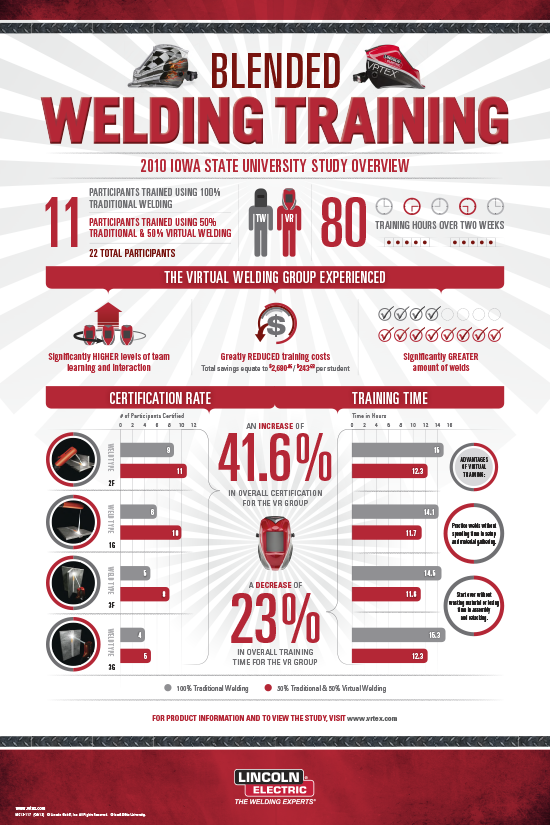
A groundbreaking study by Iowa State University compared traditional welding training with a 50/50 blended model that integrated virtual reality using Lincoln Electric’s VRTEX® system. The results speak for themselves:
- 42% increase in overall certification rates
- 23% decrease in training time
- Significant reduction in material costs—over $2,600 in total savings
- Higher student engagement and collaborative learning
- More welds completed in less time without waste
Students using virtual welding could start over instantly, practice more frequently, and refine their skills without using metal, gas, or electricity—while still achieving better results.
Want to visualize the difference? Download the infographic poster for an at-a-glance summary of this influential study.
Empowering Education Through 3D Printing
 UltiMaker is a global leader in professional desktop 3D printing, renowned for delivering accessible, reliable, and high-performance additive manufacturing solutions. In the world of education and technical training, UltiMaker's printers are empowering instructors and students alike by turning ideas into tangible models—bridging the gap between theory and practice. From middle school makerspaces to advanced engineering labs, UltiMaker’s user-friendly ecosystem provides educators with the tools they need to build 21st-century skills through hands-on, project-based learning.
Built for the classroom, UltiMaker’s printers—such as the S3 and S5—offer seamless workflows, intuitive software integration, and a broad material compatibility, making them ideal for cross-curricular applications in STEM, CTE, and design programs. Educators can unlock student creativity while teaching real-world problem-solving, prototyping, and design thinking—critical skills that prepare learners for success in today’s rapidly evolving industries.
With an extensive library of lesson plans, curriculum support, and a global community of educators, UltiMaker is more than a technology provider—it's a partner in shaping the future of education. Whether you’re launching a makerspace, enhancing a Fab Lab, or incorporating additive manufacturing into your existing curriculum, UltiMaker provides scalable solutions to fit your goals.
Explore the Right Material for Every Application
From classroom creativity to industrial production, UltiMaker offers a wide range of 3D printing materials tailored to your workflow. Whether you're teaching students with the Sketch Series, prototyping with the Method Series, or engineering with precision on the S Series, each platform features a curated lineup of filaments designed for reliability, performance, and ease of use. Find the perfect material for your project—whether it’s PLA for hands-on learning or carbon fiber composites for functional parts.

S Series Materials
The UltiMaker S Series is built for advanced prototyping and professional-grade results. Its open-material platform supports everything from easy-to-use PLA to engineering composites like Nylon and carbon fiber. Whether you're teaching future engineers or developing functional prototypes, the S Series materials deliver strength, accuracy, and flexibility across a wide range of classroom and industrial applications.

Method Series Materials
Designed for dimensionally accurate, production-quality prints, Method Series materials include high-performance polymers, composites, and dissolvable supports. Extensively tested for reliability, these filaments meet the demands of engineering classrooms and manufacturing workflows where precision and strength are critical.

Sketch Series Materials
Sketch Series materials are classroom-ready and student-safe, offering PLA and Tough PLA designed for seamless use with the MakerBot Sketch Sprint. Lightweight, easy to load, and low-maintenance, these filaments make it simple for educators to bring creative, hands-on learning to STEM and design programs.
Ultimaker S Series Materials for Classroom Innovation
The Ultimaker S Series—featuring the S3, S5, S7 and S8—is built to handle an expansive range of materials that support both foundational learning and advanced engineering projects. These printers are compatible with Ultimaker's curated material lineup, including PLA, PETG, Tough PLA, ABS, CPE, Nylon, and third-party composites like carbon fiber-infused filaments. This flexibility makes the S Series ideal for schools, colleges, and workforce training centers focused on delivering real-world, project-based learning experiences.
With open-material access, NFC-enabled spools, and pre-configured print profiles in Ultimaker Cura, instructors can confidently integrate the right material for every lesson or prototype. Whether teaching design principles or preparing students for careers in product development, manufacturing, or engineering, the S Series materials offer consistent quality, strong layer adhesion, and dependable results across a wide range of applications.
Explore compatible support materials: View Ultimaker S Series Support Materials
The UltiMaker S8 redefines what’s possible in desktop 3D printing for education and professional prototyping. With up to four times the productivity of its predecessor, the S8 combines blazing-fast performance with remarkable print accuracy—±0.15 mm at a 0.15 mm layer height. This leap in capability is driven by the innovative UltiMaker Cheetah motion planner, which ensures smooth, high-speed operation without sacrificing part quality.
Enhanced by new high-flow print cores and an upgraded dual-gear feeder system, the S8 is built to meet the demands of engineering classrooms, labs, and advanced manufacturing programs. Whether you're scaling classroom projects or iterating industrial-grade designs, the S8 delivers the throughput and precision needed to keep up with your curriculum or production goals.
Precision You Can Print
Built for accuracy, reliability, and real-world performance, Method Series materials are manufactured to strict quality and diameter standards. These manufacturing-grade and high-performance filaments are engineered to deliver repeatable results across complex geometries, functional assemblies, and production-ready parts.
With a diverse lineup—including durable polymers, composite materials, and precision dissolvable supports—the Method Series empowers users to print complex mechanical components, strong end-use tools, and fine-detail prototypes with minimal post-processing. Whether you're working in design, engineering, or advanced manufacturing education, Method Series materials provide the consistency and strength required for high-stakes applications.

Method Series Polymers
Print functional prototypes and mechanical assemblies with Method Series polymer materials engineered for industrial performance and dimensional accuracy.

Method Series Composites
Boost strength and durability with Method Series composite materials, designed for high-performance tools, fixtures, and end-use parts.

Method Series Support Materials
Experience effortless post-processing with Method Series support materials, designed for precision removal and flawless print quality.
3D Printing Materials Made for the Classroom
MakerBot Sketch Series materials are specifically designed to support safe, consistent, and hands-on 3D printing in educational environments. Featuring reliable PLA and Tough PLA options, these filaments empower students and teachers to bring ideas to life—whether creating classroom models, prototypes, or design projects.
With a 1.75 mm diameter and 500g spool size, Sketch Series materials are optimized for fast-loading, low-maintenance printing. Non-toxic and classroom-safe, these essentials give educators confidence while encouraging students to explore STEM learning through real-world applications and creativity.
UltiMaker S Series Support Materials have been specifically formulated and rigorously tested to work with a broad range of build materials. This ensures dependable dual-extrusion performance, excellent layer adhesion, and clean separation—whether printing intricate overhangs, internal channels, or multi-part assemblies. By maintaining dimensional accuracy and surface quality, these support materials help educators and engineers create complex geometries without compromising print reliability or wasting time on post-processing. When used with UltiMaker Cura’s pre-configured profiles, they provide a seamless, plug-and-play experience that maximizes print success across classroom and industrial applications.
High-Performance Polymers for Functional Prototypes
Method Series Polymers offer unmatched print reliability and mechanical performance for prototyping and production. These real-world, engineering-grade thermoplastics—such as ABS, ASA, PETG, and PC-ABS—allow users to create highly detailed mechanical assemblies, brackets, and enclosures with professional precision.
Built for demanding environments, these materials are formulated to deliver superior impact resistance, thermal stability, and dimensional accuracy. When paired with Method’s controlled heated chamber and dual extrusion system, even complex parts can be printed with minimal warping or distortion.
- Designed for structural applications and functional prototypes
- Industrial-grade polymers with production-level performance
- Validated print profiles for predictable, repeatable results
- Ideal for automotive, aerospace, tooling, and product design
Support Materials for Complex, High-Quality Prints
Method Series Support materials are engineered for clean, efficient removal—whether using dissolvable supports for internal cavities or breakaway supports for faster workflows. These materials are precisely tuned to work with Method’s dual extrusion system, ensuring perfect adhesion during printing and clean separation during post-processing.
Whether printing intricate assemblies, overhangs, or internal structures, Method support materials give users the freedom to design without limitation—no scraping or sanding required.
- Dissolvable or breakaway options for versatile applications
- Easy removal with no surface damage
- Perfect for printing internal channels and complex overhangs
- Streamlines workflow and reduces post-processing time
Pages
-
-
 SACA’s Specialist certifications certify Industry 4.0 technical skills in operations, troubleshooting, programming, maintenance, and systems integration. Each certification is keyed to a skilled occupation.
 -
 The purpose of the Certified Logistics Technician (CLT) program is to recognize through certification individuals who demonstrate mastery of the core competencies of material handling at the front-line (entry-level through front-line supervisor) through successful completion of the certification assessments.
 -
 Item Number:CPT / CPT+ / CPT 4.0The purpose of the Certified Production Technician (CPT) ® 4.0 certification program is to recognize through certification, individuals who demonstrate mastery of the foundational, core competencies of advanced manufacturing production at the entry-level to front-line supervisor through successful completion of the certification assessments.
 -
 Item Number:CT-SCAMSSC’s Certified Technician in Supply Chain Automation (CT-SCA) logistics certification enables both students and incumbent workers to gain the skills needed to meet the definition of a supply chain automation technician established by the National Science Foundation-funded National Center for Supply Chain Automation: a technician who installs, operates, supports, upgrades or maintains the automated material handling equipment and systems which support the supply chain.
 -
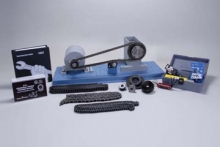 Item Number:223-000DAC Worldwide’s Chain Drive Training System (223-000) is a heavy-duty learning aide that allows for in-depth training in industrial chain drives, heavy/silent chains, and sprocket set usage.
 -
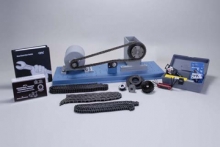 Item Number:223-PACDAC Worldwide’s Chain Drive Training System Plus (223-PAC) is a heavy-duty learning aide that allows for in-depth training in industrial chain drives, heavy/silent chains, and sprocket set usage.
 -
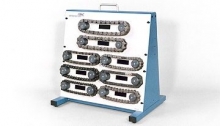 Item Number:838-PACDAC Worldwide’s Chain Sample Board (838-PAC) is an introductory hands-on teaching aid, designed to supplement courses in chain selection and maintenance. It includes samples of eight (8) industrial-quality chains for users to learn to identify.
 -
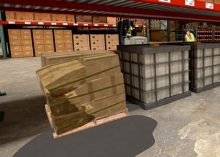 Hard Hat VR's Chemical Spill Cleanup simulation is ideal for future employees or supervisors who will work in or visit warehouses or factories. The primary goal of this course is to teach individuals safe work procedures for chemical spill cleanup.
 -
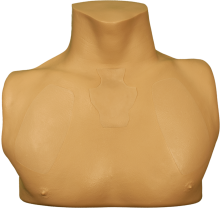 Item Number:TFX-T-CT-1The TacMed Simulation Chest Trainer is a ruggedized partial upper torso medical simulator that helps trainees during the crawl phase of training to treat patients requiring needle decompression and intraosseous (I/O) infusion. Students learn to locate realistic anatomic landmarks to execute critical patient treatment without relying on marked indicators. The unit functions as a stand-alone skills station with multiple training sites that allow for multiple uses with cost-effective replacement components.