


The primary goal of this course is to teach workers the correct procedures to follow in a potential bloodborne pathogen event. The Bloodborne Pathogen VR simulation is ideal for future employees or supervisors who will work in hazardous environments where a potential bloodborne pathogen event may occur.
Preliminary information, subject to change
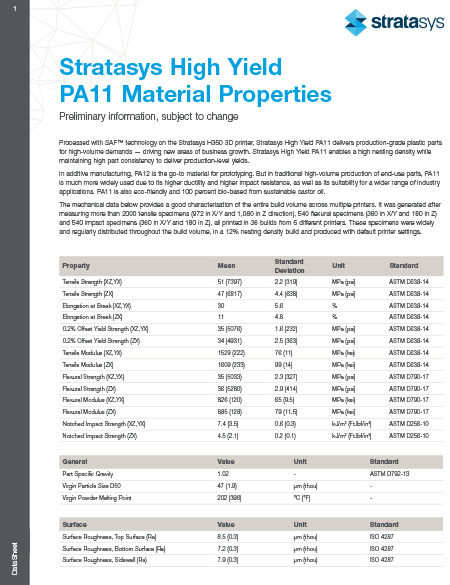
Processed with SAF™ technology on the Stratasys H350 3D printer, Stratasys High Yield PA11 delivers production-grade plastic parts for high-volume demands — driving new areas of business growth. Stratasys High Yield PA11 enables a high nesting density while maintaining high part consistency to deliver production-level yields.
In additive manufacturing, PA12 is the go-to material for prototyping. But in traditional high-volume production of end-use parts, PA11 is much more widely used due to its higher ductility and higher impact resistance, as well as its suitability for a wider range of industry applications. PA11 is also eco-friendly and 100 percent bio-based from sustainable castor oil.
The mechanical data below provides a good characterization of the entire build volume across multiple printers. It was generated after measuring more than 2000 tensile specimens (972 in X/Y and 1,080 in Z direction), 540 flexural specimens (360 in X/Y and 180 in Z) and 540 impact specimens (360 in X/Y and 180 in Z), all printed in 36 builds from 5 different printers. These specimens were widely and regularly distributed throughout the build volume, in a 12% nesting density build and produced with default printer settings.
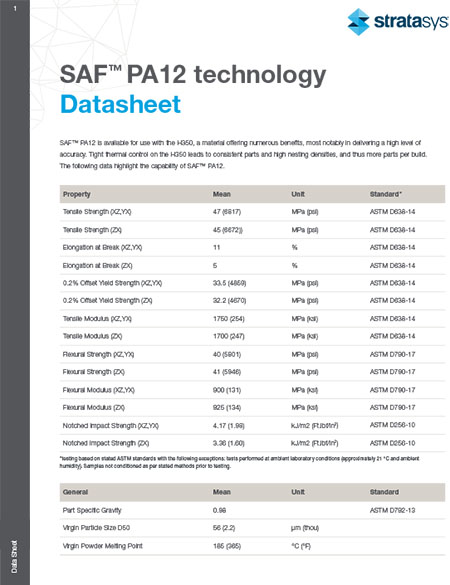
SAF™ PA12 is available for use with the H350, a material offering numerous benefits, most notably in delivering a high level of accuracy. Tight thermal control on the H350 leads to consistent parts and high nesting densities, and thus more parts per build. The following data highlight the capability of SAF™ PA12.
Stay competitive with best-in-class consistency
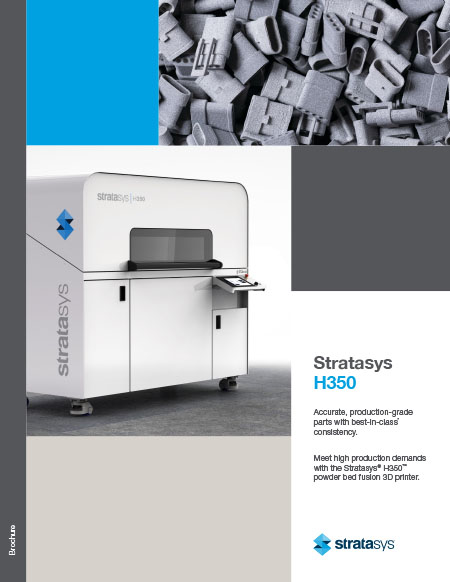
Grow your part production business for various industries and applications with a workflow you can fully control. Built for high-volume, short-run production, the Stratasys H350 3D printer gives you control of your materials, workflow, production, and costs while delivering consistency and accuracy print after print. The Stratasys H350 is the first release of the H Series™ production platform, which has Selective Absorption Fusion™ SAF™ technology at its heart to deliver functional, production-grade parts with best-in-class* consistency.
As with other manufacturing techniques, the 3D printing process can be challenging and demands a level of expertise and familiarization.
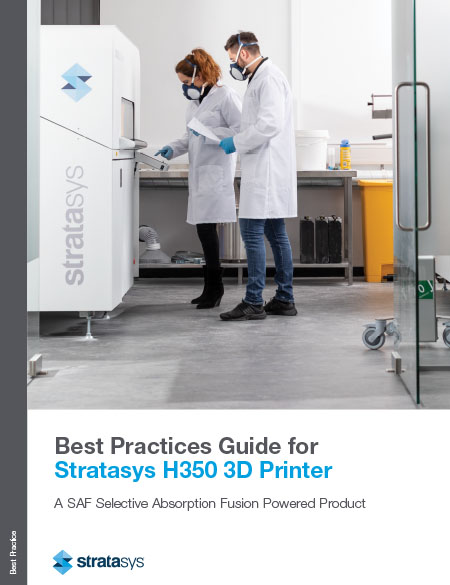
This guide aims to help designers produce quality, cost-effective parts on the Stratasys® H350™ 3D printer. The guide provides information for both new and experienced users.
The topics covered in this guide describe tools and methods for optimizing design features, strength, and durability of printed parts and ensuring that the parts meet your expectations. It provides best practices and tips on designing for additive manufacturing and examples of how to take advantage of Stratasys' unique features to get the most out of your H350 printer while minimizing printing costs and post-processing issues.
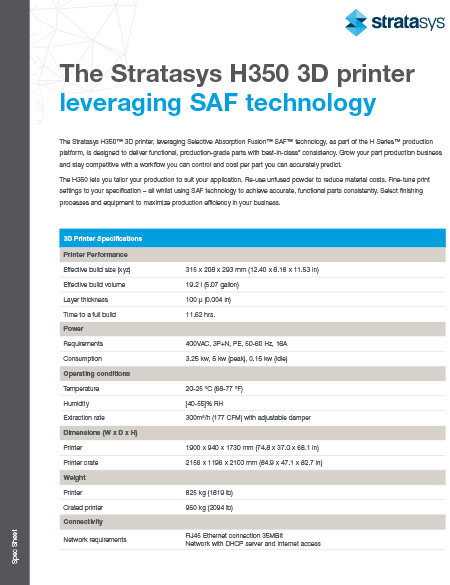
The Stratasys H350™ 3D printer, leveraging Selective Absorption Fusion™ SAF™ technology, as part of the H Series™ production platform, is designed to deliver functional, production-grade parts with best-in-class* consistency. Grow your part production business and stay competitive with a workflow you can control and cost per part you can accurately predict.
The H350 lets you tailor your production to suit your application. Re-use unfused powder to reduce material costs. Fine-tune print settings to your specification – all whilst using SAF technology to achieve accurate, functional parts consistently. Select finishing processes and equipment to maximize production efficiency in your business.
The need for movable parts is a constant when it comes to prototyping. Being able to ensure the proper fit for parts within a component can save both time and money. Whether you’re in the electronic, automotive or consumer goods industries, the Somos® 9120™ Series provides the ultimate solution for form, fit and function with parts that are semi-flexible.
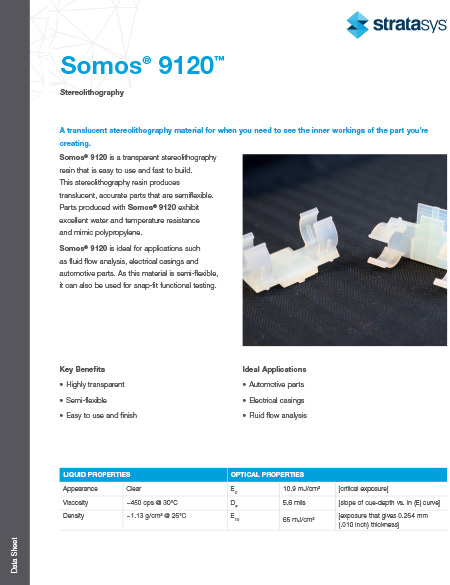
A translucent stereolithography material for when you need to see the inner workings of the part you’re creating.
Somos® 9120 is a transparent stereolithography resin that is easy to use and fast to build. This stereolithography resin produces translucent, accurate parts that are semiflexible. Parts produced with Somos® 9120 exhibit excellent water and temperature resistance and mimic polypropylene.
Somos® 9120 is ideal for applications such as fluid flow analysis, electrical casings and automotive parts. As this material is semi-flexible, it can also be used for snap-fit functional testing.
Every material comes with a safety data sheet (SDS) to provide you with information to properly handle that specific liquid stereolithography resin. While there are risks of skin sensitization, these can be easily prevented with good housekeeping, good hygiene and use of personal protective equipment (PPE).
Formulated differently than conventional materials, UV-curable products require particular instruction for their safe handling. The information provided in this guide is designed to acquaint you with UV-cure technology, identify its potential hazards, and provide general direction and guidelines for the safe application and efficient use of solvent-free, UV-curable products.
This booklet is a guide for safe handling only. The precautions outlined here should be followed in close combination with instructions provided on our product labels and Material Safety Data Sheets (MSDS), as well as in consultation with your representative regarding your specific product.
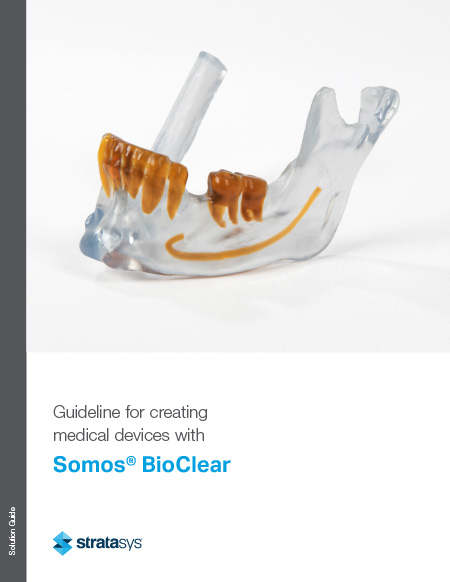
Somos® BioClear has passed cytotoxicity, irritation, sensitization, and USP VI. A toxicological profiling of the components has been performed. A Device Master File to support this material is accessible through the FDA. Ask a sales representative for more information.
Steps in the production process of 3D printed parts can influence the final part safety. This document gives guidance on areas to pay attention to when using Somos® BioClear.
Pages
-

-
 VR Hard Hat's First Aid: CPR & AED course aims to equip participants with the knowledge and hands-on skills required to effectively administer CPR and operate an AED during cardiac emergencies.
 -
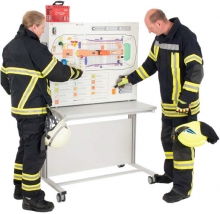 The Lucas-Nuelle training system allows first responders to practice the correct procedure for recovering hybrid and electric vehicles over and over again - until it becomes muscle memory, ensuring maximum efficiency even when working under time pressure.
 -
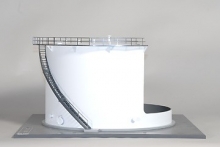 Item Number:295-203DAC Worldwide's Fixed Head Bulk Storage Tank Model (295-203) is a highly detailed scale model of a conical-roof, fixed-head storage tank.
 -
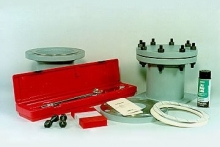 Item Number:226-000DAC Worldwide’s Flange Bolt Torquing (226-000) is a training package that includes a complete assortment of fixtures, tools, accessories, and technical data for training in proper bolt torquing using an eight-bolt pattern.
 -
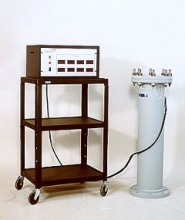 Item Number:225-000DAC Worldwide’s Flange Bolt Torquing Trainer (225-000) is a heavy-duty learning aide that allows for in-depth training in bolted joint torquing, gasket selection/usage, and torque wrench usage.
 -
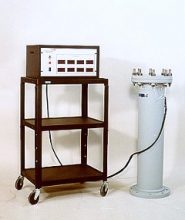 Item Number:225-PACDAC Worldwide’s Flange Bolt Torquing Training System Plus (225-PAC) is a heavy-duty learning aide that allows for in-depth training in bolted joint torquing, gasket selection/usage, and torque wrench usage.
 -
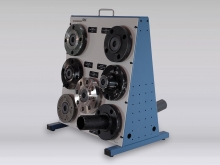 Item Number:864-PACDAC Worldwide’s Flange Sample Board (864-PAC) provides a hands-on teaching aid for piping system training, pipe fitting training, and process operations training. This industrial process system training supplement includes 15 different types of flanges on two rack-mounted panels with magnetic identification tags.
 -
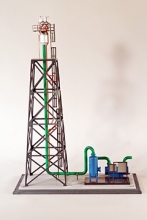 Item Number:294Hands-On Technical Trainers
 -
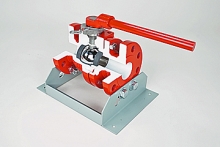 Item Number:295-753DAC Worldwide's Floating Ball Valve Cutaway (295-753) is a sectioned valve sample for training in the operating characteristics, construction, and maintenance of industrial floating-type ball valves.