

Explore Amatrol's VR Smart Factory – Allen-Bradley (VR870-AB) for Meta Quest. Train with a digital twin Mechatronics system to build real-world Industry 4.0 skills virtually.
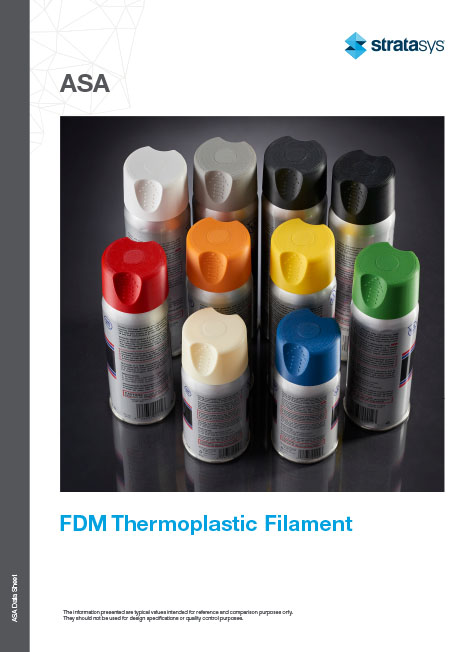
ASA (acrylonitrile styrene acrylate) FDM® filament is a broad-use commodity thermoplastic. It is similar to ABS (acrylonitrile butadiene styrene) but exhibits better UV resistance, mechanical properties, and aesthetics than ABS.
ASA suits most general-purpose 3D printing applications involving prototyping, jigs and fixtures, and low-volume production parts. ASA filament is available in the most colors of any FDM material.
Offering a variety of production-grade thermoplastics, FDM® technology creates parts that are highly accurate, tough, and suitable for both functional prototyping and end-use parts. ABS is the most common material used as it boasts good mechanical properties and high name recognition. Compared with ASA, ABS may be more familiar because of its popularity in mass production.
ASA is another popular all-purpose material for jigs and fixtures, manufacturing aids, prototyping and limited-run end-use parts. ASA matches or exceeds the mechanical properties of standard ABS and has greater heat resistance. Moreover, ASA demonstrates exceptional UV stability and, with its matte finish, offers the best aesthetics of any FDM thermoplastic. It’s especially suited for end-use parts in outdoor commercial and infrastructure applications, and its wide array of color options surpasses that of ABS.
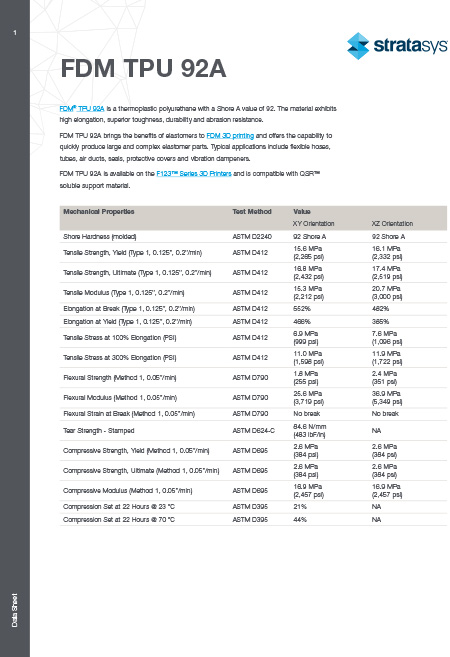
FDM® TPU 92A is a thermoplastic polyurethane with a Shore A value of 92. The material exhibits high elongation, superior toughness, durability, and abrasion resistance.
FDM TPU 92A brings the benefits of elastomers to FDM 3D printing and can quickly produce large and complex elastomer parts. Typical applications include flexible hoses, tubes, air ducts, seals, protective covers, and vibration dampeners.
FDM TPU 92A is available on the F123™ Series 3D Printers and is compatible with QSR™ soluble support material.
Produce Large and Complex Elastomer Parts
Create accurate elastomer parts quickly and efficiently with the ease and reliability of professional FDM 3D printing. The durable elasticity of FDM TPU 92A material makes it a good choice for a variety of applications, including flexible hoses, tubes, air ducts and vibration dampeners.
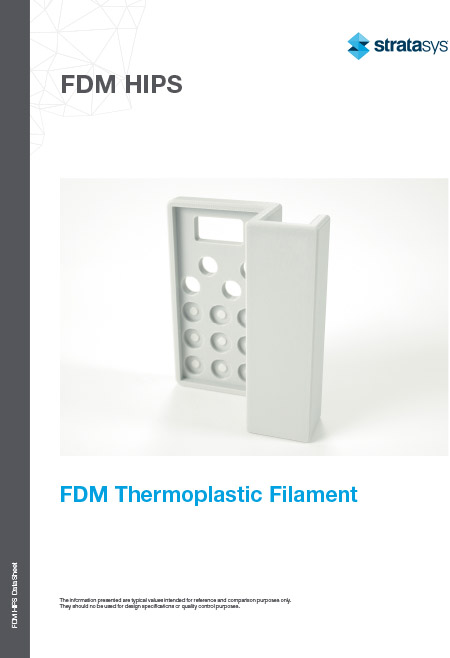
FDM® HIPS (high-impact polystyrene) is a low-cost, general-use 3D printing thermoplastic. It offers similarities to ABS but has high impact resistance making it suitable for printing lower-requirement jigs, fixtures, and prototypes at a reduced cost.
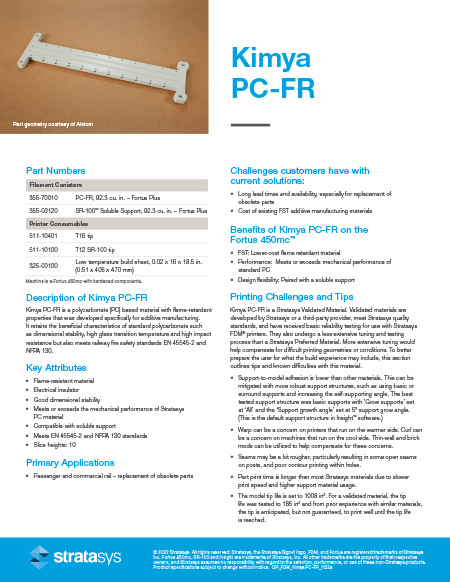
Kimya PC-FR is a polycarbonate FDM® 3D printing filament with flame-retardant properties developed specifically for additive manufacturing. It retains the beneficial characteristics of standard polycarbonate, such as dimensional stability, high glass transition temperature, and high impact resistance.
Kimya PC-FR is a polycarbonate (PC) based material with flame-retardant properties developed specifically for additive manufacturing. It retains the beneficial characteristics of standard polycarbonate such as dimensional stability, high glass transition temperature, and high impact resistance.
Key Attributes
- Flame-resistant material
- Electrical insulator
- Good dimensional stability
- Meets or exceeds the mechanical performance of Stratasys PC material
- Compatible with soluble support
- Meets EN 45545-2 and NFPA 130 standards
- Slice heights: 10
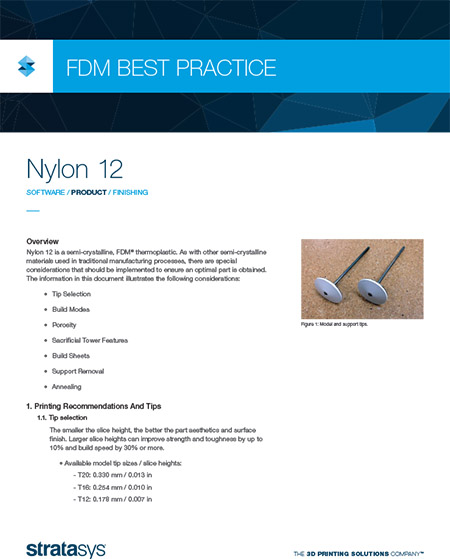
Nylon 12 is a semi-crystalline, FDM® thermoplastic. As with other semi-crystalline materials used in traditional manufacturing processes, special considerations should be implemented to ensure an optimal part is obtained. The information in this document illustrates the following considerations:
- Tip Selection
- Build Modes
- Porosity
- Sacrificial Tower Features
- Build Sheets
- Support Removal
- Annealing
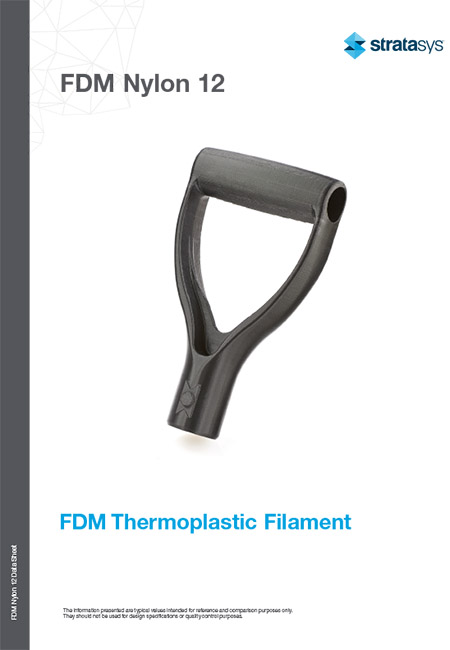
FDM® Nylon 12 filament is the 3D printing equivalent of standard industrial PA12 (polyamide 12) material. A strong engineering thermoplastic that exhibits toughness and high impact strength without being brittle. Its excellent fatigue properties make it a good option for repetitive-flex applications such as snap-fit clips, closures, and press-fit inserts.
Other applications include jigs, fixtures, low-volume production parts, and accurate prototyping of nylon 12 high-volume injection molded parts. FDM Nylon 12 is available in black.
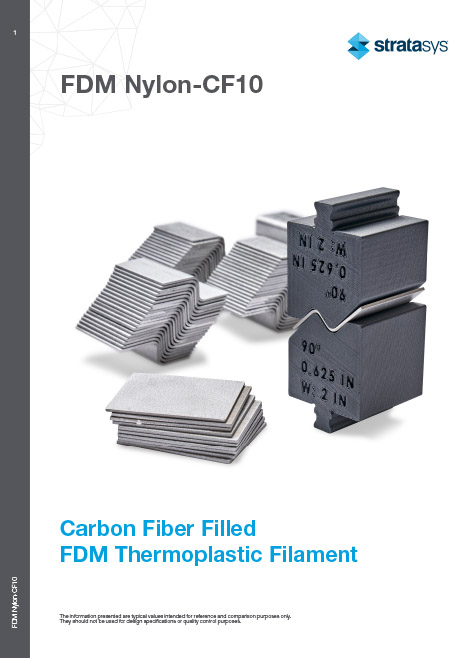
FDM® Nylon-CF10 is a composite material combining a blended nylon polymer with 10% chopped carbon fiber (by weight), enhancing the material’s strength and rigidity. The nylon base polymer also gives FDM Nylon-CF10 good chemical resistance.
Pages
-
 Item Number:VR870-AB
 -
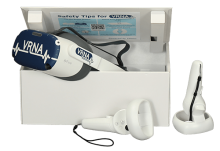 VRNA offers a fully immersive VR experience designed to enhance the efficiency and reduce the expenses associated with teaching patient care job skills typically conducted in a laboratory environment, including Certified Nursing Assistant (CNA) and Emergency Medical Services (EMS) modules.
 -
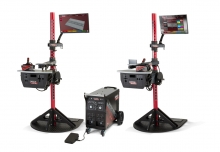 The VRTEX systems are virtual reality arc welding training simulators. These computer-based training systems are educational tools designed to supplement and enhance traditional welding training. They allow students to practice their welding technique in a simulated and immersive environment. The VRTEX systems promote the efficient transfer of quality welding skills and body positioning to the welding booth while reducing material waste associated with traditional welding training.
 -
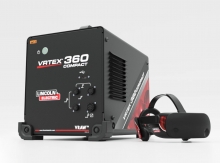 Item Number:K4914-20Lincoln Electric's VRTEX® 360 Compact is a small, portable Virtual Reality Welding Simulator for mobile use in multiple environments.
 -
 With CM Labs’ Walkaround Inspection trainees gain hands-on experience identifying issues, performing maintenance checks, and following safety protocols in a guided and measurable format. This tool builds operator confidence, reinforces safe habits, and strengthens maintenance knowledge—making it an essential part of a comprehensive training program.
 -
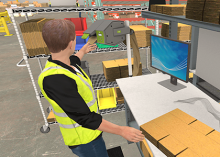 Effective packing surpasses mere item placement; it encompasses product safety, reduced shipping expenses, and the cultivation of brand loyalty. Inadequate packing practices can result in damaged goods, escalated expenses, and pose potential risks for both employees and recipients. This VR course directly confronts and addresses these challenges.
 -
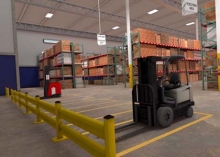 The primary goal of this course is to teach you safe work procedures to follow in a warehouse environment. You will learn how to maintain a safe warehouse and identify common hazards. The Warehouse Hazard awareness simulation is ideal for employees or supervisors who will work in or visit warehouses.
 -
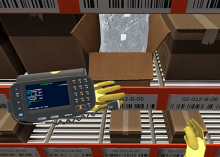 Discover the pivotal final steps of warehouse picking through VR Hard Hat's immersive Back-End Labeling course. Ensure product readiness, accurate shipment identification, and end-to-end traceability. Our course emphasizes precision in back-end labeling, minimizing logistical hurdles for efficient operations.
 -
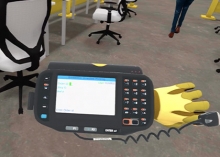 VR Hard Hat's Warehouse Picking: Case virtual reality course is meticulously designed to provide insights into the best practices of case picking, ensuring both speed and precision.
 -
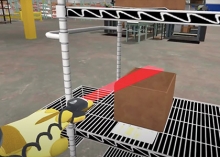 Front-end labeling, a vital component of the picking process, ensures that products are correctly identified, tracked, and dispatched. Proper labeling can reduce errors, improve efficiency, and enhance customer satisfaction. Hard Hat VR's course is designed to address the nuances of labeling at the initial stages of the picking process, ensuring that errors are minimized and efficiency is maximized.