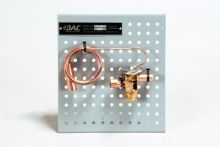
The full-size, fully-detailed example gives learners a first-hand view into a component that is found in various applications worldwide. This professionally-crafted, yet-economical component sample will enhance any training activity relating to commercial and industrial air conditioning and refrigeration systems.
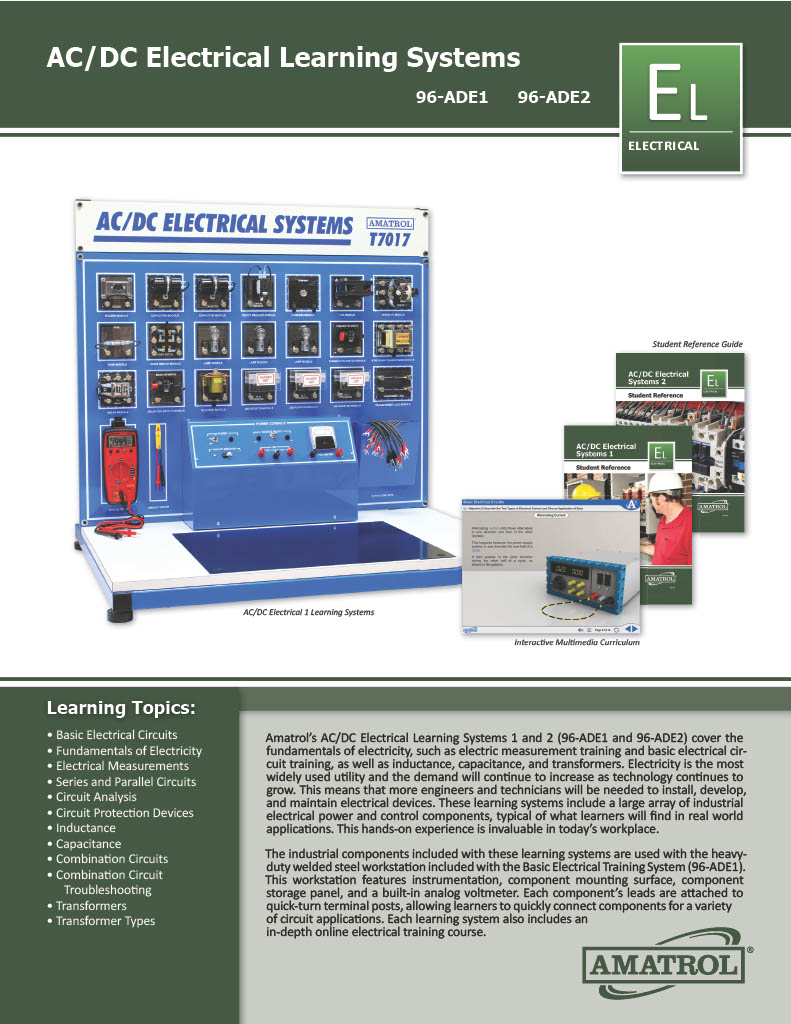
Amatrol's AC/DC Electrical Learning Systems 1 and 2 (96-ADE1 and 96-ADE2) cover the fundamentals of electricity, such as electric measurement training and basic electrical cir-cult training, as well as Inductance, capacitance, and transformers. Electricity Is the most widely used utility and the demand will continue to increase as technology continues to grow. This means that more engineers and technicians will be needed to Install, develop, and maintain electrical devices. These learning systems include a large array of Industrial electrical power and control components, typical of what learners will find In real world applications. This hands-on experience Is Invaluable In today's workplace.
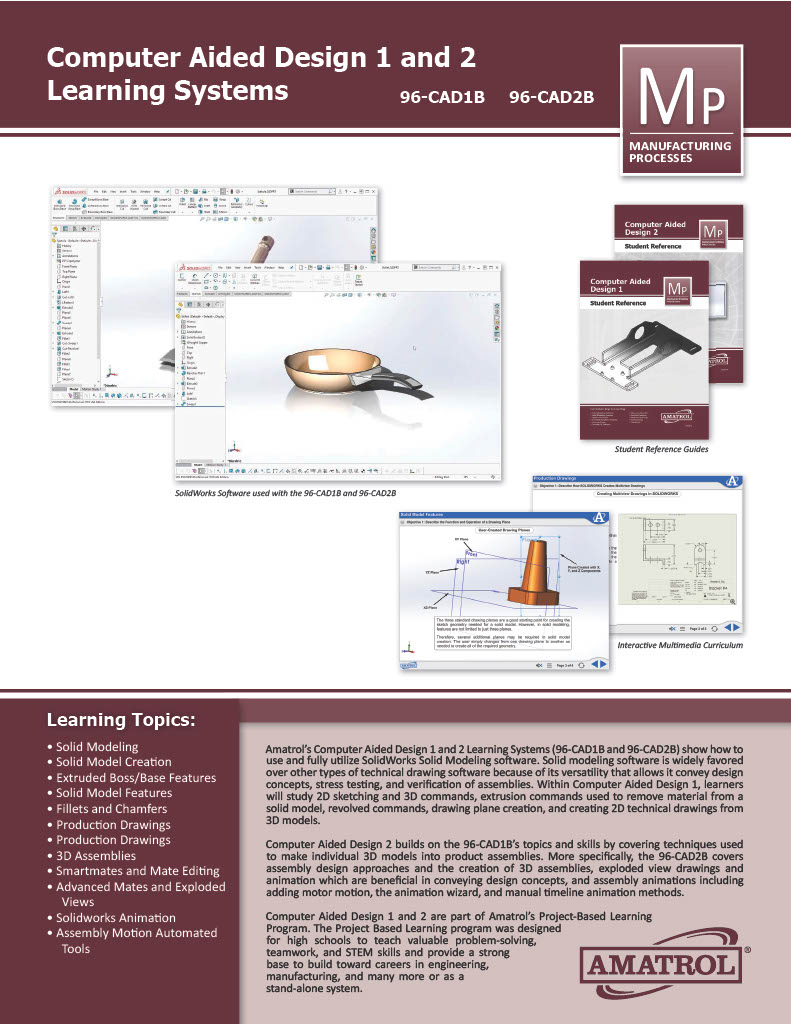
Amatrol's Computer Aided Design (CAD) 1 – SolidWorks learning system introduces solid modeling by describing the function of solid modeling software and the features of solid modeling. Solid model creation is taught by having the learner use sketch commands and tools to create a sketch and extruded boss/base features to create a solid model. Solid model features such as drawing planes; extruding cut features, fillets and chamfers; and revolved features are explored. Also included are topics such as multi-view drawings, dimensioning, and title blocks.
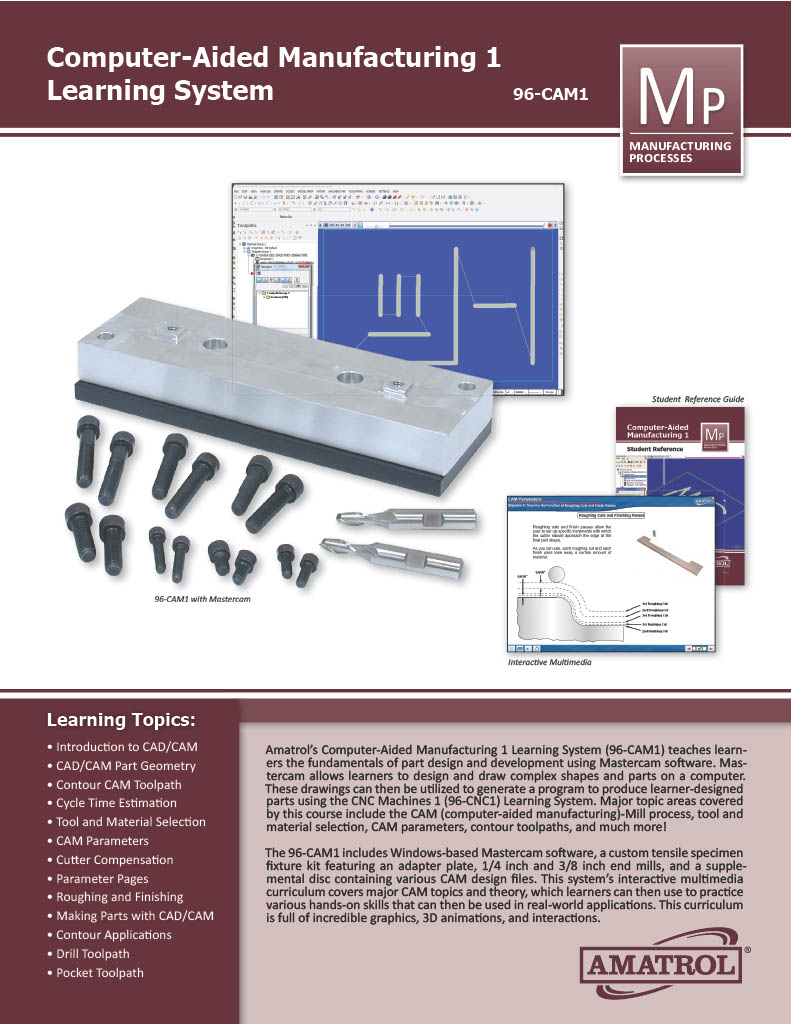
Amatrol’s Computer-Aided Manufacturing (CAM) 1 Learning System (96-CAM1) teaches learners the fundamentals of part design and development using Mastercam software. Mastercam allows learners to design and draw complex shapes and parts on a computer. These drawings can then be utilized to generate a program to produce learner-designed parts using the CNC Machines 1 Learning System (96-CNC1). Major topic areas covered by this course include the CAM mill process, tool and material selection, CAM parameters, contour toolpaths, and much more!
The 96-CAM1 training system includes Windows-based Mastercam software, a custom tensile specimen fixture kit featuring an adapter plate, 1/4-inch and 3/8-inch end mills, and a supplemental disc containing various CAM design files. This system’s interactive eLearning curriculum covers major CAM topics and theory, which learners can then use to practice various hands-on skills that can then be used in real-world applications. This curriculum is full of incredible graphics, 3D animations, and interactions.
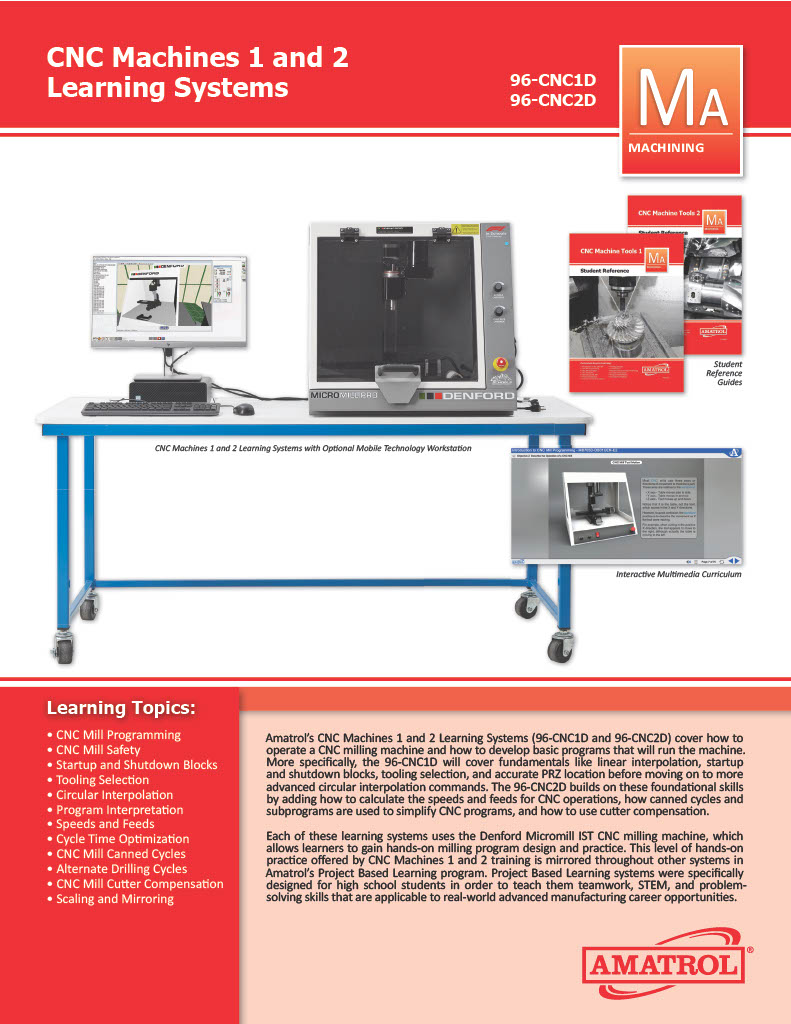
Amatrol’s CNC Machines 1 and 2 Learning Systems (96-CNC1D and 96-CNC2D) cover how to operate a CNC milling machine and how to develop basic programs that will run the machine. More specifically, the 96-CNC1D will cover fundamental CNC machine training, such as linear interpolation, startup and shutdown blocks, tooling selection, and accurate PRZ location before moving on to more advanced circular interpolation commands. The 96-CNC2D builds on these foundational skills by adding how to calculate the speeds and feeds for CNC operations, how canned cycles and subprograms are used to simplify CNC programs, and how to use cutter compensation.
Each of these learning systems uses the Denford Micromill IST CNC milling machine, which allows learners to gain hands-on milling program design and practice. This level of hands-on CNC machine training is mirrored throughout other systems in Amatrol’s Project Based Learning program. Project Based Learning systems were specifically designed for high school students in order to teach them teamwork, STEM, and problem-solving skills that are applicable to real-world advanced manufacturing career opportunities.
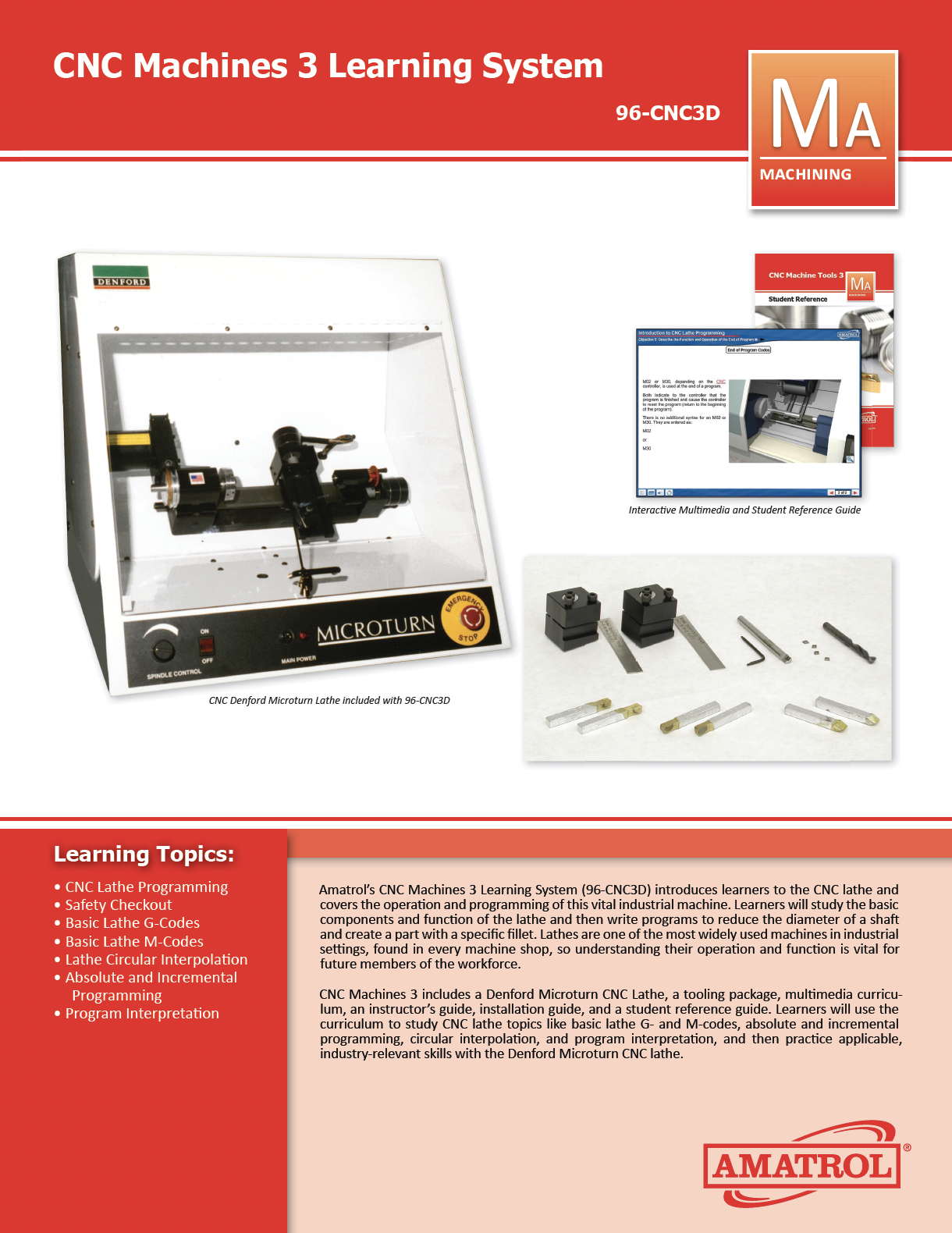
Amatrol’s CNC Machines 3 Learning System (96-CNC3D) introduces learners to the CNC lathe and covers the operation and programming of this vital industrial machine. Learners will study the basic components and function of the lathe and then write programs to reduce the diameter of a shaft and create a part with a specific fillet. Lathes are one of the most widely used machines in industrial settings, found in every machine shop, so understanding their operation and function is vital for future members of the workforce.
CNC Machines 3 includes a Denford Microturn CNC Lathe, a tooling package, multimedia curriculum, an instructor’s guide, installation guide, and a student reference guide. Learners will use the curriculum to study CNC lathe topics like basic lathe G- and M-codes, absolute and incremental programming, circular interpolation, and program interpretation, and then practice applicable, industry-relevant skills with the Denford Microturn CNC lathe.
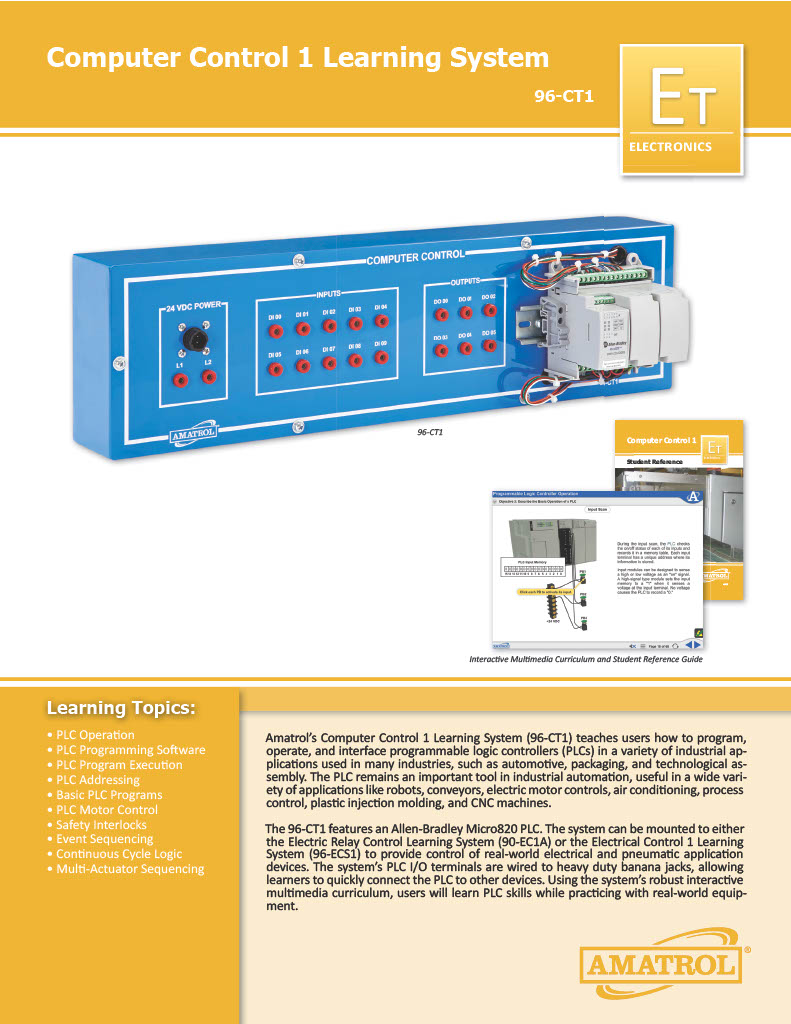
Amatrol’s Computer Control 1 & 2 Learning Systems (96-CT1 & 96-CT2) teach users how to program, operate, and interface programmable logic controllers (PLCs) in a variety of applications used in many industries, such as automotive, packaging, and technological assembly. The PLC remains an important tool in industrial automation, useful in a wide variety of applications like robots, conveyors, electric motor controls, air conditioning, process control, plastic injection molding, and CNC machines.
The 96-CT1 hardware features an Allen-Bradley Micro820 PLC. It can be mounted to either the Electrical Control 1 Learning System (96-ECS1) or Electric Relay Control Learning System (90-EC1A) to provide control of real-world electrical and pneumatic application devices. The system’s PLC I/O terminals are wired to heavy duty banana jacks, allowing learners to quickly connect the PLC to other devices. Using the system’s robust interactive multimedia curriculum, users will learn PLC skills while practicing with real-world equipment.
Computer Control 2 picks up PLC training where the first course leaves off. Learners will begin by studying step-by-step techniques that make reading and designing event sequencing programs much easier, then advance to topics like PLC timer instructions, time-driven sequencing, timer applications, PLC counter instructions, count down instructions, and latch and unlatch instructions. This training system allows learners to practice skills like: designing a PLC program that provides low voltage starting of an electric motor; designing a clamp and drill application which uses the latch/unlatch instructions; entering and editing a PLC program that uses an RTO instruction; and many more!
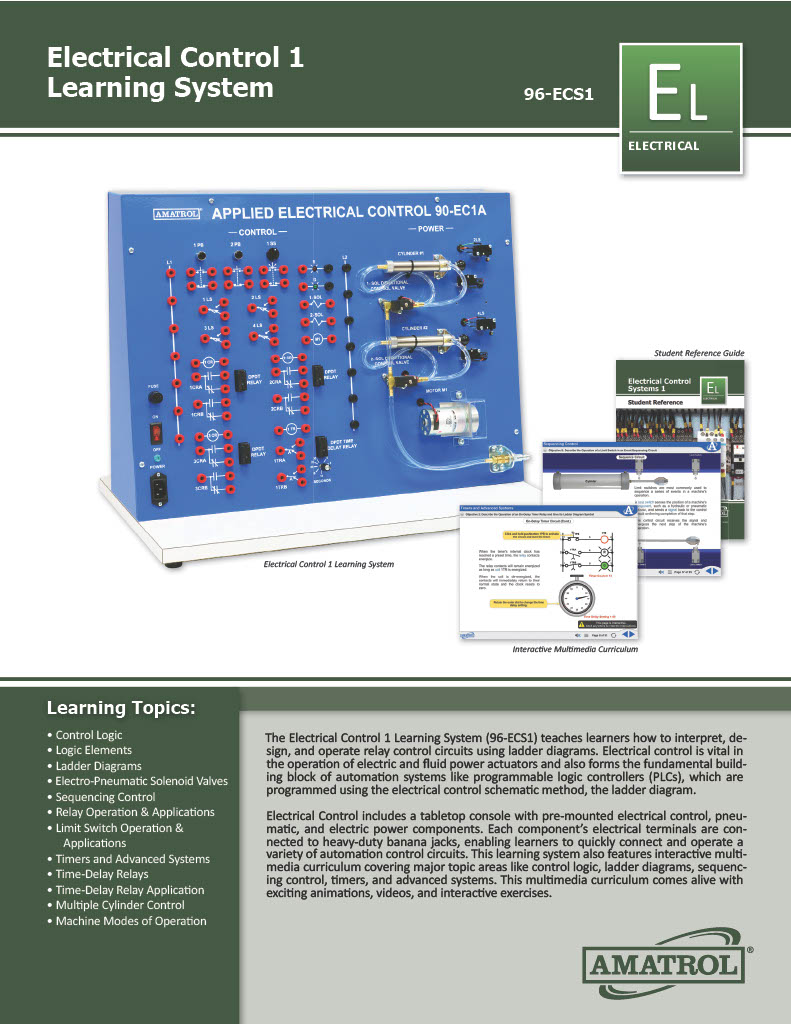
Amatrol’s Electrical Control 1 Learning System (96-ECS1) teaches learners how to interpret, design, and operate relay control circuits using ladder diagrams. Electrical control is vital in the operation of electric and fluid power actuators and also forms the fundamental building block of automation systems like programmable logic controllers (PLCs), which are programmed using the electrical control schematic method, the ladder diagram.
The 96-ECS1 includes a tabletop console with pre-mounted electrical control, pneumatic, and electric power components. Each component’s electrical terminals are connected to heavy-duty banana jacks, enabling learners to quickly connect and operate a variety of automation control circuits. This learning system also features interactive multimedia curriculum covering major topic areas like control logic, ladder diagrams, sequencing control, timers, and advanced systems. This multimedia curriculum comes alive with exciting animations, videos, and interactive exercises, as well as a virtual simulator.
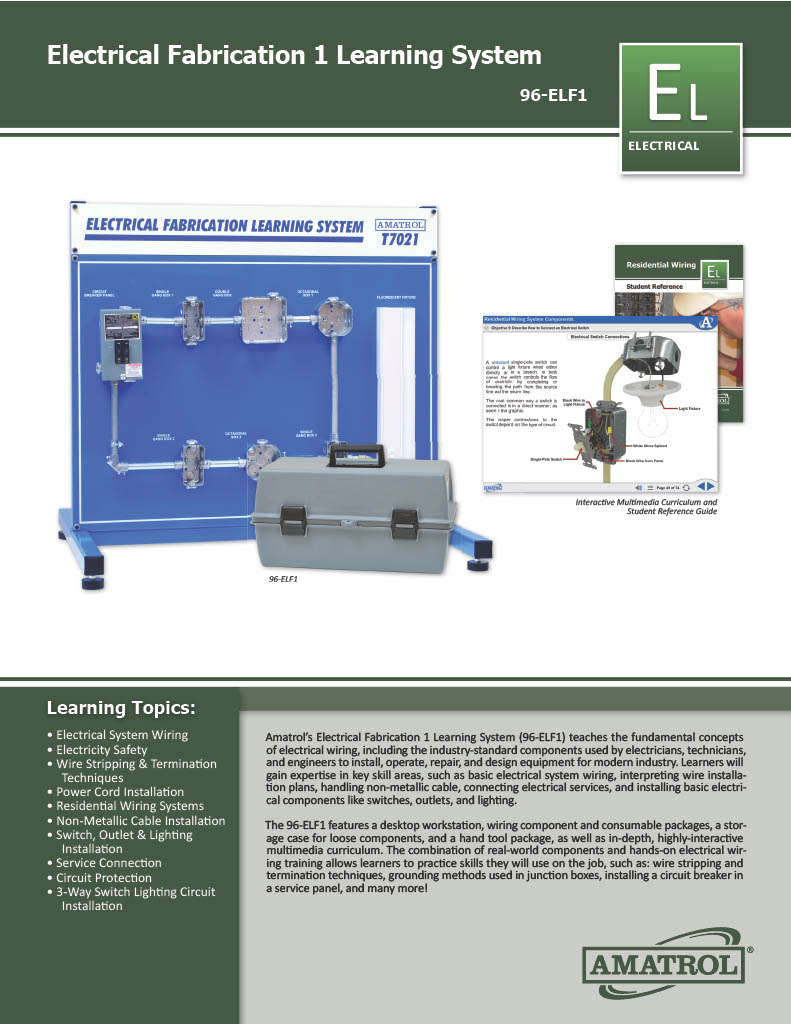
Amatrol’s Electrical Fabrication 1 Learning System (96-ELF1) teaches students skills that are commonly used by electricians, technicians, and engineers in today’s industry. Installing, operating, repairing, or designing equipment for modern industry requires fundamental knowledge of electrical wiring and components. Students will gain expertise in key skill areas such as basic electrical system wiring, interpreting wire installation plans, handling non-metallic cable, installing basic components such as switches, outlets, and lighting, and connecting electrical services.
The 96-ELF1 includes a workstation, wiring components, storage case, electrical consumable package, hand tools package, electrical accessories, multimedia student curriculum, instructor’s assessment guide, and installation guide.
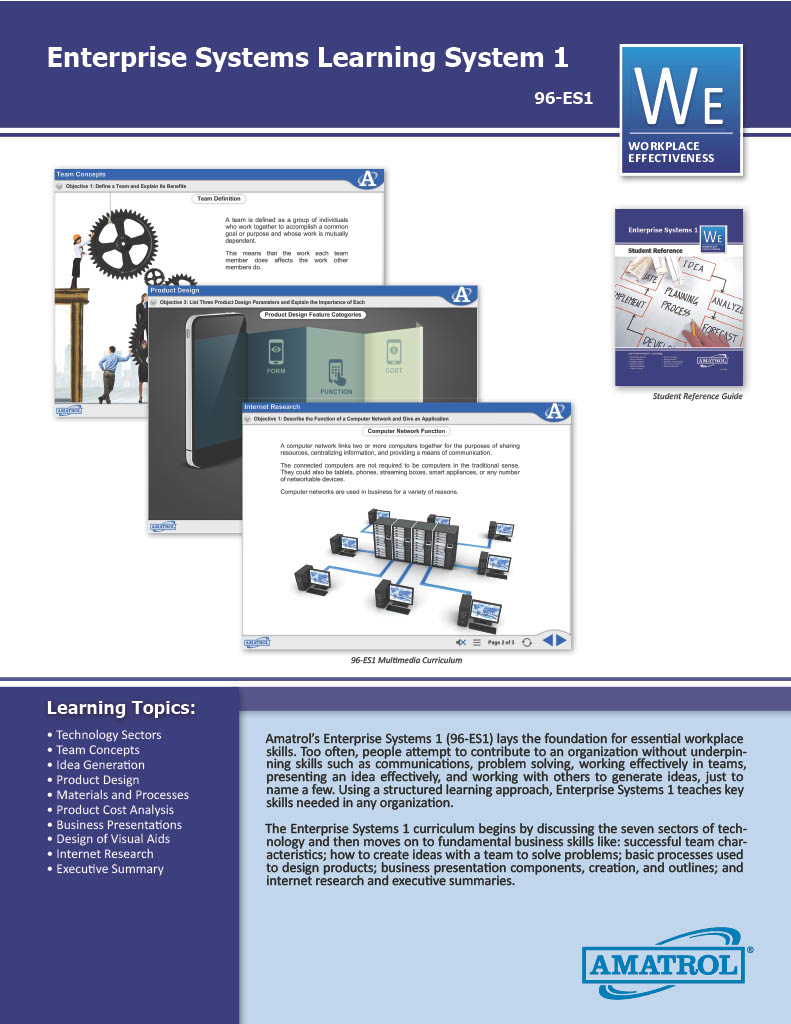
Amatrol's Enterprise Systems Learning System 1 (96-ES1) lays the foundation for essential workplace skills. Too often, people attempt to contribute to an organization without underpinning skills such as communications, problem-solving, working effectively in teams, presenting an idea effectively, and working with other to generate ideas, just to name a few. Using a structured learning approach, Enterprise Systems Learning System 1 teaches key skills needed in any organization.
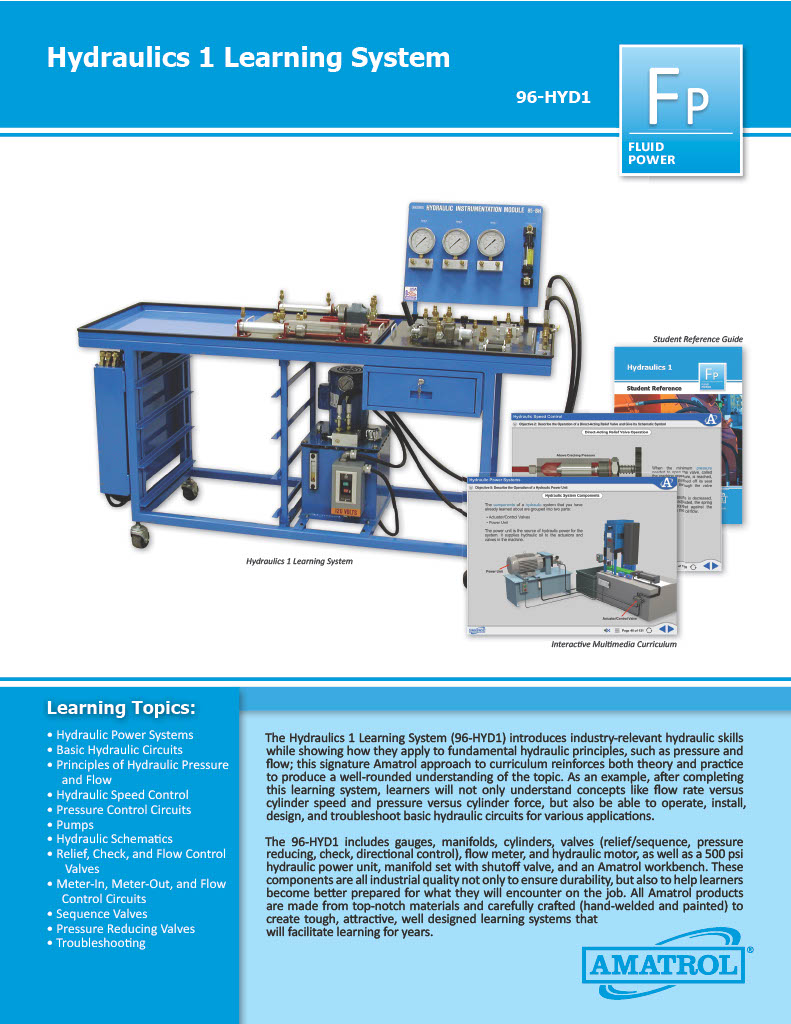
The Hydraulics 1 Learning System (96-HYD1) introduces industry-relevant hydraulic skills while showing how they apply to fundamental hydraulic principles, such as pressure and flow; this signature Amatrol approach to curriculum reinforces both theory and practice to produce a well-rounded understanding of the topic. As an example, after completing this learning system, learners will not only understand concepts like flow rate versus cylinder speed and pressure versus cylinder force, but also be able to operate, install, design, and troubleshoot basic hydraulic circuits for various applications.
The 96-HYD1 includes gauges, manifolds, cylinders, valves (relief/sequence, pressure reducing, check, directional control), flow meter, and hydraulic motor, as well as a 500 psi hydraulic power unit, manifold set with shutoff valve, and an Amatrol workbench. These components are all industrial quality not only to ensure durability, but also to help learners become better prepared for what they will encounter on the job. All Amatrol products are made from top-notch materials and carefully crafted (hand-welded and painted) to create tough, attractive, well designed learning systems that will facilitate learning for years.
Pages
-
 Item Number:373-521
 -
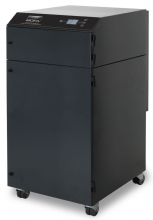 BOFA’s AD 1000 iQ high-end laser extraction system combines extremely large filter capacity with high airflow and pressure rates, making it the ideal choice for heavy-duty applications that generate large amounts of particulate and gaseous organic compounds.
 -
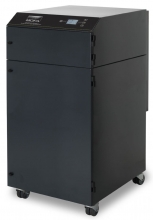
BOFA’s AD 1500 iQ is the ideal choice for heavy-duty applications that generate large amounts of particulate and gaseous organic compounds.
Performance has been further enhanced with the inclusion of several features including BOFA’s acclaimed iQ Operating System, making the AD 1500 iQ one of the most advanced systems available.
The iQ system takes performance and safety parameters to a new level and ensures that maintenance, downtime, and ownership costs are kept to a minimum.
-
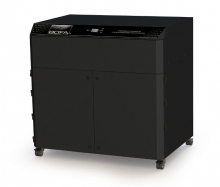 The AD 2000 iQ’s technology delivers superior and measurable performance, ensuring airflow and filtration is maintained even when particulates start to build up. It’s thanks to the vacuum/pressure which is three times greater than that of its predecessor, the AD 2000.
 -
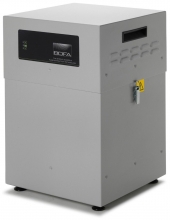
Low airflow entry-level laser fume extractor incorporating DeepPleat pre filter technology and large combined filter.
BOFA’s Advantage 250 fume extraction and filtration system has been designed to provide a cost-effective solution for light duty applications. This compact and extremely quiet system is ideal for use in schools, sign making workshops, small-scale industrial environments and light laser coding applications.
-
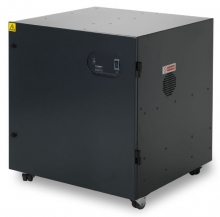
The Advantage Base C180 has been designed specifically for the GCC C180 laser engraver. The dimensions of the unit allow the C180 to fit perfectly onto the extractor, effectively doubling it up as a workstation. The unit is also offered with an onboard air compressor to provide the laser with its air assist requirements and comes complete with extraction hose kit and compressor link up on compressor models.
-
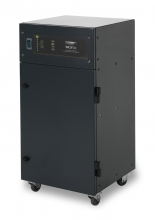
The compact system designed for small-scale industrial sites and light laser coding applications.
The AD Nano+ fume extraction and filtration system has been designed as a cost-effective solution for light to medium duty applications and is the ideal choice for installations where floor space is limited.
-
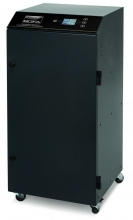
The AD Oracle iQ is our most technically advanced laser fume extractor, combining a powerful range of unique features into one compact unit.
This versatile unit can be used across a range of laser applications and the revolutionary auto-voltage sensing blower automatically self-adjusts to run on any voltage worldwide.
Our inline AD Cyclone has been designed to separate lower particle sizes during laser marking process.
-
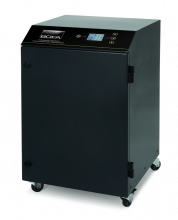 Introducing BOFA’s most technically advanced compact laser fume extractor. The AD Oracle SA iQ has been enhanced with BOFA’s iQ Operating System, RFA and ACF technology and packs a powerful range of unique features into one compact unit.
 -
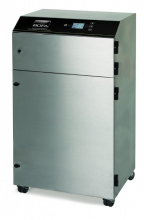
The AD PVC iQ extraction system has been designed to effectively deal with the corrosive nature of the fumes generated when lasering PVC materials.
The latest design specification now offers many of the features associated with our “Best in class” AD Oracle iQ model as standard but in addition all internally exposed surfaces have been coated to resist the corrosive nature of the fume and each unit is fitted with HCL and VOC sensors which continually monitor the exhaust air of the unit giving added safety assurance.