


Amatrol’s T7400 Commercial Refrigeration Learning System teaches students to operate, maintain, and troubleshoot refrigeration systems with real-world components, smart controllers, and FaultPro fault-insertion software.
TransitSim™ 8: Safer Routes, Stronger Operators
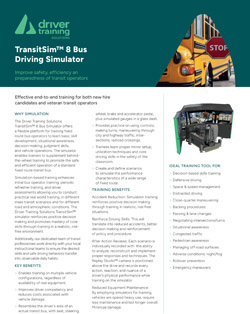
TransitSim™ 8 equips new hires and seasoned operators with decision-based training for fixed-route transit—covering urban traffic, tight turns, mirror management, pedestrian awareness, and emergencies. Use repeatable scenarios to standardize training, conduct assessments, and deliver evidence-based coaching that translates to fewer incidents and smoother operations.
The fully shrouded cockpit mirrors a modern bus driver’s area with glass-dash instrumentation, force-feedback controls, 4K displays, and up to 240° FOV. Scenario Builder™ and SkillSet™ scoring streamline instruction and documentation, while Replay Studio™ captures every action for targeted feedback.
- Training focus: defensive driving, speed/space management, intersection negotiation, congestion, and adverse conditions.
- Benefits: lower incidents, reduced maintenance/damage, consistent competency across vehicles and routes.
- Tech: Unreal™ Engine, Driver™ physics, optional D-BOX motion, performance analytics and replay.
PatrolSim™ 8: Policy-Aligned EVOC for Safer Streets
PatrolSim™ 8 helps agencies reduce risk by training pursuit management, intersection clearing, hazard scanning, and distraction control in a safe, controlled environment. Officers rehearse high-risk scenarios—traffic stops, coordinated responses, PIT maneuvers—while instructors reinforce policy and decision-driving under stress.
The Ford Police Interceptor-style cockpit, 4K visuals, 240° FOV, and force-loaded controls provide authentic vehicle feel, while performance scoring and replay accelerate coaching and documentation. Optional motion, VON radio, and MDT touchscreen add realism so skills transfer to the street.
- Focus areas: situational awareness, policy reinforcement, heavy traffic & intersections, pedestrian awareness, distracted driving.
- Tech: Unreal™ Engine, validated vehicle dynamics, optional D-BOX motion, standard scoring/scorecards.
Why Simulation Pays Off: Fewer Crashes, Faster Training, Better Retention
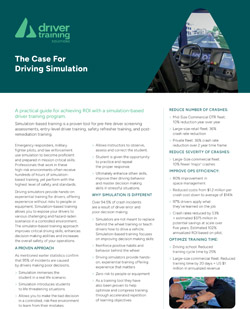
This practical guide outlines how simulation improves decision-driving, compresses training cycles, and meaningfully reduces incident rates and severity across fleets. With repeatable scenarios and objective scoring, organizations align training with safety goals, track outcomes, and scale best practices across locations and roles.
- Measured results: crash reductions, severity decreases, improved space management, and accelerated training cycles across diverse fleets.
- Best practices: leadership buy-in, standards-based curriculum, blended learning, consistent delivery, and ongoing evaluation.
- Use cases: pre-hire screening, ELDT, refresher/remediation, and policy reinforcement with after-action reviews.
TranSim™ 8: Objective, High-Fidelity Training for Commercial Drivers
TranSim™ 8 standardizes commercial driver training with a realistic Freightliner Cascadia cockpit, force-feedback controls, 4K displays, and 240° FOV—paired with advanced physics and motion options. Fleets sharpen decision-driving, hazard perception, shifting, backing, and space management while reducing incidents, costs, and downtime.
With Scenario Builder™, SkillSet™ scoring, and detailed replay, teams can align training to ELDT and fleet KPIs—delivering consistent, defensible outcomes across sites and instructors.
- Benefits: fewer preventable crashes, lower severity, improved fuel and maintenance KPIs, faster onboarding.
- Features: hundreds of vehicle configs, adverse weather/lighting, modern safety systems, optional D-BOX motion.
Prepare Students for Real-World EV Maintenance and Diagnostics
The rapid expansion of the electric vehicle (EV) industry has created a nationwide demand for technicians skilled in high-voltage systems, battery technology, and EV charging infrastructure. According to the U.S. Department of Energy, clean vehicle and battery manufacturing jobs are among the fastest-growing in the energy sector, adding over 24,000 new positions in 2023 alone.
Career opportunities are emerging for EV service technicians, electrical diagnostics specialists, energy storage engineers, and charging infrastructure installers. To prepare students for these roles, educators are turning to programs aligned with ASE L3: Light Duty Hybrid/Electric Vehicle Specialist and ASE L4: Heavy-Duty Electric Drivetrain Specialist certifications, as well as SkillsUSA Transportation competitions that emphasize hands-on EV system diagnostics and repair.
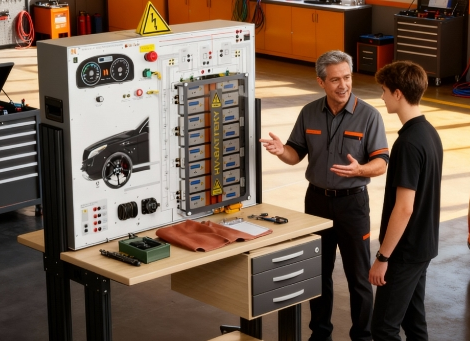
Lucas-Nülle’s electric vehicle training systems provide a structured and safe way to teach charging infrastructure, high-voltage safety, batteries/BMS, and power electronics. These modular, industry-standard trainers align directly with ASE and SkillsUSA performance standards, helping students transition from classroom fundamentals to professional EV service careers with confidence.
- ASE L3/L4 Alignment: Trainers support learning outcomes in electrical safety, high-voltage systems, power distribution, and diagnostic procedures.
- SkillsUSA Integration: Ideal for EV-focused competitions and skill demonstrations in automotive service, maintenance, and diagnostics.
- High-Voltage Safety: Structured learning paths to safely work with live systems following ISO and OSHA best practices.
- Real Fault Insertion: Develop troubleshooting skills through simulated component and communication failures.
- Instructor Support: We provide setup guidance, training recommendations, and implementation support to fit your curriculum.
- Charging Infrastructure: AC/DC systems, commissioning, insulation testing, and diagnostics.
- High-Voltage Safety: Personal protective equipment, lockout/tagout, and insulation measurement procedures.
- Battery Management: SOC/SOH analysis, balancing, fault detection, and temperature control systems.
- Power Electronics: Inverters, DC/DC converters, and on-board chargers for hybrid and full EV systems.
- Diagnostics & CAN Communication: Sensor monitoring, fault reading, and data interpretation for troubleshooting.
- EV Charging Station Trainer: Covers installation, testing, and safety protocols for ASE and SkillsUSA training events.
- High-Voltage Safety Kit: Reinforces ASE-mandated safety and isolation procedures with live system testing.
- Battery/BMS Trainer: Provides insight into voltage, current, and temperature control in lithium-ion packs.
- Power Electronics Module: Demonstrates inverter and converter efficiency, switching behavior, and system losses.
- EV Vehicle Systems (CarTrain EV/Hybrid): Enables advanced troubleshooting and CAN-based fault diagnosis aligned to ASE L3/L4.
Lucas-Nülle EV trainers integrate theory and practice to support ASE L3: Light Duty Hybrid/Electric Vehicle Specialist and ASE L4: Heavy-Duty Electric Drivetrain Specialist certification objectives, including:
- High-voltage electrical safety and measurement
- Battery management systems and charging logic
- Power electronics, inverters, and DC/DC systems
- Diagnostics, service procedures, and scan data interpretation
These same competencies align with SkillsUSA Transportation Career Cluster performance standards, giving students a competitive edge in regional and national competitions.
We partner with schools, colleges, and workforce training centers to design turnkey EV labs that meet certification goals. From equipment selection and facility layout to instructor training, our team ensures each lab supports ASE and SkillsUSA readiness.
Ready to align your EV program with ASE and SkillsUSA standards? Contact us for a customized quote, curriculum guidance, or on-site demo.
Smart Grid, Microgrid & SCADA Training Solutions for Modern Power Systems
Partner with Lucas-Nülle and us to design modern electrical power engineering laboratories that mirror today’s smart grid and renewable energy systems. This 7th-edition catalog showcases complete solutions that take learners from fundamental DC and AC concepts to advanced topics like microgrids, SCADA, cyber security, and energy management in a coordinated lab environment.
Inside the catalog, you’ll find modular training systems that cover the entire power chain: generation with conventional and renewable sources, high-voltage transmission, distribution, protection, and efficient consumption. Multi-panel training rigs, realistic protection relays, and an educational SCADA platform allow students to visualize real-time data, explore fault conditions, and experiment with intelligent grid control strategies in a safe lab setting.
What’s Included in the Electrical Power Engineering Catalog?
- Smart Grid & Microgrid Labs – scalable equipment sets for basic smart grid, microgrid extensions, fault ride-through and energy storage integration.
- SCADA & Industrial Cyber Security – educational SCADA for power labs, remote access tools, logging and analysis, and exercises in secure networking.
- Renewable Energy Trainers – professional photovoltaic systems, battery storage, solar pumping, wind turbines, hybrid PV/wind systems, and advanced fuel cell technology.
- Generation, Transmission & Distribution – synchronous generators, HVDC transmission, three-phase line models, double busbar systems, and realistic power station simulations.
- Protection & Energy Management – generator, transformer and line protection, motor protection, energy management, and reactive power compensation training systems.
- UniTrain Fundamentals – computer-based courses and experiment cards that introduce DC/AC technology, three-phase systems, transformers, power system transients, photovoltaics and fuel cells.
Benefits for Your Power Engineering Program
- Link classroom theory to hands-on practice with modular systems that build from fundamentals to advanced smart grid applications.
- Design a complete power engineering lab that integrates production, transmission, distribution, protection and consumption under one SCADA umbrella.
- Prepare students for real-world utilities and industry by teaching grid stability, protection coordination, renewable integration, and cyber-secure operation.
- Scale your investment over time by starting with core equipment sets and expanding into microgrids, HVDC, or additional renewable energy modules as your program grows.
Whether you’re launching a new power engineering program or upgrading an existing lab, this catalog helps you map out a cohesive training pathway—from UniTrain fundamentals to fully networked smart grid laboratories. Download the PDF to explore detailed system layouts, experiment topics, and ordering information, then contact us to plan a solution that fits your curriculum and budget.
The PatrolSim™ 8 Law Enforcement Driving Simulator Product Guide provides a detailed overview of this advanced training system designed to improve officer driving skills, judgment, and safety through immersive simulation.
This guide is ideal for law enforcement agencies, academies, and training programs evaluating simulation-based solutions for patrol driving, emergency response, and pursuit training.
What’s Inside the Product Guide
- System overview and simulator configurations
- Standard features and technical specifications
- Available law enforcement driving scenarios
- Supported vehicle types and training applications
- Instructor tools and performance evaluation capabilities
Download the PatrolSim™ 8 Product Guide (PDF)
Explore system details, training capabilities, and configuration options to support your law enforcement driver training program.
Explore system details, training capabilities, and configuration options to support your law enforcement driver training program.
Amatrol EV Manufacturing Training Systems are designed to help education and workforce programs address the rapid shift toward electrification in automotive and advanced manufacturing industries. These hands-on training solutions introduce learners to the core technologies used in electric vehicle production, equipping them with the skills needed for high-demand roles in EV assembly, battery manufacturing, and automated production environments.
Built around real-world industrial components and aligned with industry expectations, these systems bridge the gap between theory and practical application—helping learners understand how electric vehicles are designed, manufactured, and supported on the factory floor.
Amatrol Mitsubishi Automation Training Systems provide hands-on instruction using industrial automation technologies from Mitsubishi Electric—a global leader in factory automation. These training systems give learners direct experience with the same PLCs, HMIs, and drive technologies used in modern manufacturing facilities.
By combining Amatrol’s structured curriculum with Mitsubishi automation hardware, these solutions help learners develop job-ready skills while gaining familiarity with globally recognized industrial platforms.
Bridging the Classroom and the Factory Floor
These systems are ideal for programs focused on automation, mechatronics, and industrial maintenance. Learners gain practical experience programming, operating, and maintaining automated systems—preparing them for roles in advanced manufacturing, logistics, and industrial operations.
FANUC CNC training solutions are designed to help students, educators, and workforce trainees develop the real-world skills required for modern CNC machining environments. Built around industry-standard FANUC CNC controls, these solutions support hands-on learning in CNC programming, setup, operation, and troubleshooting. By using the same control platforms found on production shop floors, learners gain practical experience that directly translates to in-demand manufacturing careers.
Ideal for high school CTE programs, community colleges, technical schools, and industrial training centers, FANUC CNC training solutions can be integrated into curricula for machining, mechatronics, and advanced manufacturing. Whether used alongside CNC simulators, machine tools, or automation systems, these solutions bridge the gap between classroom instruction and real-world application, preparing learners to confidently operate, program, and maintain CNC equipment in today’s automated manufacturing environments.
Pages
-
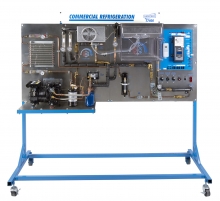 Item Number:T7400
 -
 Expand your program’s capabilities with the Compact 1000 and 1000 Pro, precision CNC routers ideal for technical education and light prototyping.
 -
 The Compact TranSim™ by Acron Aviation is a cost-effective, space-saving commercial truck driving simulator that delivers immersive, high-impact training without putting people or equipment at risk.
 -
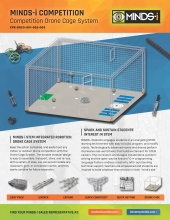 Item Number:CPK-DRCG-001-002-003Keep the action contained, and easily host any indoor or outdoor drone competition with the Drone Cage System. The durable modular design is easy to assemble, transport, store, and re-use. With a variety of sizes, you can accommodate any classroom, gym, or convention center, and they easily combine for future expansion.
 -
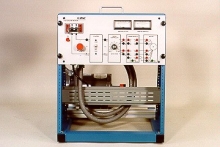 Item Number:416-000DAC Worldwide’s Compound, Cumulatively Wound, DC Motor Training System (416-000) features a common compound wound DC motor used frequently throughout industry. Each motor module includes a welded aluminum mounting baseplate, aluminum control box support structure, and a steel control enclosure.
 -
 Item Number:211-003DAC Worldwide's Compressor Inlet Unloader Valve Replica (211-003) is a plastic facsimile of an inlet unloader valve commonly found on positive displacement compressors.
 -
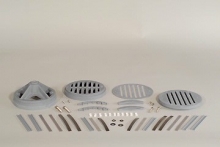 Item Number:211-004DAC's Compressor Outlet Channel Valve Replica (211-004) is a plastic facsimile of an outlet channel valve (or check valve), as found on positive displacement compressors.
 -
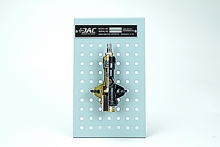 Item Number:373-195A full cutaway view of the valve body exposes the complete internal design characteristics, flow path, valve stem, compressor connection, backseat, front-seat, packing and gauge port, while retaining its operational characteristics.
 -
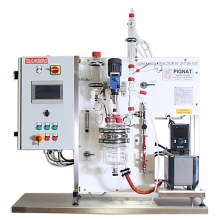 Item Number:REA/3000Pignat's Computerized Chemical Reactor (REA/3000) is a one-gallon, controlled, multi-purpose, jacketed glass reactor system specifically designed for education and research. This unit supports the study of controlled batch chemical reactions and allows students to operate and experience reaction processes and modify the variables upon which the reactions being studied are based.
 -
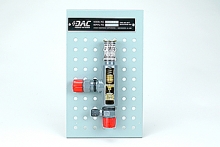 Item Number:373-519This Condenser Pressure Control Valve (KVR) Cutaway provides a full cutaway view of a control valve that exposes the complete internal components and operating principles.