Smart Home Energy Trainer

123-01
Prepare Students for Modern Residential Energy Careers
Residential renewable energy training system for technical education

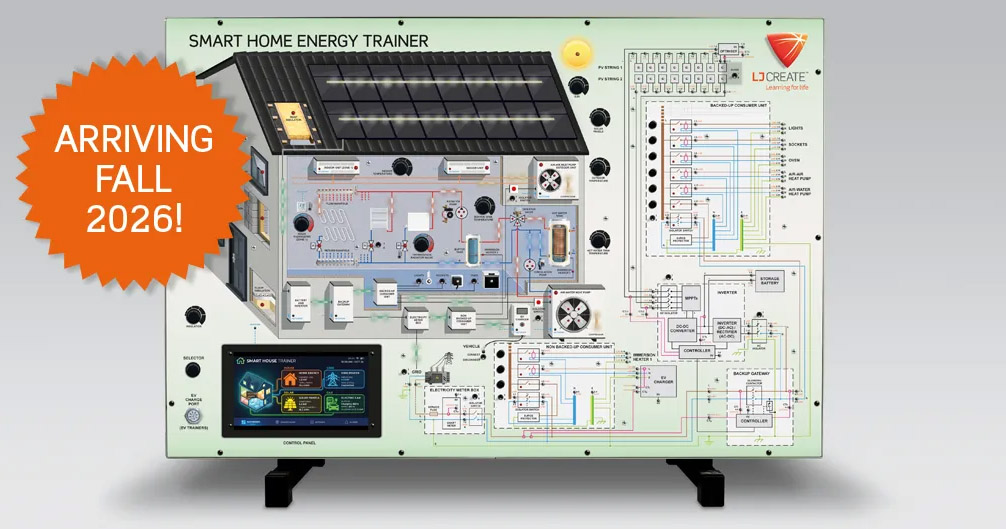
The Smart Home Energy Trainer (123-01) gives students a hands-on way to explore how a modern home generates, converts, stores, distributes, and uses electrical energy. Presented as a complete smart-home energy system on a single training panel, the trainer allows learners to investigate the interaction between solar PV generation, battery storage, household loads, EV charging, heat pump technology, and the electrical grid.

Rather than studying each technology in isolation, students can follow energy throughout the complete residential system. They can investigate AC and DC energy conversion, battery charging and discharging, backed-up and non-backed-up circuits, grid import and export, load management, and system behavior under different operating conditions.

Explore the complete smart-home energy ecosystem—from solar generation and battery storage to household loads, EV charging, and grid interaction.

The Smart Home Energy Trainer brings the major elements of a modern residential energy system together on one teaching panel. This makes it possible for students to see how individual technologies interact as part of a complete system while developing practical knowledge of energy flow, electrical distribution, and smart energy management.

  • Demonstrate solar PV generation using two PV strings
  • Explore AC and DC energy conversion
  • Investigate battery charging, discharging, and energy storage
  • Compare backed-up and non-backed-up electrical circuits
  • Examine residential lighting and heating loads
  • Investigate EV charging within a residential energy system
  • Explore air-to-water heat pump operation
  • Observe grid import and export
  • Practice circuit tracing, fault-finding, and diagnostics

Students can investigate the complete path of electrical energy through the home—from generation and conversion to storage, consumption, and interaction with the utility grid. This system-level approach helps learners understand not only how individual components operate, but also how they work together.

  1. Solar PV Generation: Observe how two photovoltaic strings generate DC electricity and supply energy to the system.
  2. Energy Conversion: Investigate the role of the inverter and DC-DC converter and explore how electrical energy is converted between AC and DC.
  3. Battery Energy Storage: Examine how energy is stored and observe battery charging and discharging as operating conditions change.
  4. Residential Loads: Investigate how lighting circuits, immersion heaters, an air-to-water heat pump, and an EV charger place different demands on the home energy system.
  5. Grid Interaction: Use the electricity meter and grid connection to explore importing electricity from the grid and exporting surplus solar energy.

Modern residential energy systems must determine which electrical loads remain powered when grid electricity is unavailable. The Smart Home Energy Trainer separates backed-up and non-backed-up circuits, allowing students to investigate the principles behind load prioritization and residential back-up power.

Learners can observe how available energy is distributed among different loads and explore how solar generation, battery storage, household demand, and grid availability affect overall system operation.

Understanding how a smart energy system should operate is only part of technician training. Students must also learn how to identify problems when the system does not behave as expected.

The Smart Home Energy Trainer supports practical fault-finding and diagnostic activities in which learners can trace circuits, identify issues, and analyze system behavior under different operating conditions. These activities help develop the systematic troubleshooting skills future electricians and renewable energy technicians need.

The Smart Home Energy Trainer includes curriculum designed to support safe exploration of the residential energy ecosystem. Instructors can use the training system to connect electrical and energy principles with practical investigation of the technologies increasingly found in modern homes.

Training topics include solar PV generation, energy conversion and storage, residential electrical loads, EV charging, heat pump technology, grid interaction, smart energy management, and fault diagnosis.

Prepare Students for Modern Residential Energy Systems

Residential electrification is bringing technologies that were once studied separately into a single interconnected energy system. Solar PV, battery storage, EV charging, heat pumps, intelligent controls, and the electrical grid must all work together.

The Smart Home Energy Trainer (123-01) gives students a practical environment for understanding those relationships while building the electrical, energy management, and diagnostic skills needed to work with modern residential energy technologies.

More Information

Manufacturer: