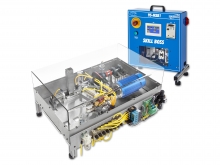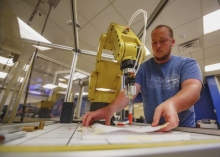
Robots are a way of the future. They can be found inside manufacturing and distribution centers and state-of-the-art factories and at Texas State Technical College.
Students can now enroll in Robotics Technology, one of four new programs being offered at TSTC’s Fort Bend County campus, and learn how to program and operate a fast-growing robotic population.
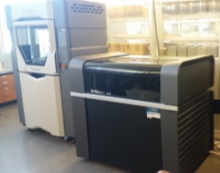
Two 3D printers at the Brown Foundation Institute of Molecular Medicine for the Prevention of Human Diseases are changing the way educators, researchers and students approach a wide variety of challenges inside and outside of labs and classrooms.

Tech-Labs, a leading reseller of technical and vocational training equipment and curriculum in Texas and Oklahoma, has partnered with Desktop Metal, a company committed to making metal additive manufacturing accessible in education.
Being one of the lightest, most durable materials on the market, the new FDM Nylon12 Carbon Fiber material. Containing 35 percent chopped carbon-fiber by weight, and an ultimate tensile strength on the xz axis of nearly 11,000 psi (76Mpa), FDM Nylon 12CF offers the best stiffness-to-weight ratio among Stratasys FDM thermoplastics, meeting the advanced functional testing.
There is a genuine interest in developing wood-derived graphene materials into electrical conductors. Rice University introduces this ground-breaking research by using the Universal Laser Systems XLS10MWH platform. This XLS laser system and processing conditions are described in detail in the following article.
As 3D printing has become more and more mainstream, the traditional resource and skills barriers for manufacturing are all but vanishing. This trend is changing the very face of design.

Digitized and portable machine enables many more schools and companies to train and certify people for the production jobs U.S. companies struggle to fill.
When Boys Town started their first welding program in over 30 years, they chose to educate students using the Lincoln Electric VRTEX system before they did live welding.