Power Electronics Training Systems | Lucas-Nuelle

Training systems from Lucas-Nuelle provide a modular, scalable approach to teaching power electronics—from foundational concepts in power converter technology to advanced applications in controlled drives. These systems are designed to evolve with your program, allowing for easy modernization, expansion, and integration of new technologies.

Hands-On Learning with Real-World Applications

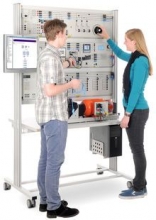
Learners gain practical experience working with key components such as diodes, thyristors, and IGBTs, while exploring their role in real-world circuits. Through guided experiments, students build, operate, and measure circuits, developing critical skills in control, modulation, and diagnostics.

  • Understand power semiconductors and their applications
  • Build and test power converter and inverter circuits
  • Develop measurement skills using multimeters and oscilloscopes
  • Explore control and modulation techniques
  • Apply knowledge to drive technology and industrial systems

Integrated Multimedia Learning with UniTrain

The UniTrain multimedia courses enhance hands-on training with interactive animations, guided experiments, and step-by-step instruction. This blended approach helps learners visualize complex concepts while reinforcing practical skills in a structured, engaging format.

Whether you are building a new program or enhancing an existing lab, Lucas-Nülle power electronics systems provide the flexibility and depth needed to prepare students for careers in advanced manufacturing, energy systems, and industrial automation.

Ready to bring power electronics training into your program? Contact us today to request a quote, schedule a demo, or explore how these systems can align with your curriculum and workforce goals.

  • Power Engineering | Micro Grid Trainer
    Item Number:
    EMG 1 / EMG 2
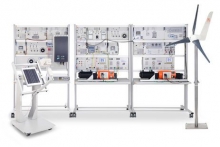
    A stand-alone power network is a type of power supply network which is closed and has no active lines coupling it to other parts of the electrical power supply grid. A stand-alone network is markedly smaller than a combined electricity grid and does not usually incorporate high-voltage power lines. For this type of network, there are two distinct modes of operation, stand-alone mode, and isolated parallel or generator-to-generator operation.
  • Smart Grid Technology Trainers
    Item Number:
    ESG 1
    Features 9 stations that can be individually configured.