



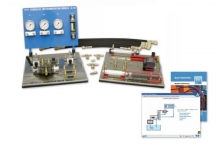
Each Basic Hydraulics training system features standard industrial grade components. This attention to quality gives students experience they would normally only get on-the-job by helping them recognize industrial components and how to troubleshoot them more effectively. Components included with Basic Hydraulics are pre-mounted on circuit panels with silk-screened labels next to each, which facilitates ease of use and identification.
Hands-On Allen-Bradley ControlLogix Skills
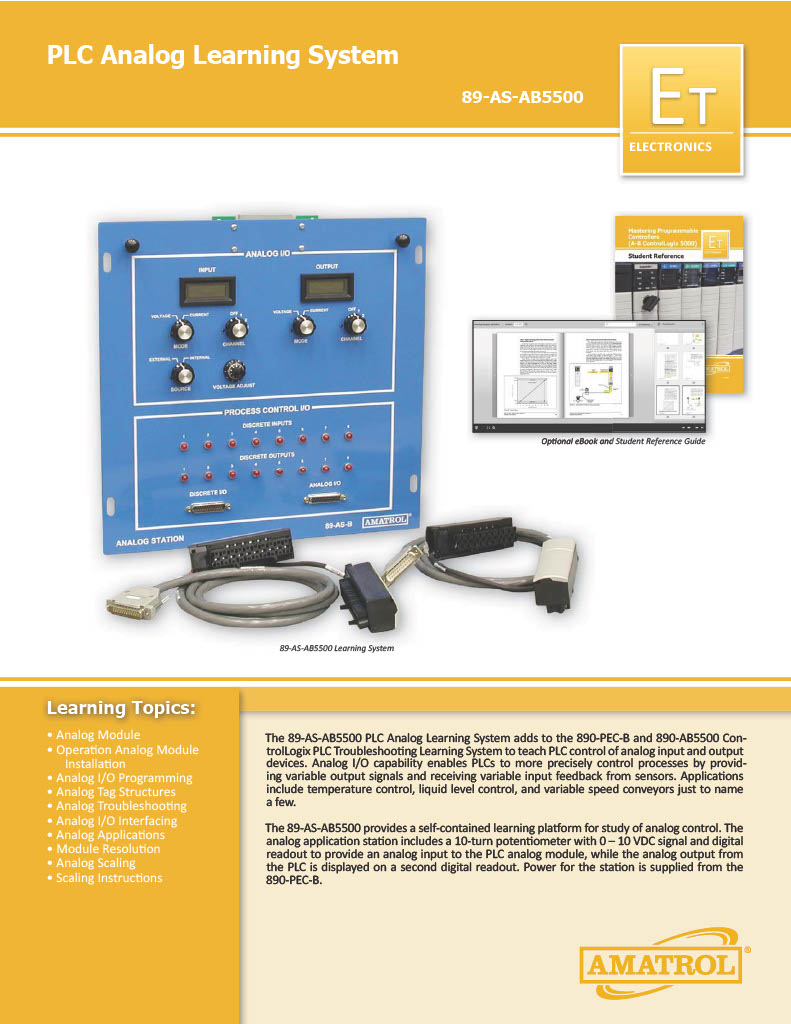
The PLC Analog Application Learning System – ControlLogix (89-AS-AB5500) adds to the Programmable Controller Troubleshooting Workstation (890-PECB) and the PLC Troubleshooting Learning System-AB ControlLogix (890-AB5500) to teach PLC control of analog input and output devices. Analog I/O capability enables PLCs to more precisely control processes by providing variable output signals and receiving variable input feedback from sensors. Popular applications include temperature control, liquid level control, and variable speed conveyors.
The analog training system includes an analog application station, cable assembly, Allen-Bradley ControlLogix combination analog module, student learning materials for both theory and lab, and a teacher’s assessment guide. Students will learn industry relevant skills including how to operate, interface, program and troubleshoot PLC systems using analog I/O.
Hands-On Allen-Bradley ControlLogix Skills
Amatrol’s PLC EtherNet Training System (89-EN-AB5500) teaches the fundamentals and troubleshooting of industrial communications networks using EtherNet/IP. EtherNet/IP has become very popular as an industrial communications network, offering high data transfer speed, flexibility of communicating on both the Enterprise level and the Automation and Control level, and a choice of vendors when purchasing equipment. It is important for technicians to understand different types of networks and their operation to be able to install and troubleshoot not only networks, but also the interconnections to the PLCs.
The main components of the 89-EN-AB5500 are two EtherNet/IP PLC modules and two EtherNet 5-port switches. Learners will use these components with additional required learning systems including the PLC Troubleshooting Learning System – AB ControlLogix (890-AB5500) to practice fundamentals such as: basic PLC operation and programming, motor control, event sequencing, I/O interfacing and testing, process control, and material transfer. Amatrol uses industrial-quality components for durability to stand up to frequent use and so that learners can get real-world experience with components that they’ll actually see in the field.
Add-On Options for 890-PECB
The PLC Expansion Package (89-MP) Expansion Module adds to the 890-PEC-B Troubleshooting Learning System to create dual PLC training system. The 89-MP is an ideal method of teaching applications such as remote I/O and Date Highway Networks, where multiple PLCs are required. With just one learning station, learners can set up a multiple PLC network between the PLCs mounted on the 89-MP and the 890-PEC-B.
The 89-MP is also a cost effective way to support multi-brand or model training. Two different PLCs can be mounted on the learning station at all time so changeover between the two PLCs only requires the student to connect a new quick-connect cable set.
The Electrical Relay Control Training System (90-EC1A) teaches how to interpret, design and operate relay control circuits using ladder diagrams. Electrical control is vital in the operation of electric and fluid power actuators and also forms the fundamental building block of automation systems like programmable logic controllers (PLCs), which are programmed using the electrical control schematic method, the ladder diagram.
The Electrical Relay Control Training System includes a tabletop console with pre-mounted electrical control, pneumatic, and electri power components. Each component's electrical terminals are connected to heavy-duty banana jacks, enabling learners to quickly connect and operate various automation control circuits.
The training system also features in-depth curriculum covering major topics including control logic, ladder diagrams, sequencing control, timers and advanced systems.
Amatrol’s Design of Structures 1 Learning System (94-DOS1) serves as an introduction to civil engineering and covers the design, construction, and analysis of structural designs, such as bridges, buildings, and tunnels. Design of structures introduces learners to the various roles that civil engineers can assume in the residential, transportation, and industrial fields. This system features world-class curriculum that intertwines theoretical lessons such as how to calculate the bending stress in beams with practical skills like building and testing a Warren Truss bridge.
The design of structures training system includes two bridge component sets that can be used to construct a variety of truss bridges, a beam component set to show how different loads affect beam stress, and a data acquisition system to test the stress on various components. These components will help learners to build skills that can be applied in the workplace, which is one example of how Amatrol transforms the global workforce one life at a time.
Concrete Beam Construction & Testing Training System
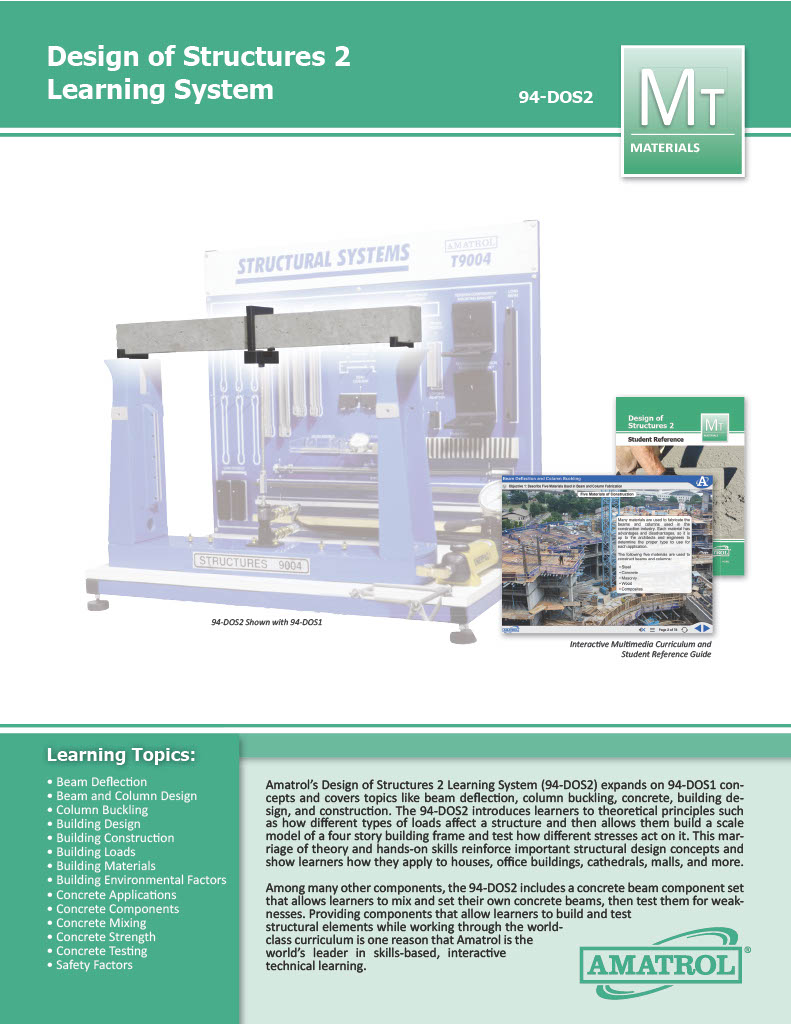
Amatrol’s Design of Structures 2 Learning System (94-DOS2) expands on 94-DOS1 concepts and covers topics like beam deflection, column buckling, concrete, building design, and construction. The 94-DOS2 introduces learners to theoretical principles such as how different types of loads affect a structure and then allows them build a scale model of a four story building frame and test how different stresses act on it. This marriage of theory and hands-on skills reinforce important structural design concepts and show learners how they apply to houses, office buildings, cathedrals, malls, and more.
Among many other components, the 94-DOS2 includes a concrete beam component set that allows learners to mix and set their own concrete beams, then test them for weaknesses. Providing components that allow learners to build and test structural elements while working through the world-class curriculum is one reason that Amatrol is the world’s leader in skills-based, interactive technical learning.
Amatrol's Design of Structures 3 (94-DOS3) covers the basic principles of surveying, surveying equipment, reading and interpreting maps, and global positioning systems. Surveying involves taking measurements of land and its features and then processing this information into usable data. Surveying provides essential information used by construction professionals, civil engineers and more!
The Design of Structures 3 Training System includes a level-transit kit, global positioning system, interactive multimedia surveying curriculum, an instructor's guide, an installation guide and a student reference guide. This equipment and curriculum will be utilitzed to cover vital topics like level-transit operation, trigonometric survey application, topographical maps, global positioning system applications, and more!
Robotics and Computer Programming
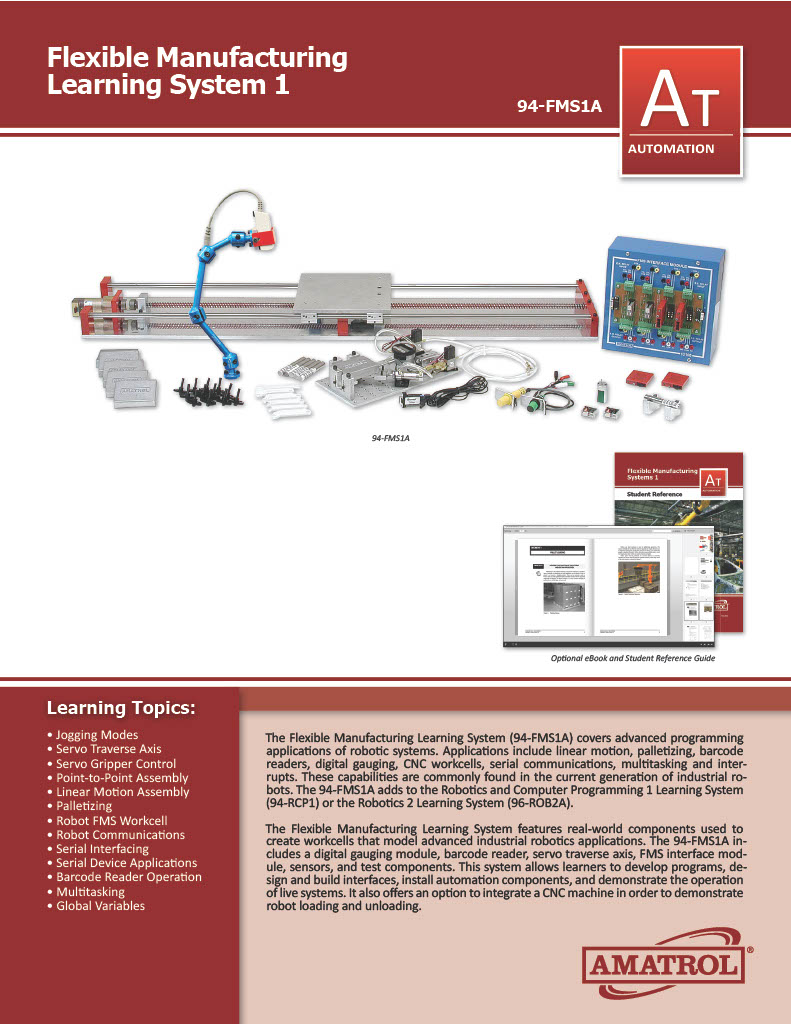
The Flexible Manufacturing Learning System 1 (94-FMS1A) adds to either the Robotics and Computer Programming 1 Learning System (94-RCP1) or the Robotics 2 Learning System (96-ROB2A) to teach advanced programming applications of robotic systems. Applications include linear motion, palletizing, barcode readers, digital gauging, CNC workcells, serial communications, multitasking, and interrupts. These capabilities are commonly found in the current generation of industrial robots.
The model 94-FMS1A provides real-world components students will use to create workcells that model industrial applications of advanced robotics. Students will develop flexible manufacturing robot programs, design and build interfaces, install automation components, and demonstrate the operation of live systems. Amatrol’s Flexible Manufacturing Learning System includes a digital gauging module, barcode reader module, servo traverse axis, FMS interface module, sensors, test components, student learning materials for theory and lab, and teacher’s assessment guide. The learning materials also support the use of an optional CNC machine module to demonstrate robot loading and unloading.
Injection, Blow, & Extrusion Molding Skills
Amatrol’s Plastics Technology Learning System (94-MP3T) is an all-in-one trainer that can perform injection molding, blow molding, and extrusion molding! With the ability to hold four ounces of plastics, the plastic injection molding training unit can perform multiple molding shots without learners needing to refill the system and wait for the plastic to melt. Additionally, this system features two digitally-controlled heater jackets located on the system’s barrel and nozzle to create dual temperature zones, which is a standard feature on industrial plastics machines.
Plastics are used in nearly every industrial area from automotive to food and beverage. Besides strong hand-on learning, the 94-MP3T features thorough theoretical knowledge that not only intricately explains the processes, operation, safety, and troubleshooting of the three major types of molding, but also offers curriculum in basic chemistry and then provides an in-depth look at polymers and the properties of plastics. The curriculum also covers safety data sheets (SDS) and plastics system purging.
Hands-On Testing & Polariscope Skills
Material strength properties affect the performance and safety of almost every product made. As technology has advanced, material choices have broadened and become more complex. Engineers and technicians alike must be able to select the proper material for an application and analyze material properties when a product fails. That calls for industrial materials testing.
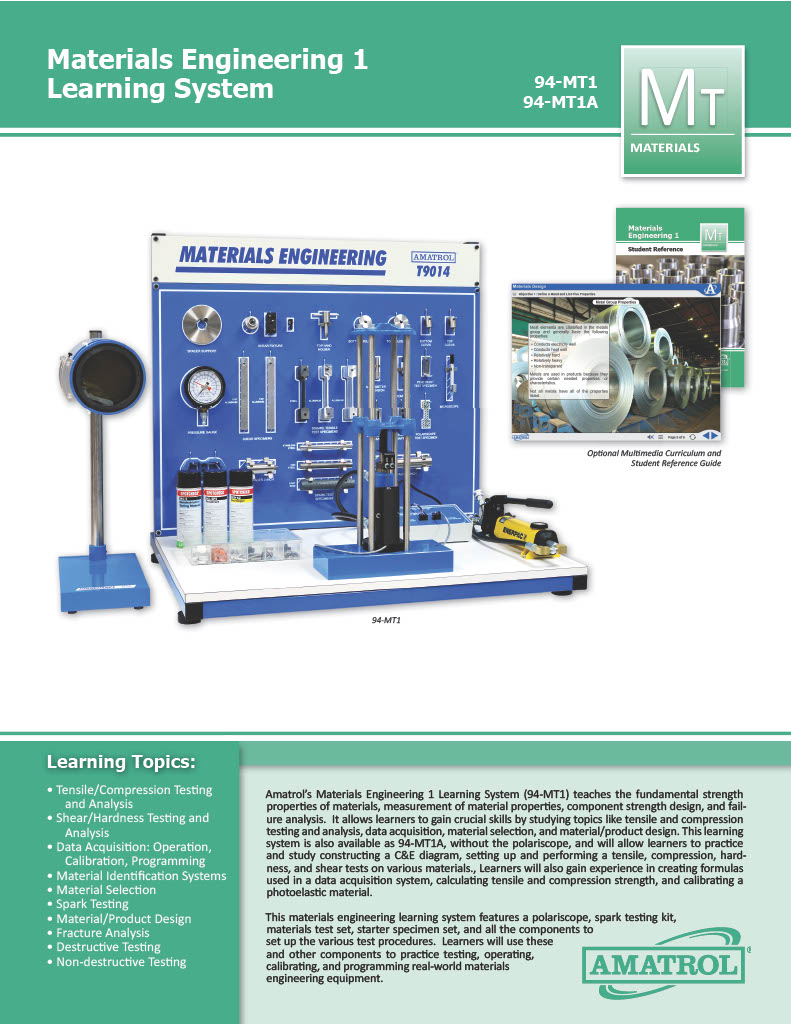
Amatrol’s Materials Engineering 1 Learning System (94-MT1) uses industrial quality components to teach students how to evaluate and use different industry grade materials. The 94-MT1 allows students to conduct a wide array of tests including tensile testing on steel alloys. Students learn industry-relevant skills in materials testing (tensile, compression, hardness, and shear), computerized data acquisition, chemistry of metals, interpretation of industry-standard numeric identification systems of various types of metals (steel, aluminum, brass, and copper), material strength analysis, and product design.
Pages
-
 Item Number:BH-85
 -
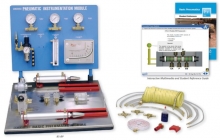 Item Number:85-BPAmatrol’s Basic Pneumatics training system (85-BP) introduces pneumatic principles through a combination of Amatrol’s top-flight multimedia curriculum with hands-on industrial pneumatic skill-building. Topics covered in this learning system include single-acting cylinder circuits, pressure vs. cylinder force, and flow control valves, while the panels can be used to practice skills such as connecting and operating a needle valve to control actuator speed.
 -
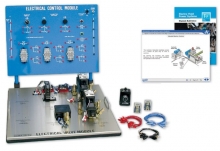 Item Number:85-EHThe Electro-Hydraulics training system includes an electrical control panel with relay control components and an electrical valve module with solenoid-operated hydraulic directional control valves and electrical/electronic sensors. These components will be used to study a variety of topics including electrical control systems, basic control devices, power devices, control relays, sequencing control, timer control, pressure control applications, and circuit applications.
 -
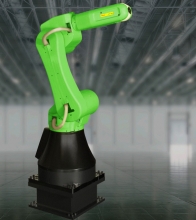 Item Number:CR-35iAFANUC’s new CR-35iA is the world’s first collaborative robot with a payload capacity of up to 35 kg. Fenceless, it opens a whole new world of possibilities. Working safely side by side with human operators, it is space as well as cost saving. And because inside it’s like any other FANUC robot, it operates like all FANUC robots. Certified to meet the requirements of ISO 10218-1:2011 and RIA/ANSI R15.06-2012, FANUC’s CR-35iA collaborative robot can work in a variety of applications alongside human workers including: machine tending, handling heavy payloads that require lift assist devices or custom equipment, higher payload mechanical assembly, palletizing or packing, and tote or carton handling.
 -
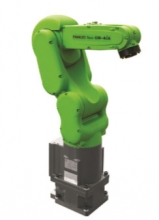 Item Number:CR-4iACR-4iA is a small collaborative robot with 4 kg payload
 -
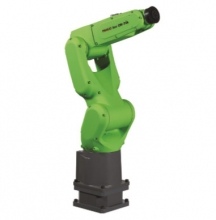 Item Number:CR-7iAThe FANUC CR-7iA is FANUC's newest collaborative robot resembles the LR Mate family. Painted green to show it's ability to work beside humans, you can expect the same reliability as FANUC's yellow robots. The CR-7iA is ideal for small part sorting and assembly, inspection, machine tending, and part delivery. It has a 7 kg payload, 717 mm reach, and is equipped with iRVision and Force Sensing. There are a variety of mounting options such as floor, wall, and ceiling.
 -
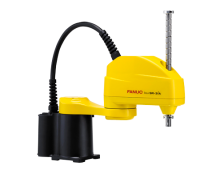 FANUC’s new SCARA robots are ideal for high-speed, precision applications such as assembly, pick and place, testing/inspection and packaging processes.
 -
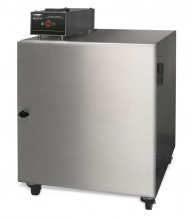
In the rare event that a burning ember or spark is drawn into the fume extraction unit, there is the possibility that debris in the filters could ignite. Although any resultant fire would typically be retained within the fume extraction unit, this would cause significant damage and in extreme circumstances, the risk may extend beyond the extraction unit. For processes where such risks have been identified, additional protection in the form of an in-line firebox is an additional precaution.
-
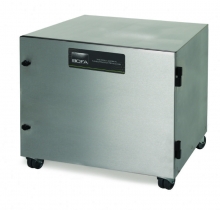
The BOFA inline pre-filter 1000 has been designed specifically for applications that generate high amounts of dust or particulate.
This inline filter unit is positioned alongside the main BOFA fume filtration system to increase the overall filter capacity and extend the life of the main filters. The DeepPleat DUO pre-filter incorporates a massive drop-out chamber within the filter, having a volume area of 15ltrs. Above the drop-out chamber but still within the housing there is a sealed 200mm deep pleat layer of F8 media giving a surface area in excess of 30 sq meters.
-
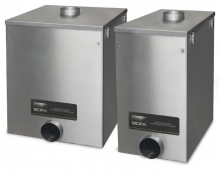 The BOFA inline prefilters have been designed specifically for applications that generate high amounts of dust or particulate.