Interactive VR training for electrical switchboard operation, feeder breaker use, relay functions, and live-dead-live testing—designed to strengthen safety and workforce readiness.
Electrical switchboards are central to safe and reliable power distribution in commercial and industrial facilities. Proper operation, inspection, and testing procedures are essential to protect personnel, prevent electrical hazards, and maintain system integrity.
This immersive virtual reality training course provides hands-on experience operating a switchboard in a safe, interactive simulation. Learners can practice critical procedures, identify components, and reinforce safety protocols before transitioning to live electrical environments.
Why Integrate Switchboard Operations VR Training?
- Hands-On Training – Operate a switchboard in a practical, interactive simulation environment.
- Critical Safety Skills – Practice opening and closing the switchboard, utilizing feeder breakers, and performing a live-dead-live test.
- Comprehensive Component Identification – Locate and understand key switchboard components and their functions.
- Realistic, Controlled Experience – Build confidence and procedural accuracy without exposure to live electrical risk.
Who Will Benefit?
- Maintenance personnel
- Electricians and electrical apprentices
- Supervisors in electrical facilities
- CTE and technical college electrical programs
Program Outcomes
- Enhance electrical safety and operational efficiency
- Gain practical knowledge of switchboard operation
- Reduce the risk of electrical hazards
- Support smooth and reliable facility operations
When the power goes out, critical systems must continue operating. Uninterruptible Power Supply (UPS) systems play a vital role in maintaining power continuity for healthcare facilities, data centers, manufacturing operations, and commercial buildings.
This immersive VR training course provides hands-on experience in safely operating, maintaining, and securing a UPS system. Learners develop practical skills in shutdown procedures, lockout/tagout protocols, and hazard assessment—building confidence before working with live equipment.
Why Integrate UPS VR Training?
- Critical Power Management Training – Understand the role of a UPS in preventing power disruptions and protecting sensitive equipment.
- Hands-On Electrical Safety – Practice proper shutdown and de-energization procedures.
- Lockout/Tagout Protocols – Safely secure a UPS system before performing maintenance.
- PPE Selection & Inspection – Identify and utilize the correct personal protective equipment.
- Risk Assessment Skills – Perform a Job Safety Analysis (JSA) to establish a safe working environment.
Who Will Benefit?
- Maintenance personnel and facility managers
- IT professionals managing critical power systems
- Electricians and industrial technicians
- Anyone responsible for power continuity and electrical safety
- CTE and technical college electrical programs
Program Outcomes
- Strengthen power infrastructure reliability
- Prevent costly downtime and power failures
- Reinforce compliance with safety and maintenance standards
- Minimize electrical hazards through proper lockout/tagout procedures
- Improve confidence in managing backup power systems
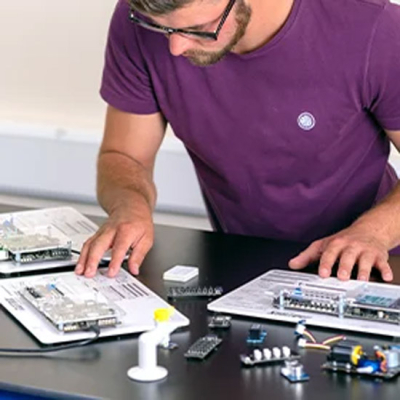
Training systems from Lucas-Nuelle provide a modular, scalable approach to teaching power electronics—from foundational concepts in power converter technology to advanced applications in controlled drives. These systems are designed to evolve with your program, allowing for easy modernization, expansion, and integration of new technologies.
Hands-On Learning with Real-World Applications
Learners gain practical experience working with key components such as diodes, thyristors, and IGBTs, while exploring their role in real-world circuits. Through guided experiments, students build, operate, and measure circuits, developing critical skills in control, modulation, and diagnostics.
- Understand power semiconductors and their applications
- Build and test power converter and inverter circuits
- Develop measurement skills using multimeters and oscilloscopes
- Explore control and modulation techniques
- Apply knowledge to drive technology and industrial systems
Integrated Multimedia Learning with UniTrain
The UniTrain multimedia courses enhance hands-on training with interactive animations, guided experiments, and step-by-step instruction. This blended approach helps learners visualize complex concepts while reinforcing practical skills in a structured, engaging format.
Whether you are building a new program or enhancing an existing lab, Lucas-Nülle power electronics systems provide the flexibility and depth needed to prepare students for careers in advanced manufacturing, energy systems, and industrial automation.
Ready to bring power electronics training into your program? Contact us today to request a quote, schedule a demo, or explore how these systems can align with your curriculum and workforce goals.
Portsmouth University is helping shape the future of engineering education with new power engineering training labs featuring Lucas-Nülle systems. Designed to support hands-on learning, these advanced labs give students and future professionals the opportunity to build practical skills in modern energy engineering, sustainable power generation, and real-world electrical systems.
As the energy sector continues to evolve, training environments must do more than teach theory. They must give learners the confidence to work with the technologies, systems, and processes they will encounter in the field. With Lucas-Nülle training systems, Portsmouth University is creating an immersive learning environment that helps bridge the gap between classroom instruction and workforce readiness.
Why This Lab Matters
- Supports hands-on learning in power engineering
- Helps prepare students for modern energy industry careers
- Strengthens instruction with real-world training applications
- Introduces learners to sustainable energy and advanced power systems
- Creates a more engaging and career-relevant educational experience
Training for a Changing Energy Landscape
From renewable energy concepts to advanced power engineering applications, Portsmouth University’s new labs demonstrate how institutions can better prepare students for the demands of a changing industry. With modern equipment, interactive training experiences, and a focus on applied learning, these labs set a strong example for universities looking to strengthen engineering and energy education programs.
See What’s Possible with Advanced Training Solutions
We help education and training organizations identify solutions that align with their program goals, industry demands, and student outcomes. Contact us to learn more about Lucas-Nülle training solutions for power engineering, electrical systems, and workforce development.
Date: Tuesday-Wednesday, July 14-15, 2026
Location: Omni Hotel, Fort Worth, Texas
Date: Monday August 3, 2026
Location: Arvest Convention Center, Tulsa, OK
Date: Tuesday, August 4, 2026
Location: Hyatt Regency Tulsa, OK
Date: Tuesday, August 4, 2026
Location: Hyatt Regency Tulsa, OK
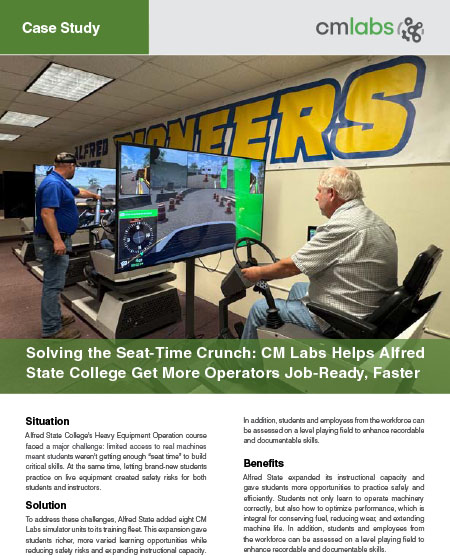
Solving the Seat-Time Challenge with Simulation Training
Alfred State College faced a critical challenge in its Heavy Equipment Operation program: limited access to real machinery meant students weren’t getting enough hands-on experience to build essential skills. At the same time, training inexperienced students on live equipment introduced safety risks for both learners and instructors.
To overcome these challenges, Alfred State integrated CM Labs simulators into its training program. By adding multiple simulation units, the college expanded instructional capacity, increased student access to practice time, and created a safer, more controlled learning environment.
How Simulation Transformed Training
- Increased Capacity: Expanded program enrollment and provided consistent access to training resources.
- Enhanced Safety: Allowed students to build confidence before operating real equipment.
- Faster Skill Development: Training time improved by an estimated 20–30%.
- Real-World Scenarios: Simulators replicate weather, lighting, and jobsite conditions.
- Objective Assessment: Performance metrics such as task time, fuel usage, and precision support measurable outcomes.
Students were able to gain critical seat time faster, improving skill development and reducing training bottlenecks.
Real Impact for Workforce Readiness
With the addition of simulation, Alfred State grew its program from approximately 40 students to over 100, all while improving training quality. Students now gain exposure to multiple machine types and develop both operational and performance-optimization skills—helping reduce fuel consumption, minimize wear, and extend equipment life.
By combining simulation with traditional training, Alfred State has created a scalable, safe, and highly effective pathway to workforce readiness—preparing students with the confidence and competence needed to succeed in the field.
Engineering Education Systems bring complex engineering concepts to life through hands-on, interactive learning experiences. These systems are designed to help students move beyond theory and develop practical skills that align with real-world engineering applications across multiple disciplines.
Solutions within this category support a wide range of program areas, including mechanical, electrical, civil, and manufacturing engineering. By combining physical hardware, structured curriculum, and data acquisition tools, these systems enable students to explore, test, and analyze engineering principles in a controlled lab environment.
From foundational concepts to advanced applications, Engineering Education Systems provide scalable learning pathways for universities, community colleges, and advanced STEM programs. Students gain experience with industry-relevant equipment and methodologies, preparing them for careers in engineering, manufacturing, energy, and emerging technologies.
- Hands-On Learning: Reinforce theoretical concepts through real-world experimentation and lab-based activities.
- Industry-Relevant Skills: Utilize equipment and processes that mirror modern engineering environments.
- Structured Curriculum: Support instructors with guided learning materials, lab exercises, and assessment tools.
- Multi-Disciplinary Coverage: Address core engineering topics including mechanics, fluid dynamics, electrical systems, and automation.
- Scalable Solutions: Adapt to different education levels, from introductory courses to advanced engineering programs.
- Mechanical & Structural Engineering
- Electrical & Electronic Systems
- Fluid Mechanics & Process Control
- Automation & Manufacturing Systems
- Materials & Testing
Whether building a new lab or enhancing an existing program, our Engineering Education solutions provide the tools to deliver engaging, outcomes-focused training that prepares students for the demands of today’s engineering workforce.
Pages
-
-
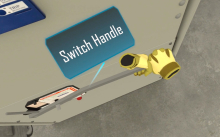
 Intellia Team Training enables multiple operators to collaborate in the same virtual environment to complete shared tasks—developing the communication and coordination skills essential for real-world worksite success. This safe, immersive solution replicates complex team-based scenarios.
 -
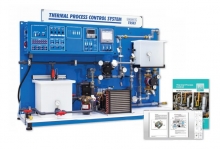 Item Number:T5553Amatrol’s Temperature Process Control Learning System (T5553) demonstrates how to install, calibrate, operate, adjust, and tune thermal process control systems in a wide variety of industrial applications, including food processing, chemical manufacturing, and biotechnology.
 -
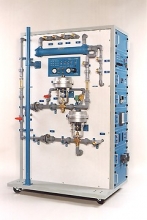 Item Number:602-PACProcess control systems maintain precise control of liquid and gas variables, such as liquid level, flow rate, pressure, temperature, and pH level. These multifaceted systems are a critical part of major industries like power generation, refineries, petrochemicals, chemical manufacturing, pharmaceuticals, biotechnology, and food processing and bottling.
 -
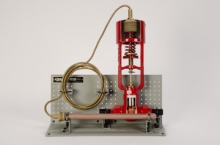 Item Number:295-701DAC Worldwide's Temperature Regulator Cutaway (295-701) is a sectioned temperature regulator allowing for convenient classroom or lab training in the design, operation, construction, and maintenance of this common control device used in oil and gas production.
 -
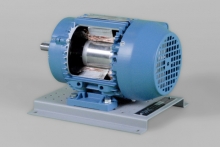 Item Number:273-920This 3-phase, squirrel-cage, induction motor cutaway supports industrial training activities related to electric motor types, as well as repair and troubleshooting. An integral horsepower, industrial-duty motor is modified for training purposes.
 -
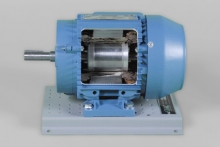 Item Number:273-925The 3-phase, squirrel-cage, explosion-proof induction motor cutaway supports industrial training activities related to electric motor types, as well as repair and troubleshooting. An integral horsepower, industrial-duty motor is modified for training purposes.
 -
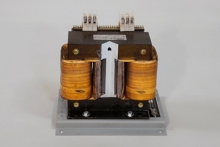 Item Number:273-915DAC Worldwide’s Three-Phase Transformer Cutaway (273-915) is a detailed and professionally-crafted three-phase transformer cutaway that depicts a common coaxially-wound, three-phase, delta-wye wired transformer.
 -
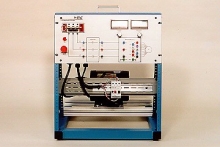 Item Number:412-000DAC Worldwide’s Three-Phase, Squirrel Cage Rotor, AC Motor Training System (412-000) provides a starting point for understanding a common, widely-used industrial induction motor. These self-starting, 56 frame, simply constructed motors are used in applications like generators or where low starting torque is required.
 -
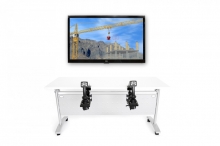 Item Number:TCRSimlog's simulation software puts you at the controls of a modern freestanding top-slewing tower crane with trolley jib. Instrument readings include working slew angle, working radius, lowering depth (hook height), and load weight. There is also a simulated three-way switch for hoist gear selection. You can even change the viewpoint during the simulation at the touch of a button.