


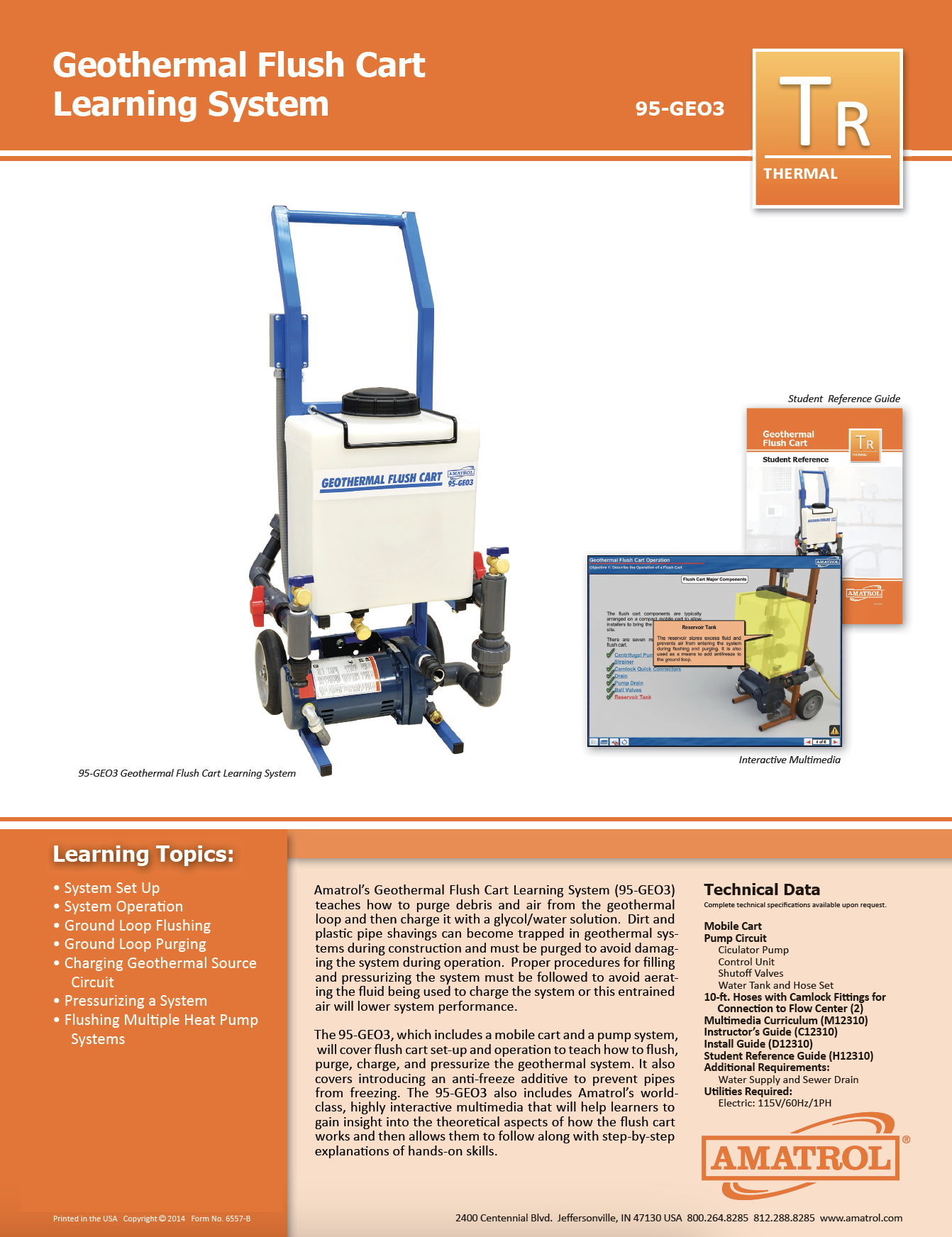
DAC Worldwide’s Fan Balancing Training System Plus (202-PAC) is a hands-on industrial training system that allows learners to gain experience with fan balancing to achieve maximum fan efficiency and stability.
The Electrical Relay Control Training System (90-EC1A) teaches how to interpret, design and operate relay control circuits using ladder diagrams. Electrical control is vital in the operation of electric and fluid power actuators and also forms the fundamental building block of automation systems like programmable logic controllers (PLCs), which are programmed using the electrical control schematic method, the ladder diagram.
The Electrical Relay Control Training System includes a tabletop console with pre-mounted electrical control, pneumatic, and electri power components. Each component's electrical terminals are connected to heavy-duty banana jacks, enabling learners to quickly connect and operate various automation control circuits.
The training system also features in-depth curriculum covering major topics including control logic, ladder diagrams, sequencing control, timers and advanced systems.
Amatrol’s Design of Structures 1 Learning System (94-DOS1) serves as an introduction to civil engineering and covers the design, construction, and analysis of structural designs, such as bridges, buildings, and tunnels. Design of structures introduces learners to the various roles that civil engineers can assume in the residential, transportation, and industrial fields. This system features world-class curriculum that intertwines theoretical lessons such as how to calculate the bending stress in beams with practical skills like building and testing a Warren Truss bridge.
The design of structures training system includes two bridge component sets that can be used to construct a variety of truss bridges, a beam component set to show how different loads affect beam stress, and a data acquisition system to test the stress on various components. These components will help learners to build skills that can be applied in the workplace, which is one example of how Amatrol transforms the global workforce one life at a time.
Concrete Beam Construction & Testing Training System
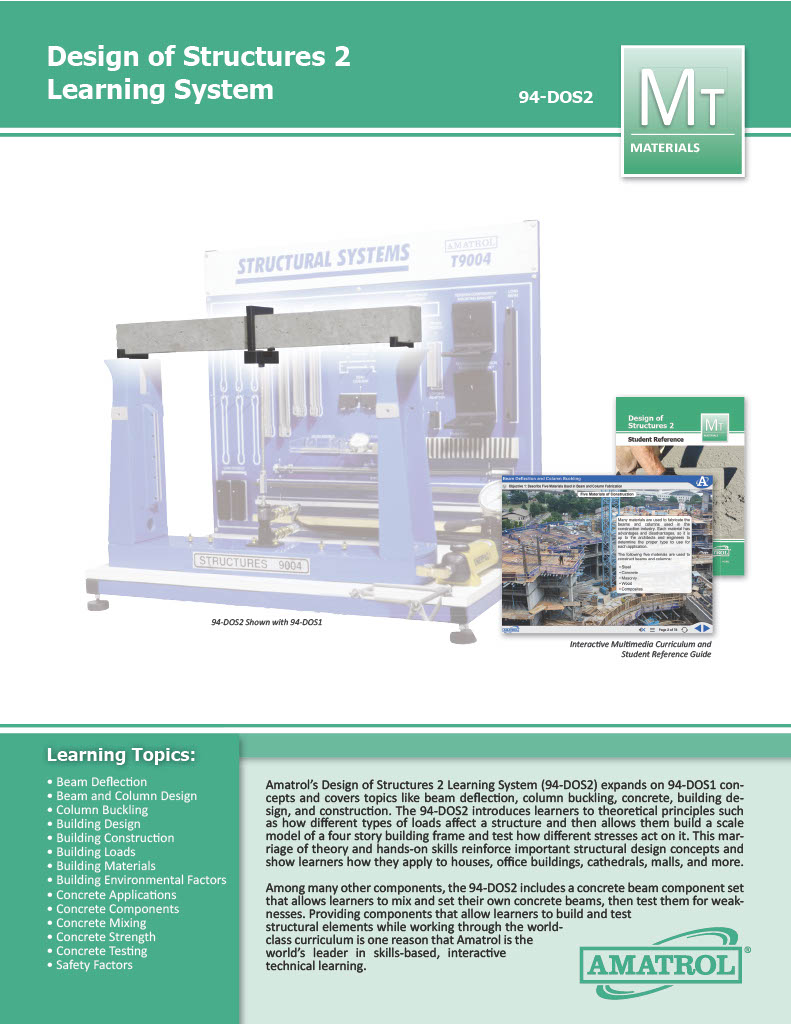
Amatrol’s Design of Structures 2 Learning System (94-DOS2) expands on 94-DOS1 concepts and covers topics like beam deflection, column buckling, concrete, building design, and construction. The 94-DOS2 introduces learners to theoretical principles such as how different types of loads affect a structure and then allows them build a scale model of a four story building frame and test how different stresses act on it. This marriage of theory and hands-on skills reinforce important structural design concepts and show learners how they apply to houses, office buildings, cathedrals, malls, and more.
Among many other components, the 94-DOS2 includes a concrete beam component set that allows learners to mix and set their own concrete beams, then test them for weaknesses. Providing components that allow learners to build and test structural elements while working through the world-class curriculum is one reason that Amatrol is the world’s leader in skills-based, interactive technical learning.
Amatrol's Design of Structures 3 (94-DOS3) covers the basic principles of surveying, surveying equipment, reading and interpreting maps, and global positioning systems. Surveying involves taking measurements of land and its features and then processing this information into usable data. Surveying provides essential information used by construction professionals, civil engineers and more!
The Design of Structures 3 Training System includes a level-transit kit, global positioning system, interactive multimedia surveying curriculum, an instructor's guide, an installation guide and a student reference guide. This equipment and curriculum will be utilitzed to cover vital topics like level-transit operation, trigonometric survey application, topographical maps, global positioning system applications, and more!
Robotics and Computer Programming
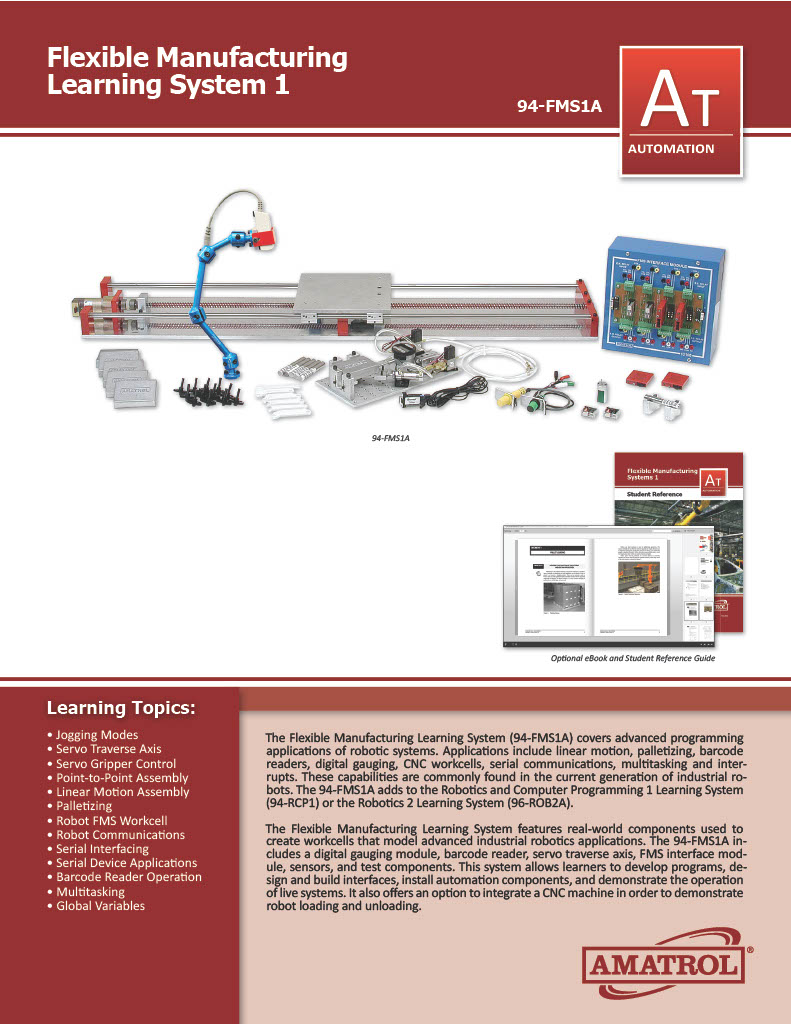
The Flexible Manufacturing Learning System 1 (94-FMS1A) adds to either the Robotics and Computer Programming 1 Learning System (94-RCP1) or the Robotics 2 Learning System (96-ROB2A) to teach advanced programming applications of robotic systems. Applications include linear motion, palletizing, barcode readers, digital gauging, CNC workcells, serial communications, multitasking, and interrupts. These capabilities are commonly found in the current generation of industrial robots.
The model 94-FMS1A provides real-world components students will use to create workcells that model industrial applications of advanced robotics. Students will develop flexible manufacturing robot programs, design and build interfaces, install automation components, and demonstrate the operation of live systems. Amatrol’s Flexible Manufacturing Learning System includes a digital gauging module, barcode reader module, servo traverse axis, FMS interface module, sensors, test components, student learning materials for theory and lab, and teacher’s assessment guide. The learning materials also support the use of an optional CNC machine module to demonstrate robot loading and unloading.
Injection, Blow, & Extrusion Molding Skills
Amatrol’s Plastics Technology Learning System (94-MP3T) is an all-in-one trainer that can perform injection molding, blow molding, and extrusion molding! With the ability to hold four ounces of plastics, the plastic injection molding training unit can perform multiple molding shots without learners needing to refill the system and wait for the plastic to melt. Additionally, this system features two digitally-controlled heater jackets located on the system’s barrel and nozzle to create dual temperature zones, which is a standard feature on industrial plastics machines.
Plastics are used in nearly every industrial area from automotive to food and beverage. Besides strong hand-on learning, the 94-MP3T features thorough theoretical knowledge that not only intricately explains the processes, operation, safety, and troubleshooting of the three major types of molding, but also offers curriculum in basic chemistry and then provides an in-depth look at polymers and the properties of plastics. The curriculum also covers safety data sheets (SDS) and plastics system purging.
Hands-On Testing & Polariscope Skills
Material strength properties affect the performance and safety of almost every product made. As technology has advanced, material choices have broadened and become more complex. Engineers and technicians alike must be able to select the proper material for an application and analyze material properties when a product fails. That calls for industrial materials testing.
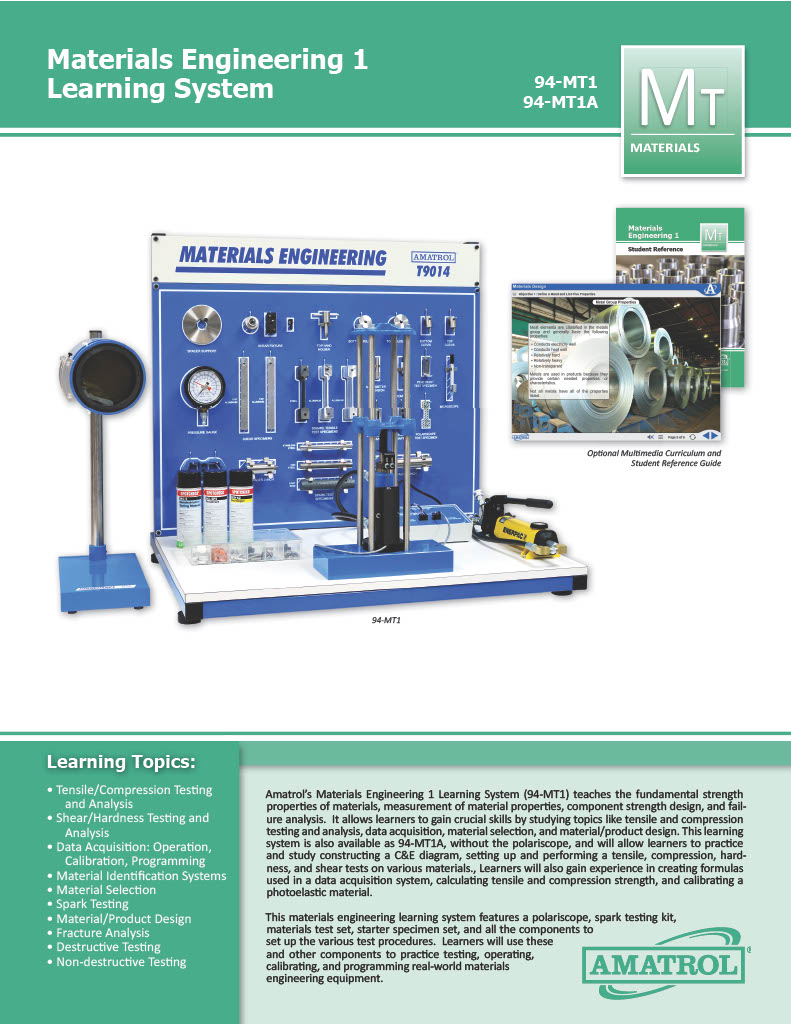
Amatrol’s Materials Engineering 1 Learning System (94-MT1) uses industrial quality components to teach students how to evaluate and use different industry grade materials. The 94-MT1 allows students to conduct a wide array of tests including tensile testing on steel alloys. Students learn industry-relevant skills in materials testing (tensile, compression, hardness, and shear), computerized data acquisition, chemistry of metals, interpretation of industry-standard numeric identification systems of various types of metals (steel, aluminum, brass, and copper), material strength analysis, and product design.
Hose and Tube Fitting
Amatrol’s Pneumatic Fitting Construction Learning System (94-PFC-1) covers how to select the proper fittings required for connecting components and installing fittings to hoses and flexible tubing. Major topics covered by the Pneumatic Fittings training system include air supply connections, control air connections, and power air connections. The topics and pneumatic skills included in this system are required knowledge for any technician or engineer involved in the construction of pneumatic systems.
The Pneumatic Fittings training system includes a tabletop workstation with pre-mounted pneumatic components like a pneumatic cylinder, flow control valve, manifold, and directional control valve. Learners will use these and other components to practice skills like installing a rubber hose onto a push-on type fitting, connecting tubing using a ferrule type fitting, and installing a bulkhead fitting. Working with these industrial-grade components will help learners gain confidence and build real-world applicable skills for rewarding careers like industrial maintenance technicians.
Amatrol’s Geothermal Flush Cart Learning System (95-GEO3) teaches how to purge debris and air from the geothermal loop and then charge it with a glycol/water solution. Dirt and plastic pipe shavings can become trapped in geothermal systems during construction and must be purged to avoid damaging the system during operation. Proper procedures for filling and pressurizing the system must be followed to avoid aerating the fluid being used to charge the system or this entrained air will lower system performance.
Pages
-
 Item Number:202-PAC
 -
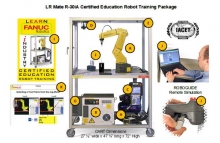 A large working envelope with a reach of 717 mm, and a payload of 7 kg, combine to provide solutions for high productivity handling and assembly applications.
 -
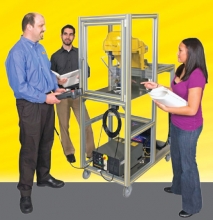 With FANUC Robotics’ CERT Program, new courses and project based activities prepare students for a workplace that will be increasing in robotic automation. The Fanuc Robotics Education Training Cart incorporates the compact M-1+A robot housed in a self contained, mobile enclosure. The lightweight parallel-link M-1+A robot is designed for small part handling, high speed picking and assembly applications.
 -
 FANUC America now offers Certified Education Robot Training (CERT) to qualifying High Schools, Community Colleges, and Universities. With FANUC America's educational robots, students can learn to utilize the latest automation technology while applying Science, Technology, Engineering, and Math. Industrial robotics training in the classroom can safely be achieved through the CERT program. FANUC America provides the necessary training to the instructor as well as a curriculum to introduce students to robot applications.
 -
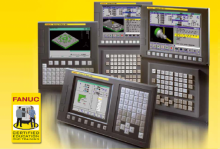 The FANUC CNC Certified Education Training program is an industry certification available to qualified high schools, community colleges, and universities. The program certifies instructors at educational institutions to train their students to program, set-up and operate CNC machine tools using FANUC’s control platform.
 -
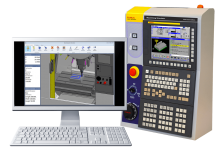 Item Number:D73F-0320-PB00Experience the cutting-edge in CNC machining simulation with FANUC's D73F-0320-PB00 simulator. Equipped with real kinematics, live machine movement, and advanced features like collision detection, immerse yourself in a true-to-life machining experience. Discover the power of virtual milling or lathe operations with our software-only version for seamless integration. Get ready to revolutionize your CNC training!
 -
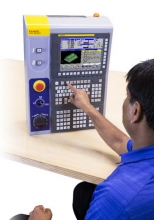 Item Number:A02B-0158-B100#USThe FANUC CNC simulator is a perfect addition to the classroom and an essential component to gain maximum exposure to FANUC CNC controls when actual machine time is limited.
 -
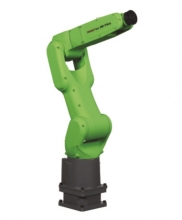 Item Number:CR-7iA/LAllows for a collaborative operation with human operators due to no need of safety fences, and enables to locate the robots close together in the manufacturing processes where operators also work, with using the compact size.
 -
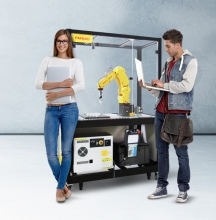 Item Number:FANUC ER-4iADesigned with students in mind, this all-in-one robotics-training bundle enables individuals to gain first-hand experience of programming and operating cutting-edge industrial robots. Package content is highly relevant for modern factory applications and contains everything instructors require to teach students to program and operate robots.
 -
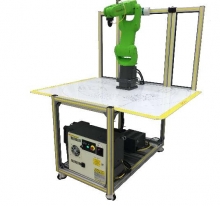 The FANUC Fenceless Collaborative Cert Cart was developed by combining FANUC DCS Position and Speed Check software with an Allen Bradley SafeZone Mini Safety Laser Scanner. The result is FANUC’s NEW FENCELESS CERT Cart, which still fits through a standard door and runs off 110V power. The FENCELESS cart allows a greater work envelope and introduces students to the latest integrated safety products from FANUC and Allen Bradley.