• Amatrol Quality Assurance Training | Measurement

Amatrol’s Measurement Tools 1 Learning System (950-MES1) teaches learners the fundamental principles of measurement, including basic and precision measurement and direct and indirect gauging. The concepts and skills covered in Amatrol’s in-depth curriculum are critical and used in every manufacturing plant in the world by inspectors, machinists, manufacturing engineers, and others to determine if parts meet quality standards. After all, the ability to produce quality products begins with determining whether a product meets specified dimensions.

Using Amatrol’s comprehensive multimedia curriculum, learners will study a variety of measurement topics, including: digital and dial calipers; dimensional gauging; statistical process control; control chart operation and analysis; geometric dimensioning and tolerancing; and location, orientation, and form tolerances. The measurement tools training system also includes industrial-quality components, such as a tabletop workstation, measurement tools like digital and dial calipers, variable length shafts and diameter disks, and more! The combination of robust curriculum with real-world equipment gives learners practical, hands-on experience with instruments they’ll encounter on the job.

  • Amatrol Measurement Tools 96-MES3

Amatrol's Measurement Tools 3 Learning System (96-MES3) teaches the high demand skills of conventional and geometric dimensioning and tolerancing, a key component of quality assurance. General Dimensioning & Tolerancing (GD&T) techniques are common practice offered by the 96-MES3 will provide learners with marketable skills. The 96-MES3 covers basic GD&T information and skills before focusing on three main areas: location tolerances, orientation tolerances, and form tolerances.

  • Amatrol Machine Tools Training 96-MP1

Amatrol's Machine Tools 1 Learning System (96-MP1) is a comprehensive resource that explores the uses and functionality of two essential manufacturing tools: the band saw and the drill press. Through this system, learners engage in safe practices for cutting raw materials precisely and creating various hole types, such as countersink, counterbore, reamed, and tapped, crucial for manufacturing applications. Understanding the applications and safe operation of the drill press and band saw is vital for anyone entering the workforce in manufacturing.

This learning system encompasses multimedia curriculum materials, an instructor's guide, installation guide, and a student reference guide. Schools have the option to use their own equipment or acquire Amatrol's Manual Machine Tool Package, which includes essential tools like a band saw, drill press, bench vise, and belt sander. These components, combined with the multimedia curriculum, cover essential topics like stock selection, band saw components, drill press tooling, and tapping and chamfering techniques. Developed as part of Amatrol's Project Based Learning initiative, this system not only imparts technical knowledge but also fosters problem-solving, teamwork, and STEM skills. It serves as a strong foundation for careers in engineering, manufacturing, and related fields or can function as a standalone educational tool.

  • Amatrol Machine Tools Trainer 96-MP2

Amatrol's Machine Tools 2 Learning System (96-MP2) begins by explaining how to use basic hand tools, like a hacksaw and a file, and then focusses on manual milling machine operation and its real-world applications. The milling machine is a flexible and widely-used piece of industrial equipment that is utilized extensively in machine shops and maintenance departments. This learning system requires Amatrol's Machine Tools 1 Learning System, a manual milling machine with tooling and raw materials.

  • Amatrol Machine Tools 3 96-MP3

Amatrol's Machine Tools 3 Learning System (96-MP3) focuses on the components, function and operation of the manual lathe. The lathe is a machine tool used for machining round parts and is found in almost all manufacturing facilities and machine shops. Machine Tools 3 requires the Machine Tools 1 Learning System (96-MP1), a computer, and a customer-supplied manual lathe.

  • Amatrol Mechanical Fabrication (96-MPF1)

Mechanical fabrication plays an important role in today’s economy as the cost to produce goods increases and the profit margins shrink. To stay competitive, companies must manufacture high quality goods. In our information based world, learners increasingly do not have knowledge or skills for mechanical fabrication. Amatrol’s Mechanical Fabrication 1 Learning System (96-MPF1) focuses on the safe application of basic hand tools used in assembly.

The Mechanical Fabrication training system includes real-world hand tools and associated components such as screwdrivers, wrenches, and sockets for hands-on skill-building. Learners will gain hand tools training and basic assembly skills training by practicing skills like: inspecting and installing a threaded fastener; using fixed, adjustable, Allen, and ratchet wrenches to tighten threaded fasteners; and installing pipe thread and straight thread pneumatic fittings. This hand tools training system also includes interactive multimedia curriculum, an instructor’s assessment guide, an installation guide, and a student reference guide. Amatrol combines equipment, strong print-based curriculum, and interactive multimedia so that learners can study and practice mechanical fabrication skills in the style that they need.

  • Technical Training for Agriculture

TECHNICAL TRAINING FOR AGRICULTURE

When it comes to industries, agriculture can stake its claim to being one of the oldest industries in the world with a history that stretches back over 12,000 years. What began with small groups of people in different parts of the world figuring out how to domesticate animals and grow their own food has become a multi-trillion-dollar industry that connects nations across the globe.

Sparked by a series of industrial revolutions, major changes have taken place throughout industry over the last couple of centuries. These same changes have shaped agriculture over the years. Manual processes and hand tools were replaced with machines. Technological advances, including computers and the Internet, have made agricultural machines and processes more productive and efficient.

As technology continues to advance, agriculture must keep evolving to ensure that productivity keeps pace with an ever-expanding world population. In fact, today’s agricultural experts need experience with more types of technology than ever before.

Today's agriculture experts need experience with more types of technology then ever before.

  • Amatrol Mechanical Fabrication 2 96-MPF2

Amatrol’s Mechanical Fabrication 2 Learning System (96-MPF2) adds to Mechanical Fabrication 1 to expand a learner’s knowledge of hand tools. This Mechanical Fabrication training system covers more sophisticated assembly training and components including fasteners, torque wrenches, power tools, and many more. This hand tools training system expands on basic hand tools used in assembly.

This basic hand tools training system includes a bench vise, torque wrench, cordless drill, dead blow hammer, needle nose pliers, and more. Learners use these real-world components to practice skills like using a vise to hold parts during assembly, performing an assembly task with pliers, and using a twisted safety wire to lock a nut. This assembly skills training system also includes interactive multimedia curriculum, an instructor’s assessment guide, an installation guide, and a student reference guide.

  • Amatrol Materials Engineering 96-MT1

Amatrol’s Materials Engineering training system (96-MT1) uses industrial quality components to teach students how to evaluate and use different industry grade materials. The 96-MT1 allows students to conduct a wide array of tests including tensile testing on steel alloys. Students learn industry-relevant skills in materials testing (tensile, compression, hardness, and shear), computerized data acquisition, chemistry of metals, interpretation of industry-standard numeric identification systems of various types of metals (steel, aluminum, brass, and copper), material strength analysis, and product design.

  • Plastic Injection Molding Training for High School

Amatrol’s 96-PLS1T Plastics Technology 1 Learning System is designed to teach modern technical skills in plastics and polymer science using injection molding training. Plastics are found in almost any industry in an astounding array of applications, including clothing, housing, autos, aircraft, packaging, energy, electronics, biomedical devices, and many more. They impact virtually every aspect of modern industry. Understanding how to work with plastics is an important technical skill for engineers, technicians, and operators.

Pages

  • FANUC CRX-5 Fenceless Cart
    FANUC CRX-5 Fenceless Cart – a collaborative robot solution with steel or aluminum cart options, integrated iRVision, and industry-leading safety features for flexible automation in education and industry.
  • FANUC’s NEW Fenceless Cart
    The NEW FANUC LR Mate 200iD/4S Fenceless CERT Cart was developed from combining FANUC DCS Position and Speed Check software with an Allen Bradley SafeZone Mini Safety Laser Scanner. The result is FANUC’s NEW Fenceless Cart that will still fit through a standard door and runs off 110V power. The Fenceless cart allows a greater work envelope and introduces students to the latest in integrated safety products from FANUC and Allen Bradley.
  • Geothermal Training Equipment
    Item Number:
    95-GEO3
    Amatrol’s Geothermal Flush Cart Learning System (95-GEO3) teaches how to purge debris and air from the geothermal loop and then charge it with a glycol/water solution
  • Geothermal Training Equipment
    Item Number:
    950-GEO1
    Amatrol’s 950-GEO1 Geothermal Energy Training System enables learners to understand and apply their newly obtained technician skills in the ever-growing area of geothermal energy.
  • Amatrol Geothermal Training Systems
    Item Number:
    950-GEO1D
    Amatrol’s 950-GEO1 Geothermal Energy Training System enables learners to understand and apply their newly obtained technician skills in the ever-growing area of geothermal energy.
  • Geothermal Troubleshooting Trainer
    Item Number:
    950-GEO2D
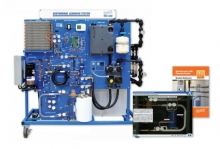
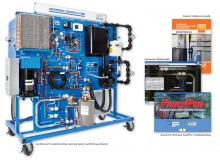
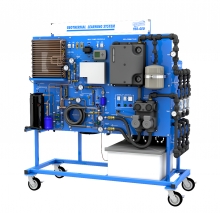
    Amatrol’s 950-GEO2D Geothermal Troubleshooting Learning System with Desuperheater uses an exposed component layout so that learners can see each component’s role in a geothermal system.
  • Amatrol HVAC/R Learning Systems
    Item Number:
    T7031
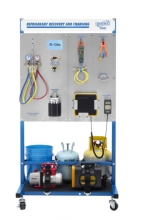
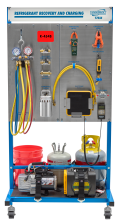
    With Amatrol’s Refrigerant Recovery and Charging Learning System for R-134a, you can train future HVAC/R technicians hands-on the critical technical skills required for a successful career. Students will work with real equipment, including a recovery machine, manifold gauges, submersible cooler, temperature probe, filter dryer, low side liquid charger, vacuum pump, and micron vacuum gauge.
  • HVAC/R Career & Technical Education Training Equipment
    Item Number:
    T7032
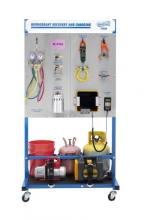
    Teach aspiring HVAC/R technicians the critical technical skills needed to succeed on the job with Amatrol’s Refrigerant Recovery and Charging Learning System for R-410a (T7032). Students will work with real equipment, including a recovery machine, manifold gauges, submersible cooler, temperature probe, filter dryer, liquid vaporizer, low side liquid charger, vacuum pump, and micron vacuum gauge.
  • Heat Pump Trainer
    Item Number:
    T7100
    Amatrol’s Residential Heat Pump Troubleshooting Learning System (T7100) is used to teach hands-on the critical skills HVAC/R technicians need to succeed when working with residential HVAC systems that use a heat pump and traditional ducting. Students will work with real equipment, including a heat pump condenser, heat pump air handler, Wi-Fi-enabled thermostat, fuse box, ducting, and manifold.
  • Amatrol HVAC/R Learning Systems
    Item Number:
    T7130
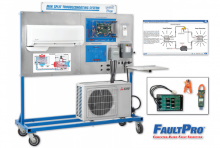
    With Amatrol’s Residential Mini-Split Heat Pump Learning System (T7130) you can teach the critical hands-on technical skills HVAC/R technicians need when working with residential ductless (“mini-split”) HVAC systems. Students will work with real equipment, including a heat pump condenser, evaporator unit, thermostat, panel-mounted gauges, and condensate pump.

Pages