Pignat’s OTP Pilots simulate full-scale industrial processes, giving students and professionals a realistic, high-fidelity environment to explore advanced chemical engineering operations. These systems replicate complex processes like controlled continuous distillation, CO₂ absorption and regeneration, and distillation control using industrial-grade components and instrumentation.

Designed for universities, pilot plants, and advanced workforce development centers, OTP Pilots emphasize safety, control systems, and operational efficiency. Learners gain experience with real process variables, troubleshooting, and scalable process optimization—preparing them for roles in chemical manufacturing, environmental engineering, and process design.

Absorption processes are critical in gas-liquid operations where a component from a gas phase is transferred into a liquid solvent. Commonly used in environmental control (e.g., CO₂ capture) and chemical production, these systems help study parameters such as gas solubility, contact efficiency, and column dynamics. Educational units like Pignat’s ABS/100 and ABS/2000 provide hands-on training in both manual and automated gas absorption processes, reinforcing understanding through transparent components and real-time instrumentation.

Adsorption is a surface-based separation technique in which molecules from a fluid phase adhere to a solid surface, often used for purification, drying, and environmental applications. With units like ADM/2000 and ADS/2000, learners can explore gas-solid and liquid-solid adsorption in lab and pilot scales. These systems support detailed study of breakthrough curves, isotherms, and regeneration cycles, making them ideal for chemical engineering and process technology programs.

Crystallization is a key method for purifying solid compounds from liquids and is widely used in pharmaceuticals, food processing, and chemical manufacturing. Pignat’s CRA/100 and CRA/200 systems enable the study of both batch and continuous crystallization. These units support investigation into cooling and evaporation methods, crystal size distribution, and process optimization—ideal for demonstrating real-world industrial separation techniques in an academic setting.

Distillation is a fundamental separation technique that exploits differences in boiling points to purify or fractionate chemical mixtures. Pignat’s product line ranges from lab-scale DVI/100 and DVI/300 mini units to advanced pilot-scale DVI/6000 systems. These solutions cover essential concepts like mass and energy balances, reflux ratios, thermosiphon reboilers, and differential pressure monitoring, preparing students and professionals for real-world industrial distillation operations.

An ebulliometer is used to determine the boiling point of liquids and study vapor-liquid equilibrium, a core topic in thermodynamics. Pignat’s EEA/1000 and EEA/2000 ebulliometers allow for both manual and automated experiments, supporting instruction in azeotrope formation, Raoult’s Law, and boiling point elevation. These compact units serve as vital tools in chemical engineering labs focusing on phase equilibrium and fluid properties.

Liquid-liquid extraction is a separation method used to isolate compounds based on solubility differences in two immiscible liquids. Pignat’s ELA/100 and ELA/3000 stirred extraction units, along with the ELM/2000 mixer-settler system, allow learners to explore batch and continuous extraction processes. These systems are ideal for studying partition coefficients, emulsion formation, and separation efficiency in pharmaceutical, food, and chemical industries.

Evaporation is essential for concentrating solutions by removing solvents, typically water, through thermal energy. Pignat offers both simple (EVV/100) and multiple-effect (EVV/1000, EVV/2000) evaporators to demonstrate core concepts like heat transfer, boiling point elevation, and energy savings through effect cascading. These units are ideal for exploring process efficiencies and the design considerations found in food processing and chemical production.

Filtration is a solid-liquid separation process that is foundational in industries such as pharmaceuticals, water treatment, and chemical manufacturing. Pignat’s FSP/3000, FIL/2000, and FIP/2000 units offer varied filtration methods and study parameters such as flow rate, cake resistance, and filter media selection. These systems enhance student comprehension of industrial-scale separation challenges while maintaining hands-on laboratory relevance.

Chemical reaction systems provide students with practical experience in kinetics, reactor design, and process control. Pignat’s REA/2000 and REA/3000 reactors offer both basic and computerized training platforms to investigate isothermal and non-isothermal reactions. These units are designed to demonstrate fundamental reaction engineering principles, including residence time distribution, catalyst behavior, and heat effects, preparing learners for diverse applications in chemical and pharmaceutical industries.

Pages

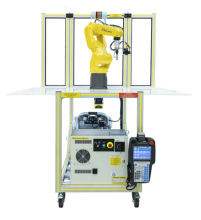
  • FANUC CERT Cart - LR MATE 200iD
    A large working envelope with a reach of 717 mm, and a payload of 7 kg, combine to provide solutions for high productivity handling and assembly applications.
  • Fanuc Robotics Cert Program
    With FANUC Robotics’ CERT Program, new courses and project based activities prepare students for a workplace that will be increasing in robotic automation. The Fanuc Robotics Education Training Cart incorporates the compact M-1+A robot housed in a self contained, mobile enclosure. The lightweight parallel-link M-1+A robot is designed for small part handling, high speed picking and assembly applications.
  • FANUC America now offers Certified Education Robot Training (CERT) to qualifying High Schools, Community Colleges, and Universities. With FANUC America's educational robots, students can learn to utilize the latest automation technology while applying Science, Technology, Engineering, and Math. Industrial robotics training in the classroom can safely be achieved through the CERT program. FANUC America provides the necessary training to the instructor as well as a curriculum to introduce students to robot applications.
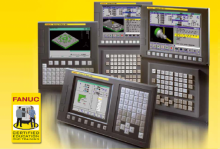
  • CNC Certified Education Training
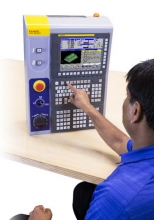
    The FANUC CNC Certified Education Training program is an industry certification available to qualified high schools, community colleges, and universities. The program certifies instructors at educational institutions to train their students to program, set-up and operate CNC machine tools using FANUC’s control platform.
  • Master CNC Techniques with Cutting-Edge Simulation
    Item Number:
    D73F-0320-PB00
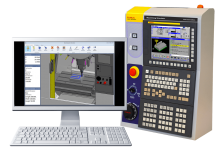
    Experience the cutting-edge in CNC machining simulation with FANUC's D73F-0320-PB00 simulator. Equipped with real kinematics, live machine movement, and advanced features like collision detection, immerse yourself in a true-to-life machining experience. Discover the power of virtual milling or lathe operations with our software-only version for seamless integration. Get ready to revolutionize your CNC training!
  • Part number AEX-6263-0300
    Item Number:
    A02B-0158-B100#US
    The FANUC CNC simulator is a perfect addition to the classroom and an essential component to gain maximum exposure to FANUC CNC controls when actual machine time is limited.
  • FANUC CR-7iA/L Collaborative Robot
    Item Number:
    CR-7iA/L
    Allows for a collaborative operation with human operators due to no need of safety fences, and enables to locate the robots close together in the manufacturing processes where operators also work, with using the compact size.
  • Robots Educational Package
    Item Number:
    FANUC ER-4iA
    Designed with students in mind, this all-in-one robotics-training bundle enables individuals to gain first-hand experience of programming and operating cutting-edge industrial robots. Package content is highly relevant for modern factory applications and contains everything instructors require to teach students to program and operate robots.
  • FANUC CR-4iA Collaborative Robot
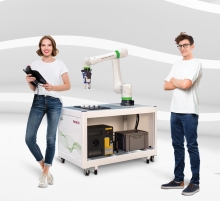
    The FANUC Fenceless Collaborative Cert Cart was developed by combining FANUC DCS Position and Speed Check software with an Allen Bradley SafeZone Mini Safety Laser Scanner. The result is FANUC’s NEW FENCELESS CERT Cart, which still fits through a standard door and runs off 110V power. The FENCELESS cart allows a greater work envelope and introduces students to the latest integrated safety products from FANUC and Allen Bradley.
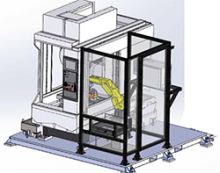
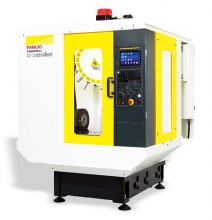
  • Fanuc ROBODRILL Education Packages
    Students trained on ROBODRILL products will be more productive. Excellent repeatability makes the ROBODRILL suited for milling, drilling, tapping, and boring with flexibility, versatility, and reliability. Specific ROBO DRILL education packages have been configured for the needs of educational institutes teaching 3-axis and 5-axis machining, robotic machine tending, and Connected Smart Manufacturing (CSM).

Pages