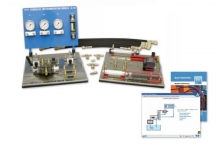
Each Basic Hydraulics training system features standard industrial grade components. This attention to quality gives students experience they would normally only get on-the-job by helping them recognize industrial components and how to troubleshoot them more effectively. Components included with Basic Hydraulics are pre-mounted on circuit panels with silk-screened labels next to each, which facilitates ease of use and identification.
CM Labs' Motor Grader Simulator is the only solution that allows operators to fully manipulate the blade by changing the angle, tilt, and height during operations. It allows trainees to learn advanced grading skills for maximum precision.
CM Labs' Concrete Pump Training Pack is a unique training solution that accurately simulates the backlash of the boom and hose whip when the remote control box is mishandled. This allows operators to develop the right techniques when controlling the machine, resulting in a safer and more precise pour.
CM Labs' Backhoe Simulator Training Pack is the only solution on the market that realistically simulates a backhoe’s backlash and instability when stopping a full-speed swing.
Boom deflection can have dramatic consequences during heavy lifts. When not handled properly, the load will swing, jeopardizing the worksite's safety.
CM Labs; Crawler Crane Simulator Training Pack is the only solution that realistically simulates boom deflection and cable behavior during heavy lifts. It allows operators to develop advanced lifting skills that transfer to the actual machine in a safe environment.
CM Labs' Mobile Crane Simulator Training Pack is the only solution with the possibility of tipping during heavy lifts. This allows operators to train in a challenging environment where they can explore the capacity and limits of the mobile crane and safely experience potentially life-altering scenarios in the real world.
Tidying trenches is about more than looking good. It's critical that your simulator be able to teach trainees this skill to mitigate the risk of trench cave-in, which results in stoppages and a substantial risk of personnel injury and fatalities.
Using the most advanced soil simulation, CM Labs' Excavator Simulator Training Pack lets operators practice advanced skills, such as cleaning trenches or leveling.
Experienced dozer operators are skilled at leveling surfaces through finely spreading materials. Trainees who do not learn this skill using simulation-based training can slow work down when they get to the job site.
CM Labs' Dozer Simulator Training Pack is the only solution on the market that teaches complex leveling and grading techniques thanks to the most advanced earthmoving simulation that captures blade/dirt interactions within one inch of precision.
DAC Worldwide’s Transformer Connections Training System (491-000) teaches the essential skills that a utility worker must master to confidently operate modern generating equipment, such as the paralleling of generators and connecting to a larger power grid. The system replicates utility workers' conditions and circumstances when making common transformer connections in the field.
For example, learners can practice ground, primary, and secondary connections easily using banana jacks. Three-phase and single-phase applications are provided, and a 208 VAC, 3-phase source is stepped down to a 41 VAC, 3-phase system for safety.
Users will find that the Transformer Connections Training System provides a safe, efficient, realistic alternative to a full-voltage field experience. Standard accessories include patch cords, fourteen (14) transformers, a panel-mounted voltmeter, and phase rotation meter.
lndustry 4.0 and other new technologies are helping industry advance at a rapidly, creating a massive growth in the need for individuals with technical skills. The modern versions of technical occupations, such as technicians, technologists, engineers, and operators, all require individuals with technical depth and breadth and the ability to problem-solve and optimize systems.
To address this demand, the
The Amatrol Learning System
- Hands-On Workstations With Industrial Quality Equipment
- Task-Based Hands-On Exercises
- Interactive Multimedia Curriculum With Virtual Simulation
- Computerized Assessments With Pre- And Post-Testing
- Instructor Guides
- Instructor Training Courses
- Instructor Support Services
The elements of the Amatrol Learning System have been designed to work seamlessly with each other. The multimedia lessons directly apply to the hands-on skill exercises, and the computerized assessments directly tie to the objectives of the multimedia lessons. This makes it easy for instructors to implement even if they are new to the technology or teaching.
Located in the heart of the world's refining and chemical processing center, Bayport Technical has a fully-equipped research and manufacturing center that produces industry-relevant learning resources used worldwide.
Hands-On Learning Systems
Bayport Technical produces various hands-on learning resources to prepare individuals for real-world careers The training resources include Electro-Mechanical Maintenance, Fluids, Heat Transfer, Instrumentation and Proces Control, Oil and Gas, and Unit Operations.
- Working Demonstrators offer learners realistic, first-hand visualization into the inner workings of industrial components and systems.
- Cutaways allow students to see and identify a component’s internal features. They may be taken apart and reassembled for further skill development.
- Models: detailed, to-scale training aids that depict various industrial machines based on common equipment by industry leaders.
- Basic & Advanced Trainers: hands-on systems designed to give students real-world experience working on full-sized, industrial components they will encounter on the job.
Custom Work: Can’t find exactly what you need? Let us help! Bayport Technical offers customized services to produce unique, one-of-a-kind learning devices.
Pages
-
 Item Number:BH-85
 -
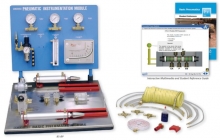 Item Number:85-BPAmatrol’s Basic Pneumatics training system (85-BP) introduces pneumatic principles through a combination of Amatrol’s top-flight multimedia curriculum with hands-on industrial pneumatic skill-building. Topics covered in this learning system include single-acting cylinder circuits, pressure vs. cylinder force, and flow control valves, while the panels can be used to practice skills such as connecting and operating a needle valve to control actuator speed.
 -
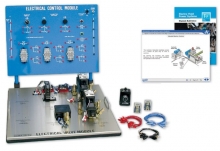 Item Number:85-EHThe Electro-Hydraulics training system includes an electrical control panel with relay control components and an electrical valve module with solenoid-operated hydraulic directional control valves and electrical/electronic sensors. These components will be used to study a variety of topics including electrical control systems, basic control devices, power devices, control relays, sequencing control, timer control, pressure control applications, and circuit applications.
 -
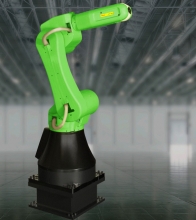 Item Number:CR-35iAFANUC’s new CR-35iA is the world’s first collaborative robot with a payload capacity of up to 35 kg. Fenceless, it opens a whole new world of possibilities. Working safely side by side with human operators, it is space as well as cost saving. And because inside it’s like any other FANUC robot, it operates like all FANUC robots. Certified to meet the requirements of ISO 10218-1:2011 and RIA/ANSI R15.06-2012, FANUC’s CR-35iA collaborative robot can work in a variety of applications alongside human workers including: machine tending, handling heavy payloads that require lift assist devices or custom equipment, higher payload mechanical assembly, palletizing or packing, and tote or carton handling.
 -
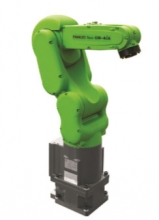 Item Number:CR-4iACR-4iA is a small collaborative robot with 4 kg payload
 -
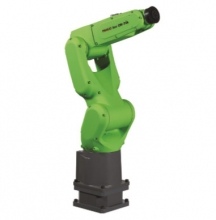 Item Number:CR-7iAThe FANUC CR-7iA is FANUC's newest collaborative robot resembles the LR Mate family. Painted green to show it's ability to work beside humans, you can expect the same reliability as FANUC's yellow robots. The CR-7iA is ideal for small part sorting and assembly, inspection, machine tending, and part delivery. It has a 7 kg payload, 717 mm reach, and is equipped with iRVision and Force Sensing. There are a variety of mounting options such as floor, wall, and ceiling.
 -
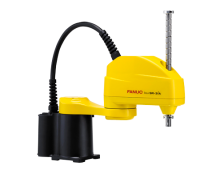 FANUC’s new SCARA robots are ideal for high-speed, precision applications such as assembly, pick and place, testing/inspection and packaging processes.
 -
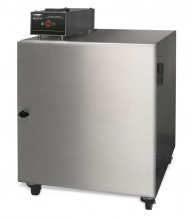
In the rare event that a burning ember or spark is drawn into the fume extraction unit, there is the possibility that debris in the filters could ignite. Although any resultant fire would typically be retained within the fume extraction unit, this would cause significant damage and in extreme circumstances, the risk may extend beyond the extraction unit. For processes where such risks have been identified, additional protection in the form of an in-line firebox is an additional precaution.
-
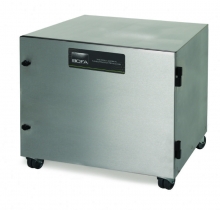
The BOFA inline pre-filter 1000 has been designed specifically for applications that generate high amounts of dust or particulate.
This inline filter unit is positioned alongside the main BOFA fume filtration system to increase the overall filter capacity and extend the life of the main filters. The DeepPleat DUO pre-filter incorporates a massive drop-out chamber within the filter, having a volume area of 15ltrs. Above the drop-out chamber but still within the housing there is a sealed 200mm deep pleat layer of F8 media giving a surface area in excess of 30 sq meters.
-
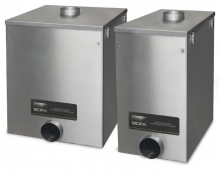 The BOFA inline prefilters have been designed specifically for applications that generate high amounts of dust or particulate.