



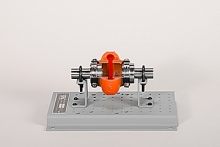
DAC Worldwide’s Urethane Tire Coupling Cutaway (200-2083) highlights a professionally-crafted, sectioned industrial shaft coupling. The full-size, fully-detailed example gives learners a first-hand view into a component that is found in various applications worldwide and supports both instructor-led training and student self-discovery.
Amatrol’s Mechanical Fabrication 2 Learning System (96-MPF2) adds to Mechanical Fabrication 1 to expand a learner’s knowledge of hand tools. This Mechanical Fabrication training system covers more sophisticated assembly training and components including fasteners, torque wrenches, power tools, and many more. This hand tools training system expands on basic hand tools used in assembly.
This basic hand tools training system includes a bench vise, torque wrench, cordless drill, dead blow hammer, needle nose pliers, and more. Learners use these real-world components to practice skills like using a vise to hold parts during assembly, performing an assembly task with pliers, and using a twisted safety wire to lock a nut. This assembly skills training system also includes interactive multimedia curriculum, an instructor’s assessment guide, an installation guide, and a student reference guide.
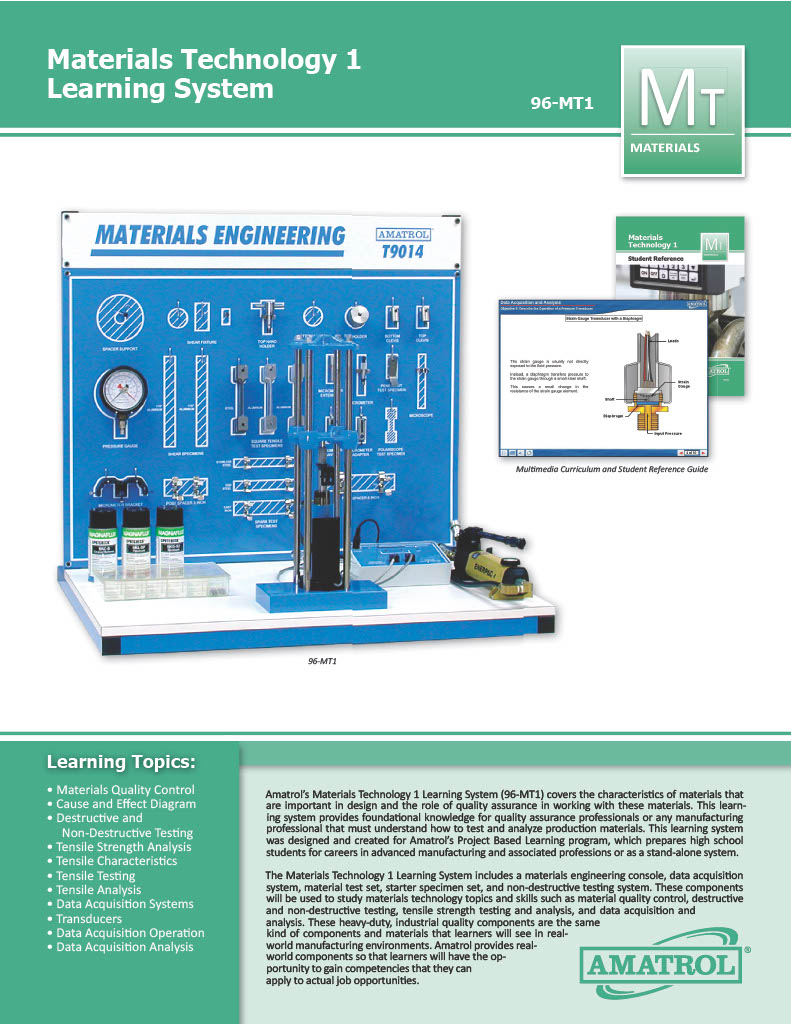
Amatrol’s Materials Engineering training system (96-MT1) uses industrial quality components to teach students how to evaluate and use different industry grade materials. The 96-MT1 allows students to conduct a wide array of tests including tensile testing on steel alloys. Students learn industry-relevant skills in materials testing (tensile, compression, hardness, and shear), computerized data acquisition, chemistry of metals, interpretation of industry-standard numeric identification systems of various types of metals (steel, aluminum, brass, and copper), material strength analysis, and product design.
Amatrol’s 96-PLS1T Plastics Technology 1 Learning System is designed to teach modern technical skills in plastics and polymer science using injection molding training. Plastics are found in almost any industry in an astounding array of applications, including clothing, housing, autos, aircraft, packaging, energy, electronics, biomedical devices, and many more. They impact virtually every aspect of modern industry. Understanding how to work with plastics is an important technical skill for engineers, technicians, and operators.
Amatrol’s high school pneumatics training system (96-PNE1) teaches learners how to operate and install basic pneumatic systems, analyze performance, and design basic pneumatic circuits. Pneumatic power is a foundation of industry used in applications across fields like agriculture, pharmaceuticals, automation, and many more!
The high school pneumatics training system includes a basic pneumatics panel, basic pneumatics instrumentation panel, and a pneumatic hose and fittings set. The system features industrial-quality components to prepare learners for what they will encounter on the job. Learners will use these components to study major topic areas, such as pneumatic power systems, basic pneumatic circuits, principles of pneumatic pressure and flow, and pneumatic speed control circuits. The system can also be expanded with Amatrol’s Pneumatics 2 Learning System to teach intermediate pneumatic knowledge and skills.
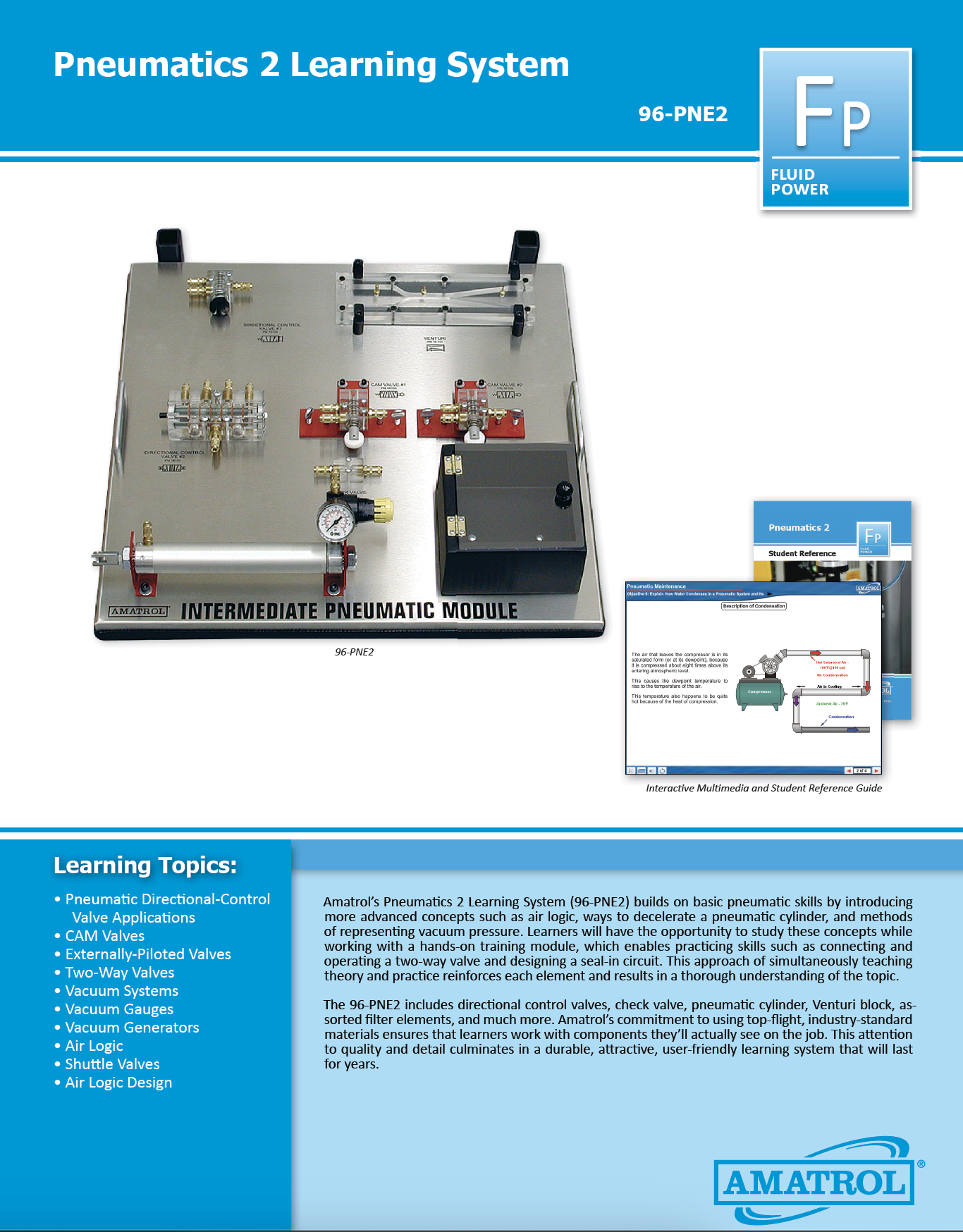
Amatrol’s Pneumatics 2 Learning System (96-PNE2) builds on basic pneumatic skills by introducing more advanced pneumatics training concepts, such as air logic, ways to decelerate a pneumatic cylinder, and how to connect and operate a vacuum generator. Learners will have the opportunity to study these concepts while working with a hands-on training module, which enables the practice of skills such as connecting and operating a two-way valve and designing a pneumatic circuit to control a reciprocating cylinder; this approach of simultaneously teaching theory and practice reinforces each element and results in a thorough understanding of the topic. This system requires Pneumatics 1, a computer, and a Hand Tool Package (41221).
Pneumatics 2 includes directional control valves, check valve, pneumatic cylinder, Venturi block, assorted filter elements, and much more. Amatrol’s commitment to using top-flight, industry-standard materials ensures that learners work with components they’ll actually see on the job. This attention to quality and detail culminates in a durable, attractive, user-friendly learning system that will last for years.
Print reading skills are essential for anyone directly involved in developing and manufacturing products. Engineers and designers communicate all the technical information required to make a product via prints. Manufacturing personnel must correctly interpret the prints to create the product. Technicians use prints to understand how to repair and troubleshoot machinery. Beginning with the basics, Amatrol’s 96-PR1 Print Reading 1 Learning System leads students to a thorough understanding of print reading techniques and skills.
The 96-PR1 is set up to accommodate either self-directed or traditional classroom formats. This learning system can be used by itself and is also a core system in Amatrol’s project-based learning program. The Print Reading 1 Learning System uses interactive computer- based instruction with both theory and hands-on tutorials consisting of text, digital video, voice, online self-review tests, interactive simulations, color diagrams and color photos. Student curriculum covers industry related skills in print reading, including use of different reference coordinates, creating and editing drawings, using technical drawing views and dimensions, multi-view drawings, and developing schematic diagrams.
Amatrol’s Robotics 1 Learning System (96-ROB1A) teaches articulated arm servo robotics and how it’s applied in industrial tasks like assembly, material handling, and inspection. This introductory robotics training system includes a 5-axis articulated servo robot arm with a 360-degree work envelope, mobile workstation, industrial controller, and state-of-the-art teach pendant. Using these real-world components, learners will be able to practice over 140 executable commands using the powerful MCL II programming language.
The system also includes in-depth multimedia curriculum covering the major topic areas of basic robot operation, programming, interfacing, and material handling. For example, learners will study: homing procedures for a servo robot; commands like grasp, release, and Pmove; and applications of robots in material handling. Amatrol’s combination of theoretical knowledge and hands-on practice allows learners to gain both conceptual and practical knowledge, broadening competency in robotic applications.
Amatrol's Robotics 1 and 2 Simulation Learning Systems (96-RSS1 and 96-RSS2) teaches the programming and operation of the Pegasus articulated servo robot. The Pegasus simulation software includes powerful 3D graphic simulation tool that reproduce the Pegasus and workcells in realistic 3D images with dynamic characteristics similar to actual operation. Learners can see four different views of workspace simultaneously. Solids modeling technology provides a realistic view of program results, including collision detection.
Intro to Civil Engineering
Amatrol’s Structural Engineering 1 Learning System (96-SE1) introduces high school students to the field of civil engineering. Civil engineers are responsible for creating structures such as skyscrapers, bridges, tunnels, dams, mass transit systems, water treatment facilities, and many more structures that we use every day for living, transportation, and industry. Learners will learn the fundamentals of structural analysis as well as bridge design and construction.
The structural engineering training system includes the T9004 Structural Testing Systems consisting of a workstation, bridge component sets, a test fixture set, indicator package, bridge designer software, supplemental CD, and interactive multimedia student curriculum. These components are used to teach topics such as civil engineering careers, structural stability, force vectors, and bridge design.
Intermediate Structural Engineering Training System for High School
Amatrol’s Structural Engineering 2 Learning System (96-SE2) adds to the Structural Engineering 1 Learning System (96-SE1) to teach statics, data acquisition, and bridge design analysis. The data acquisition system uses structural members equipped with stain gauges to measure the forces acting on a structure, constructed by the learners, and the system records these values to provide a clear picture of how the structure is reacting to the applied force. Through calculations and data acquisition analysis, intermediate structural engineering learners will analyze the forces in truss bridge designs.
The intermediate structural engineering training system includes a data acquisition system, bridge components fitted with strain gauges, a test fixture hardware package, and interactive multimedia student curriculum. The learning content covers topics such as bending stress and the moment of inertia, data acquisition, and truss bridge analysis.
Pages
-
 Item Number:200-2083
 -
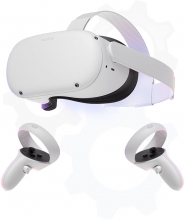 Every individual should be trained with hands-on skills for basic workplace safety. With our Enterprise Safety package, you get seven modules that allow learners to put safety training into practice in a safe, virtual environment. The training modules include Confined Space, LOTO, Fall Protection, AED, CPR, Fire Suppression, and Virus Vision.
 -
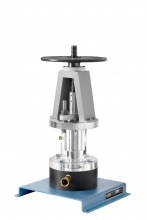 Item Number:250-000DAC Worldwide’s Valve Packing Training System (250-000) is a detailed replica of a six-inch gate valve, equipped with a backseat, which facilitates the proper removal and installation of packing.
 -
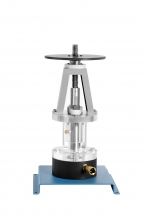 Item Number:250-PACIndustrial maintenance technicians must be familiar with a wide variety of valves used throughout many different types of industries. A common task technicians encounter on the job is replacing valve packing to prevent valves from leaking.
 -
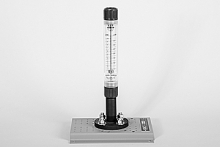 Item Number:272-718DAC Worldwide's Dissectible Variable Area Flow Meter (272-718) (rotameter) allows for close visual inspection of a common PVC and acrylic liquid flow meter to better understand its function, design characteristics, operation, and possible maintenance.
 -
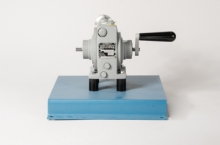 Item Number:205-290DAC Worldwide's Variable Speed Gear Reducer Cutaway is a sectioned variable speed industrial gear reducer. Speed variations allow for continuous variable-ratio speed adjustment of mechanical systems are still regularly encountered in industrial applications due to their durability, dependability, and consistency of operation.
 -
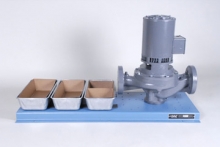 Item Number:275-128DDAC Worldwide’s Vertical Centrifugal Pump Dissectible (275-128D) is an actual industrial centrifugal pump assembly that allows for realistic training in the field or bench-top disassembly, inspection, and reassembly of a vertical centrifugal pump.
 -
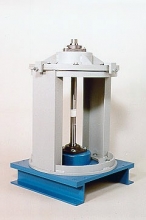 Item Number:207-000DAC Worldwide’s Vertical Coupling/Shaft Alignment Training System (207-000) is a heavy-duty, precision learning system that allows for convenient, realistic training in shaft alignment. When paired with a variety of hands-on exercises, the system creates a complete performance-based course in the maintenance of shaft alignment.
 -
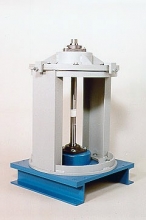 Item Number:207-PACDAC Worldwide’s Vertical Coupling/Shaft Alignment Training System Plus (207-PAC) is a heavy-duty, precision learning package that allows for convenient, realistic training in shaft alignment. When paired with a variety of hands-on exercises, the training system creates a complete performance-based course in the maintenance of shaft alignment.
 -
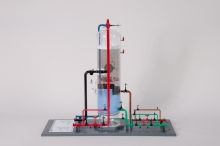 Item Number:295-115DAC Worldwide's Vertical Cross-Flow Separator Model (209) is a highly-detailed scale model of a common vertical cross-flow separator used throughout the oil and gas industry, as well as other processing, production, and refining applications.