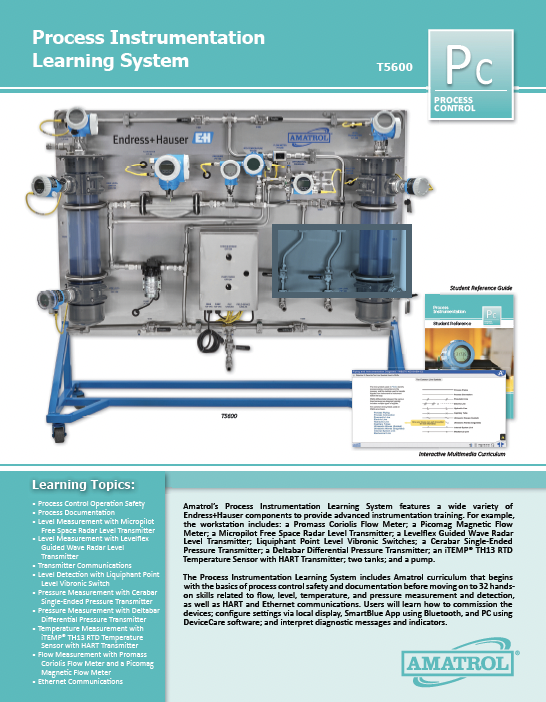
Download the brochure for Amatrol’s Process Instrumentation Learning System (T5600) and explore a hands-on training solution designed to build real-world skills in modern process control and instrumentation.
This learning system features a wide variety of Endress+Hauser instrumentation components, including flow meters, radar level transmitters, pressure transmitters, point level switches, and an RTD temperature sensor with HART transmitter. Learners can develop practical experience with core process measurement applications involving flow, level, pressure, and temperature.
The included multimedia curriculum begins with the fundamentals of process control, safety, and documentation before progressing into 32 hands-on skills. Students also learn transmitter communications, device commissioning, configuration through local display and software tools, and diagnostic interpretation using HART and Ethernet communications.
What You’ll Find in the Brochure
- Overview of the T5600 Process Instrumentation Learning System
- Featured Endress+Hauser instrumentation components
- Learning topics covering safety, documentation, and measurement applications
- Details on HART and Ethernet communications training
- Information about the included multimedia curriculum and hands-on skill development
Key Training Areas
- Process control operation safety
- Process documentation
- Level measurement and detection
- Pressure measurement
- Temperature measurement
- Flow measurement
- Transmitter communications
- Ethernet communications
Watch the Amatrol T5600 Process Instrumentation Learning System video to see how this advanced training system helps learners build practical skills in process control, instrumentation, and transmitter communications. Developed through a partnership between Amatrol and Endress+Hauser, this system is designed for hands-on training in calibration, commissioning, and diagnostics using industry-relevant instrumentation components.
In the video, viewers get an overview of the trainer’s measurement and detection capabilities across flow, level, pressure, and temperature, as well as its role in teaching calibration, commissioning, and diagnostic procedures. The system is also built for durability, with heavy-duty features such as stainless steel mounting panels and tubing, Swagelok compression fittings, NPT-threaded connections, anti-vibration mounting, and plastic sight tubes.
- An overview of the T5600 Process Instrumentation Learning System
- Featured Endress+Hauser transmitters and measurement devices
- How learners practice calibration, commissioning, and diagnostics
- Training applications for flow, level, pressure, and temperature measurement
- Examples of transmitter communication using HART, Bluetooth, and Ethernet
- How the system supports engineering, electrical, process control, and industrial training programs
- Promass Coriolis Flow Meter
- Picomag Magnetic Flow Meter
- Micropilot Free Space Radar Level Transmitter
- Levelflex Guided Wave Radar Level Transmitter
- Liquiphant Point Level Vibronic Switches
- Cerabar Single-Ended Pressure Transmitter
- Deltabar Differential Pressure Transmitter
- iTEMP® TH13 RTD Temperature Sensor with HART Transmitter
- Process control safety and documentation
- Flow measurement and detection
- Level measurement and point level detection
- Pressure measurement
- Temperature measurement
- Calibration and commissioning procedures
- Device diagnostics and troubleshooting
- Transmitter communication via HART, Bluetooth, and Ethernet
Learners can configure settings directly on the device, through Endress+Hauser’s SmartBlue application, or on a PC with DeviceCare software. This makes the T5600 a strong fit for programs preparing students and technicians for work in process control, instrumentation, and industrial maintenance environments.
Driver Training Solutions’ Sanitation Simulator provides immersive, scenario-based training designed specifically for waste collection and sanitation fleet operators. Trainees can safely develop critical skills such as route navigation, vehicle handling, stop-and-go operations, backing, tight turns, and hazard awareness—all within a controlled virtual environment.
By removing the risks, costs, and wear associated with on-road training, organizations can deliver consistent, repeatable instruction while protecting both equipment and personnel. The simulator allows drivers to build confidence and competence before ever operating a real vehicle.
Ideal for municipalities, private waste contractors, and fleet training academies, this solution supports safer operations, reduces accident rates, and improves overall efficiency across a wide range of waste management applications.
Experience how the Voyage™ Arc Virtual Reality Headset introduces students to welding in a way that is engaging, interactive, and approachable. This demo highlights how virtual reality can spark interest in skilled trades while providing a strong foundation for career exploration.
Designed for classrooms, CTE programs, and workforce development initiatives, Voyage™ Arc delivers a safe, immersive environment where students can explore welding concepts before entering a lab setting.
What You’ll See in This Demo
- Immersive virtual environment designed to capture student attention
- Interactive introduction to welding fundamentals and processes
- Simple, classroom-ready VR setup with no internet required
- Safe, controlled training experience with no consumables
- How students explore welding careers through guided activities
Why Use VR for Welding Training?
Virtual reality lowers the barrier to entry for welding programs by removing safety concerns, reducing equipment limitations, and creating an inviting first experience for students. It helps build confidence and awareness before transitioning into hands-on training.
This approach is especially effective for program recruitment, introductory courses, and expanding access to skilled trades pathways.
Designed for Education and Workforce Training
The Voyage™ Arc system is a fully self-contained solution that can be easily integrated into existing curriculum or used as a stand-alone career exploration tool. Educators can quickly deploy the system and use it to enhance engagement across a variety of learning environments.
Ideal Applications
- K-12 and secondary career exploration programs
- CTE welding and manufacturing pathways
- Open houses, recruitment events, and demonstrations
- Workforce development and training centers

Explore how virtual reality is transforming welding education with the Voyage™ Arc VR Headset from Lincoln Electric.
This downloadable brochure provides a detailed overview of the Voyage™ Arc system, including features, classroom benefits, and technical specifications. Designed as a career exploration tool, the system introduces students to welding fundamentals through an immersive virtual environment.
As highlighted in the brochure, students are placed in an interactive setting where they complete welding-based tasks using processes like GMAW and SMAW—helping build awareness and interest in skilled trades careers.
Download the brochure to see how VR can enhance engagement, support CTE programs, and create a strong entry point into welding pathways.
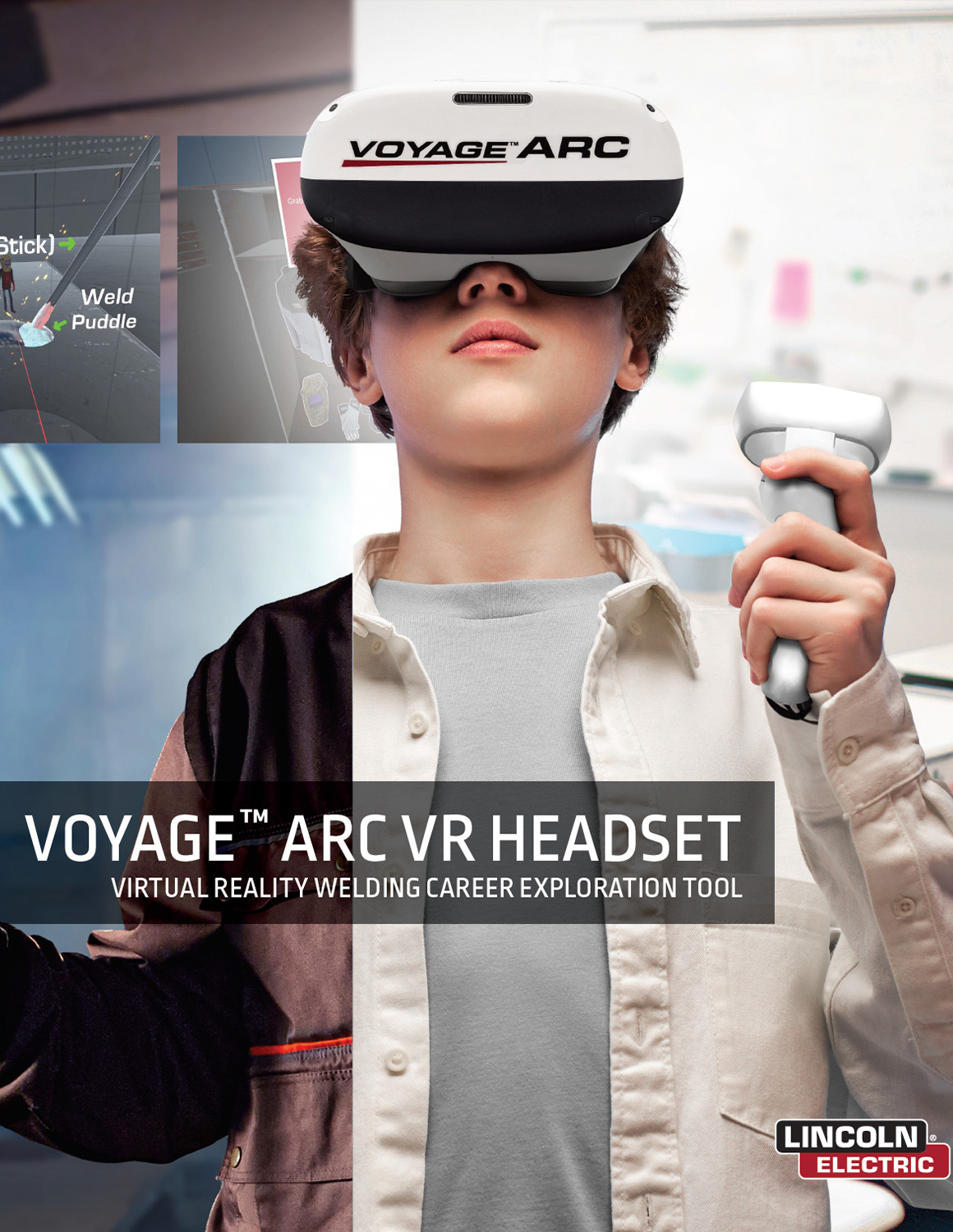
Download the Voyage™ Arc Virtual Reality Welding Career Exploration brochure to discover how immersive technology is transforming welding education. This innovative solution introduces students to welding fundamentals through an engaging, interactive virtual experience.
Designed to capture the attention of today’s tech-savvy learners, Voyage™ Arc provides a unique entry point into skilled trades by combining career exploration with hands-on virtual learning.
What You’ll Learn
- How VR introduces welding fundamentals in a safe, engaging environment
- Interactive lessons covering GMAW (MIG) and SMAW (Stick) processes
- How students explore real-world welding applications through guided scenarios
- Classroom benefits including easy implementation and student progress tracking
- Technical specifications, system components, and bundle options
Immersive Learning That Sparks Interest
The Voyage™ Arc experience places students in a virtual amusement park where they complete welding tasks and learn key concepts through guided, self-paced lessons. This approach helps students understand welding applications while building confidence and interest in the field.
As outlined in the brochure, students progress through bite-sized learning modules, practice welding techniques, and apply their skills in realistic scenarios—making it an effective tool for career exploration and program recruitment.
Designed for the Modern Classroom
The Lincoln Electric Voyage™ Arc is a stand-alone, classroom-ready solution that requires minimal setup and no internet connection. Educators can easily integrate the system into existing curriculum or use it as a foundation for new career exploration programs.
The system also supports classroom-wide deployment with optional LAN connectivity, allowing instructors to monitor student progress, track performance metrics, and enhance learning outcomes.
Build a Pathway into Welding Careers
Voyage™ Arc represents the first step in a complete welding education pathway—introducing students to the trade before advancing to simulation and hands-on lab training. This progression helps programs improve engagement, retention, and overall student success.
Ready to bring VR welding training to your program? Contact us to schedule a demo or discuss how Voyage™ Arc can support your CTE or workforce development initiatives.
Designed with education in mind, these 3D printing solutions support quick adoption in classrooms and labs through intuitive setup, guided workflows, and minimal technical barriers. Students can move from concept to physical part with confidence, allowing more time to focus on design thinking, iteration, and problem-solving.
A fully connected ecosystem of hardware, materials, and cloud-based software enables instructors to manage multiple devices and student projects efficiently. This streamlined approach is especially valuable in environments where scalability, ease of management, and consistent results are critical.
Reliable performance and repeatable output help ensure successful prints across a wide range of applications, from introductory STEM activities to more advanced engineering and prototyping projects. Built-in safeguards and user-friendly interfaces support safe operation while maintaining a strong emphasis on hands-on learning.
This approach aligns well with K-12, early college, and workforce training programs seeking to introduce additive manufacturing in a way that is accessible, structured, and easy to integrate into existing curriculum pathways.
See how a dedicated STEM center is expanding access to hands-on learning through 3D printing, mentorship, and shared resources. Students from multiple schools are gaining real experience designing, prototyping, and testing their ideas—using industry-relevant equipment in an environment built for exploration and growth.
This video highlights how quickly learners can get started, build confidence through iteration, and develop skills aligned with today’s technical education and workforce pathways. With accessible tools, certification opportunities, and mentor support, programs like this help improve engagement and create meaningful, career-connected learning experiences.
Watch to see how this scalable model supports goals around equity, access, and workforce readiness—and how similar approaches can be implemented to strengthen STEM programs and expand opportunities for your students.

Matrix TSL engineering education systems are designed to bridge the gap between theory and real-world application by giving students hands-on experience with core engineering principles. Developed by Matrix TSL, these compact, lab-ready solutions support universities, community colleges, and advanced STEM programs with equipment and curriculum that align directly with industry expectations. From mechanical and structural analysis to fluid dynamics and advanced manufacturing, each system is built to reinforce critical concepts through experimentation, measurement, and applied learning.
Unlike traditional lecture-based instruction, Matrix systems emphasize active engagement—allowing learners to visualize, test, and analyze engineering concepts in a controlled environment. Integrated data acquisition, structured experiments, and instructor resources make it easy to deliver consistent, outcomes-focused training while supporting a wide range of teaching styles. Whether introducing foundational concepts or advancing into specialized applications, these systems help students develop the problem-solving skills and technical confidence required for today’s engineering careers.
By combining scalable hardware with guided curriculum, Matrix TSL solutions enable institutions to modernize their labs without overcomplicating setup or delivery. The result is a flexible, future-ready learning environment where students gain practical experience that directly translates to the workplace—preparing them for careers in engineering, manufacturing, and technology-driven industries.