Intellia Instructor

Simulation Training Management
Maximize simulation training efficiency with Intellia Instructor by CM Labs. Streamline instruction, track trainee progress, and enable self-paced learning from any device.



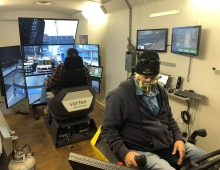
With the advent of remote operations technology and terminal automation, ports need new ways to train both experienced and new operators ahead of new equipment deployment. CM Labs’ Remote Operating Station gives trainees the unique opportunity to experience realistic remote operations and the control room environment prior to equipment commissioning, or while the real equipment is being used for production. The Remote Operating Station (ROS), developed in collaboration with German manufacturer Spohn + Burkhard, provides an ergonomic, convenient setup for remote simulation training.
The ROS is delivered as a fully functional operating desk with controls and a full multi-screen layout. It is part of a system that simulates all remote equipment functions, camera displays, and automated safety functions for a full training experience that translates directly to real work environments..
Designed for versatility, the Remote Operating Station (ROS) easily accommodates a wide range of remotely operated equipment..
The touchscreen makes it easy for the student to log in and switch between training exercises. It also acts as the equipment computer interface, including auxiliary controls and the operator’s dashboard..
The Remote Operating Station has been built with durability in mind. CM Labs collaborated with Spohn + Burkhardt for the development of the ROS, given its many years of experience as a high-quality equipment control system manufacturer supplying the ports industry. The ROS is expected to last and meet the demands of a busy training organization.
The ROS is fully compatible with ROS Intellia Training Packs and Intellia Instructor. With Intellia Instructor, trainers can instantly access key metrics, performance indicators, and progress reports—enabling fast, objective evaluations of operator skills. Meanwhile, ROS Intellia Training Packs offer the most realistic remote equipment simulations on the market.
Together, these tools form a powerful Intelligent Training System that delivers advanced performance tracking, unmatched realism, and rugged hardware built to last.
As container terminals turn to remote operations to boost safety and productivity, simulation is becoming a vital part of the training loop. By integrating it early into the training process, ports can reduce operator errors, minimize incidents, and proactively address workflow issues—keeping operations efficient and high-performing.