Mastrex MX-300 Metal 3D Printer
Large-Build Dual-Laser Metal 3D Printing
Explore the Mastrex MX-300 large-build dual-laser LPBF metal 3D printer for production-focused education, applied research, and workforce training.

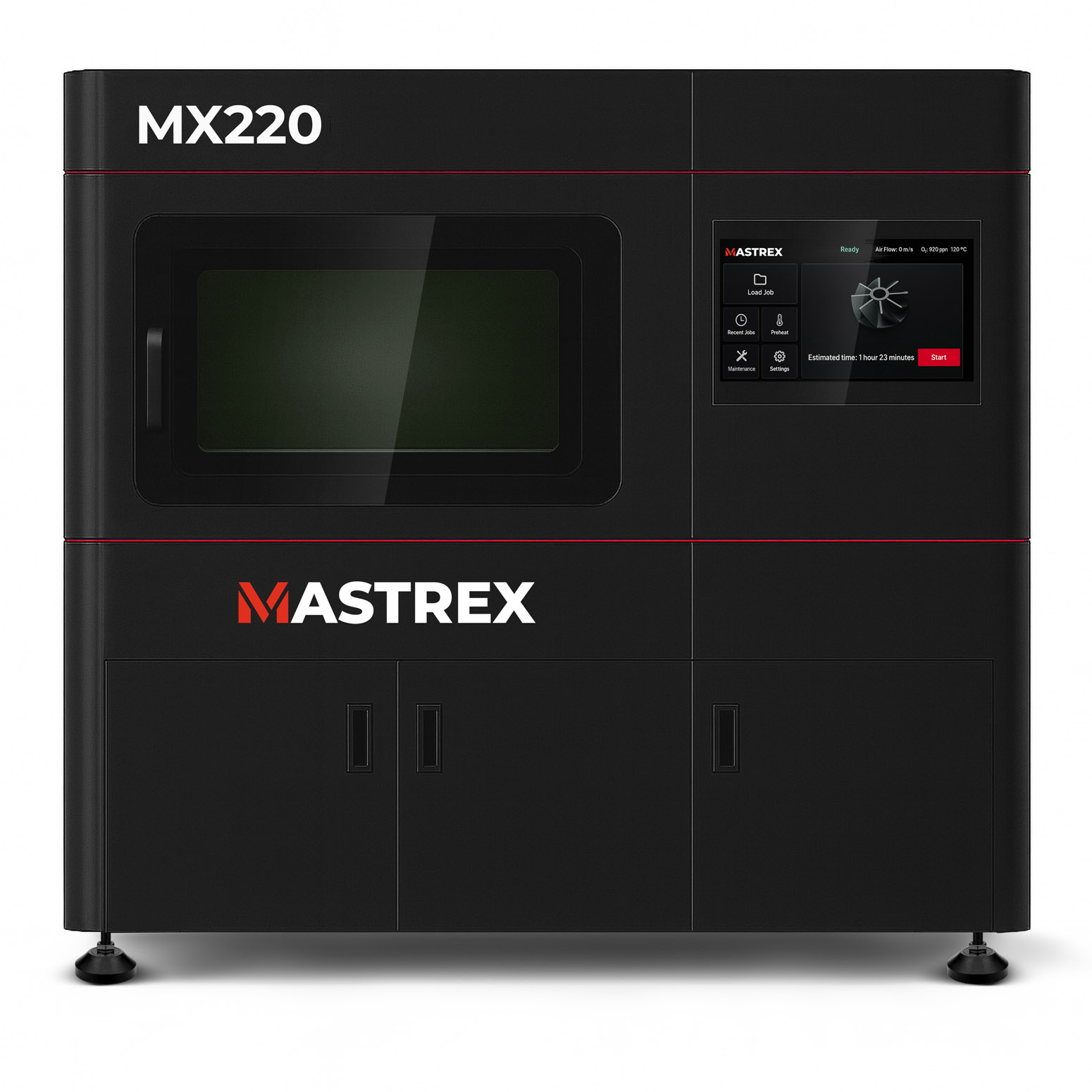

The Mastrex MX-220 is a production-ready Laser Powder Bed Fusion (LPBF) metal 3D printer for advanced manufacturing education, applied research, prototyping, and industrial workforce training. Its 8.66 × 5.51 × 7.87-inch build volume and two independent 500 W lasers provide greater throughput for larger parts and multi-part builds.
Learners can practice production-oriented workflows that include build preparation, dual-laser operation, powder recovery, depowdering, part removal, post-processing, inspection, and process documentation. Tech-Labs provides the MX-220 as a training solution manufactured by Mastrex.
Introduce learners to coordinated multi-laser processing using two independent lasers that cover the full build area.
Use a larger build volume and increased build rate to support batch planning, workflow analysis, and production-oriented projects.
Explore how scan coordination, calibration, build layout, material selection, and post-processing influence part quality and consistency.
Prepare learners for higher-throughput metal additive manufacturing with a dual-laser LPBF system.
When supported by the program's curriculum and operating procedures, the MX-220 can help learners develop skills in:
Two independent lasers cover the full build area, giving instructors a platform for teaching multi-laser operation and higher-throughput processing.
Mastrex uses coordinated scanning and calibration to reduce overlap artifacts and support consistent results across the build platform.
An 8.66 × 5.51 × 7.87-inch build volume supports larger parts, multi-part layouts, and production-planning exercises.
Instructors can explore how layer thickness affects surface finish, detail, build time, and productivity.
Mastrex lists titanium alloy, stainless steel, aluminum, cobalt-chromium alloy, copper alloy, and additional compatible materials.
A centralized interface supports machine control, workflow monitoring, instructor demonstrations, and supervised learner operation.
Confirm transport, the final configuration, site requirements, electrical service, service scope, and included items with Tech-Labs before installation.
Mastrex identifies professional on-site installation and training as included. Its product page does not identify a packaged academic curriculum, student workbooks, assessments, eLearning library, LMS integration, or credential alignment.
Programs should plan to integrate the MX-220 into their own additive-manufacturing curriculum or confirm additional instructional resources with Tech-Labs during project planning.
The MX-220 combines a production-oriented build volume with two independent 500 W lasers and a higher build rate for advanced training and applied research.
Product specifications and configuration details should be confirmed with Tech-Labs. Learners should follow institution-approved procedures for metal powder handling, equipment operation, personal protective equipment, housekeeping, and emergency response.