LinkedIn
X
Facebook
YouTube
Contact Tech-Labs
Search

The Modern Semiconductor Technician
The Skills That Power Advanced Manufacturing | Article 4 of 8
Tuesday, September 8, 2026
Executive Summary
The modern semiconductor technician works at the intersection of multiple technologies. Electrical systems, electronics, automation, instrumentation, mechanical systems, vacuum technology, software, and data increasingly operate as parts of one connected manufacturing environment. Success requires strong technical fundamentals, but it also requires understanding how these technologies interact and how changes in one system can affect another.
Table of Contents
- What Makes the Modern Semiconductor Technician Different?
- Why Is Systems Thinking an Essential Technical Skill?
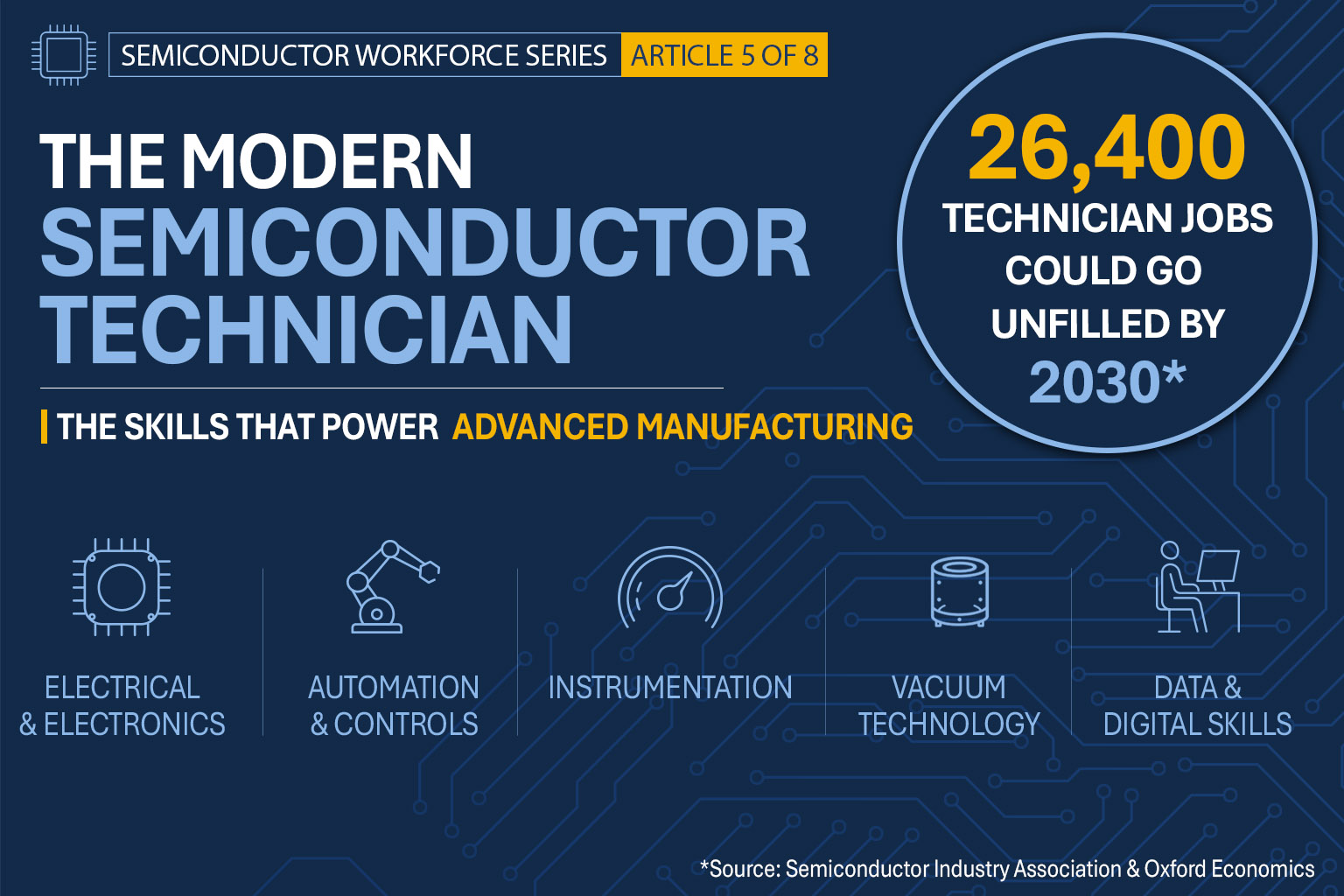
- What Technical Skills Do Semiconductor Technicians Need?
- Why Do Data and Digital Skills Matter?
- What Professional Skills Complete the Modern Technician?
- How Tech-Labs Helps Prepare the Modern Technical Workforce
- Conclusion
- One Final Thought
- Frequently Asked Questions
- Coming Next in the Semiconductor Workforce Development Series
What Makes the Modern Semiconductor Technician Different?
An equipment alarm appears during production. The component displaying the fault may be operating correctly, while the actual problem originates in a sensor, power supply, vacuum line, mechanical assembly, or software command somewhere else in the system. For the technician responding, finding the answer requires more than knowing one technology. It requires understanding how the technologies work together.
The first four articles in this series examined the semiconductor workforce challenge, the need to build a stronger talent pipeline, the evolution of technical education, and the importance of hands-on learning. Together, they lead to the next question: What kind of technician must those efforts ultimately prepare?
Inside a modern semiconductor fabrication facility, nearly everything is connected to something else. Equipment depends on electrical power, electronic controls, sensors, instrumentation, mechanical components, software, communications networks, process utilities, and precisely controlled operating conditions. Although a tool may perform a highly specialized process, keeping it operating reliably requires knowledge that increasingly spans traditional technical disciplines.
Key Takeaway
The modern semiconductor technician is not defined by how many technologies they know. They are defined by how well they understand the connections between them.
This broader perspective does not replace specialization. Semiconductor manufacturing will always require professionals with deep expertise in particular equipment, processes, and technologies. What is changing is the foundation surrounding that specialization: technicians increasingly need depth in their areas of responsibility and breadth across the larger systems in which they operate.
Why Is Systems Thinking an Essential Technical Skill?
Systems thinking is the ability to understand individual components not simply as separate pieces of equipment, but as parts of a larger operating system. In semiconductor manufacturing, that perspective matters because the performance of one subsystem can influence many others, sometimes producing symptoms far removed from the original condition.
Consider a simplified automated process. Sensors provide information about equipment conditions; controllers interpret that information; software determines which actions should occur; actuators carry out those commands; and instrumentation confirms whether the expected result occurred. Mechanical systems provide motion, electrical systems provide power, and process utilities create the conditions required for manufacturing. The process depends upon all of them working together.
A technician who focuses only on the component displaying a fault may recognize that something is wrong. In contrast, a technician who understands the larger system is better positioned to recognize what else may be influencing it. Instead of seeing isolated components, the technician begins thinking in terms of relationships, sequences, inputs, outputs, and dependencies.
Industry Insight
As manufacturing systems become more connected, understanding the relationships among technologies is becoming as important as understanding the technologies themselves.
Equipment will change, software will evolve, and semiconductor processes will continue becoming more sophisticated. The ability to understand how a complex system is organized provides technicians with a foundation that can remain valuable as the technologies around them change.
What Technical Skills Do Semiconductor Technicians Need?
Electrical and electronics knowledge remains part of the foundation because semiconductor equipment depends on electrical power, electronic controls, sensors, motors, drives, power supplies, safety systems, and other components operating within defined parameters. Technicians benefit from understanding electrical fundamentals, measurement, schematics, component operation, and the electronic signals that allow equipment to monitor conditions and respond to commands.
Automation, controls, and instrumentation add another essential layer. Modern equipment must perform complex sequences with extraordinary precision and repeatability, which requires technicians to understand how sensors, controllers, actuators, interfaces, and other automated components work together. Advanced programming may not be required for every technician, but understanding control logic, operating sequences, system status, and instrumentation can help technicians recognize what equipment is doing and why.
Mechanical and process-related knowledge remain equally relevant because even sophisticated automated systems depend upon physical components and controlled environments. Bearings wear, seals deteriorate, valves fail, mechanisms become misaligned, and filters become clogged. Semiconductor technicians may also encounter pneumatics, thermal systems, gas delivery, chemical handling, filtration, and other process technologies depending upon their role.
Vacuum technology is particularly important because many semiconductor processes operate under carefully controlled pressures far below normal atmospheric conditions. Technicians working with this equipment benefit from understanding the basic functions of vacuum pumps, gauges, valves, seals, and chambers, as well as the conditions that can prevent a system from reaching or maintaining the required vacuum.
Together, these disciplines give technicians the breadth to understand the equipment they support, recognize relationships among systems, and identify when a condition outside their primary specialty may be affecting performance.
Why Do Data and Digital Skills Matter?
Modern semiconductor equipment does more than perform physical processes. It continuously generates information about operating conditions, alarms, process values, events, maintenance, and performance. As a result, technicians increasingly work with both the physical equipment in front of them and the digital information describing what that equipment is doing.
Technicians do not need to become data scientists. Still, they do need enough digital fluency to navigate equipment interfaces, interpret system information, review trends, access electronic documentation, and place data in context. A problem that appears suddenly may have been developing gradually, while an intermittent condition may leave clues in an event history that cannot be observed during a physical inspection.
Workforce Perspective
Modern technicians increasingly work with two versions of the same equipment: the physical system in front of them and the digital information describing what that system is doing.
The strongest technicians learn to use both, combining physical observation with digital information to develop a more complete understanding of equipment performance.
What Professional Skills Complete the Modern Technician?
Technical knowledge alone does not define an effective semiconductor technician. Modern fabrication environments require technicians to work alongside operators, engineers, equipment specialists, maintenance teams, process professionals, supervisors, and vendors, making communication and collaboration extensions of technical competence rather than separate skills.
Clear documentation is equally important because technical work must often be traceable and repeatable. Technicians need to communicate what they observed, what actions were taken, what measurements were obtained, and what condition existed when equipment was returned to service. Attention to detail, safety, and procedural discipline are especially important in an environment where small deviations can have significant consequences.
Curiosity supported by humility may be one of the most valuable professional characteristics. Complex technical environments routinely present situations even experienced professionals have not encountered before, and strong technicians recognize when to ask questions, consult documentation, or seek additional expertise. These professional qualities do not replace technical skill; they make technical skill more valuable.
How Tech-Labs Helps Prepare the Modern Technical Workforce
For more than forty-five years, Tech-Labs has worked with educational institutions to help prepare students for careers across advanced manufacturing and other high-demand technical fields. As those environments become more technologically integrated, preparing students requires a broader view of the technical foundation they will need.
Through instructional technologies spanning electrical systems, electronics, industrial automation, instrumentation, robotics, mechanical systems, process technologies, and advanced manufacturing, Tech-Labs helps educators create learning environments that reflect this growing technical complexity. The objective is not to prepare students to master every technology they may encounter, but to help them develop strong fundamentals, understand how multiple technologies interact, and build a foundation for continued learning as their careers become more specialized.
Conclusion
The modern semiconductor technician works where electrical systems meet mechanical systems, sensors meet controls, and physical processes meet digital information. Semiconductor manufacturing will continue to require specialists with deep knowledge of particular equipment and processes, but those specialists increasingly operate within environments where technologies are interconnected.
Electrical and electronics fundamentals, automation, controls, instrumentation, mechanical and process systems, vacuum technology, and digital literacy provide important parts of that foundation. Communication, attention to detail, safety, curiosity, and professional discipline help technicians apply those capabilities effectively.
Taken together, these skills describe a technical professional capable of seeing beyond the component immediately in front of them and understanding its place within a much larger system.
One Final Thought
The semiconductor industry manufactures some of the smallest and most sophisticated devices ever created, yet the equipment required to produce them depends upon an extraordinary collection of technologies working together. The most valuable technicians will not simply be those who know the most about one machine, but those who understand the system well enough to recognize how the pieces fit together and possess the curiosity and discipline to keep learning as those pieces change.
Frequently Asked Questions
Semiconductor technicians benefit from knowledge of electrical and electronics, automation and controls, instrumentation, mechanical and process fundamentals, vacuum technology, digital literacy, and an understanding of how these systems interact. Specific requirements vary by role and employer.
Semiconductor equipment integrates many different technologies, and a condition in one system can create symptoms in another. Systems thinking helps technicians recognize these relationships rather than viewing equipment as a collection of unrelated components.
Not necessarily. Requirements vary by role, but many technicians benefit from understanding automation logic, operating sequences, system interfaces, and how software influences equipment behavior even when specialists handle advanced programming.
Many semiconductor processes require carefully controlled environments at pressures far below normal atmospheric conditions. Technicians working with this equipment benefit from understanding basic vacuum principles and the components used to create, measure, and maintain those conditions.
Yes. Technicians routinely work with engineers, operators, maintenance teams, equipment specialists, supervisors, and vendors. Clear communication and documentation allow technical information to move accurately between people, teams, and shifts.
Coming Next in the Semiconductor Workforce Development Series
Article 6: Building Stronger Workforce Partnerships
Connecting Industry, Education, and Communities
Developing technicians with this range of capabilities requires more than a strong curriculum or a well-equipped laboratory. It requires sustained cooperation among industry, education, workforce organizations, and communities. In the next article, we’ll examine how these partners can combine their strengths to keep workforce development aligned with the needs of employers and the regions they serve.
About the Author

Chris Harris brings a unique perspective as President at Tech-Labs and X-Cal, a mindset and performance expert, and a former elite trainer for military special forces. With a 25-year background in high-performance leadership, Harris has authored 14 books—including Bridging America’s Skills Gap, co-authored with Mark Goodman—and inspired audiences in over 60 countries.