Executive Summary
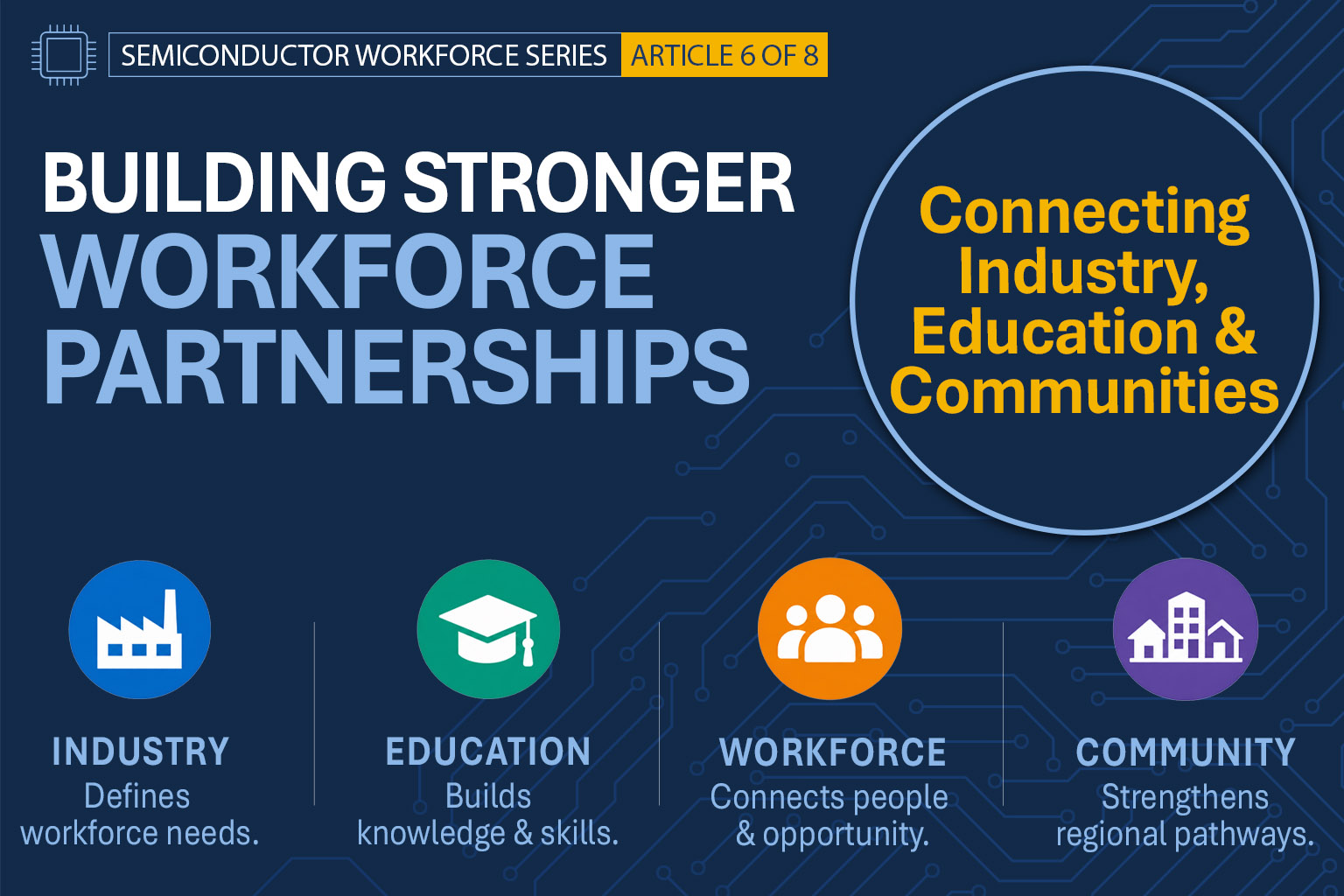
Strong semiconductor workforce partnerships connect the organizations that understand the work with those that educate, develop, and support the people who will perform it. Industry brings knowledge of workforce needs, education transforms those needs into learning, and workforce and community organizations connect people with opportunity. When those partners communicate continuously, workforce development becomes more responsive, coordinated, and aligned with changing industry needs.
Table of Contents
- Why Are Strong Workforce Partnerships Essential?
- How Should Industry and Education Define Their Roles?
- How Can Regional Partners Build a Workforce Ecosystem?
- How Can Partners Turn Industry Needs into Workforce Competencies?
- What Makes a Workforce Partnership Sustainable?
- How Should Workforce Partnerships Measure Success?
- How Tech-Labs Helps Strengthen Workforce Alignment
- Conclusion
- One Final Thought
- Frequently Asked Questions
- Coming Next in the Semiconductor Workforce Development Series
Why Are Strong Workforce Partnerships Essential?
A semiconductor workforce does not belong to a single company, school, college, workforce organization, or community. The technician working inside a fabrication facility may have developed technical foundations at a local school or community college, received assistance from a workforce organization, gained experience with a regional employer, and continued developing after being hired. Different organizations contributed at different stages, which is why workforce partnership must mean more than bringing industry and education together for an occasional meeting. It requires connecting organizations that possess different pieces of the information, expertise, and resources needed to develop people successfully.
Manufacturers understand what is happening inside their facilities; educators understand how knowledge and capabilities are developed; workforce organizations understand regional labor conditions and pathways into employment; and community organizations often understand barriers and opportunities that may never appear in a job description or course catalog. Problems arise when those perspectives remain disconnected: employers may recognize changing requirements that educators do not hear about soon enough, while colleges may build programs around assumptions that no longer reflect regional needs. Every organization can be doing good work and still contribute to a workforce system in which the individual pieces are not working together.
Key Takeaway
Strong workforce partnerships do more than bring organizations together. They keep information moving between them.
That distinction matters because semiconductor workforce needs continually change as equipment, processes, technologies, and job responsibilities evolve, while educational programs and students require time to respond. If communication occurs only when someone needs employees, equipment, funding, or enrollment, workforce development will react to industry rather than develop alongside it. The objective is not simply partnership. It is alignment.
How Should Industry and Education Define Their Roles?
Industry possesses something no other workforce partner can completely replicate: direct knowledge of the work as it exists today. Employers know which capabilities employees need, which technologies are becoming more important, how responsibilities are changing, and what separates someone who meets a job's qualifications from someone prepared to perform it successfully. For that knowledge to strengthen workforce development, employers must communicate with greater precision than simply saying they need more technicians or better-trained graduates. Educators need to understand what employees are expected to know and do, which capabilities should be in place before employment, and which can reasonably be developed after hiring.
Education brings a different expertise to the partnership. Schools and colleges must translate occupational requirements into learning while recognizing that not every task performed inside a semiconductor facility belongs in a curriculum and not every company-specific requirement should become part of an educational program. Employers naturally focus on the workforce needed for their operations, while educators must prepare students whose careers may span multiple employers, technologies, and positions. Industry can identify what employees must be able to do, while education determines the underlying knowledge and transferable capabilities students need to get there.
Industry Insight
Industry should help education understand where the work is going. Education should determine how to prepare people to grow with it.
This creates an important boundary between foundational preparation and employer-specific training. Educational institutions can develop transferable technical foundations and professional capabilities, while employers provide proprietary processes, specialized equipment knowledge, procedures, and site-specific requirements. When that division is understood, employers are less likely to expect graduates to arrive already trained for every proprietary system. At the same time, educators gain a clearer understanding of the foundation industry expects them to provide.
How Can Regional Partners Build a Workforce Ecosystem?
Industry and education are essential partners, but they do not represent the entire workforce system. Workforce development organizations, economic development groups, local governments, and community organizations can identify where programs overlap, where gaps remain, where people struggle to connect with opportunities, and where several employers share workforce needs that may be difficult for one company to address alone. Their greatest contribution may be coordination—helping organizations see how their individual efforts fit within a larger regional workforce system.
That regional view should also extend beyond the semiconductor fab itself. Every fab depends upon equipment suppliers, materials providers, contractors, maintenance organizations, engineering firms, and specialized technical services whose employees are also part of the semiconductor workforce. Many of these employers require overlapping capabilities, which creates an opportunity for workforce partners to identify common needs and develop pathways that support an entire regional ecosystem rather than a single company.
Workforce Perspective
A workforce ecosystem becomes stronger when organizations stop asking only, “What can we build?” and begin asking, “What already exists, what is missing, and who is best positioned to provide it?”
Without coordination, a region can accumulate many workforce programs without ever developing a workforce system. Sometimes the strongest solution is not another program but a better connection among existing resources, employers, educational institutions, and opportunities.
How Can Partners Turn Industry Needs into Workforce Competencies?
One of the most important functions of a workforce partnership is translation because participating organizations often describe the same challenge in different ways. Employers speak in terms of jobs, equipment, responsibilities, and production requirements; educators organize learning around competencies, courses, and assessments; and workforce organizations often think in terms of occupations, pathways, and labor demand. A strong partnership creates a shared language by beginning with a straightforward question: What must a person be able to do successfully in this role?
Employers can identify responsibilities and expectations; educators can determine the knowledge and capabilities that support them; and multiple employers can identify where their requirements overlap. Those shared competencies allow workforce development to serve a regional industry rather than being designed around the vocabulary, equipment, or immediate needs of one company. When each organization understands both what it contributes and what belongs to another partner, a collection of independent efforts begins to function as a workforce system.
What Makes a Workforce Partnership Sustainable?
Strong workforce partnerships must continue working after the initial enthusiasm fades, priorities change, technologies evolve, and the people who originally championed them move into different roles. That requires structure: participants must understand their responsibilities, how information will be shared, how changing workforce needs will be identified, and how decisions will move from conversation to action. Advisory boards and industry councils can support that process, but only when they function as working relationships rather than occasional meetings where employers are asked to approve decisions already made.
Communication must also move in both directions. Employers can explain how workforce requirements are changing, educators can share what they are seeing among students and programs, and workforce organizations can identify regional trends or barriers. Over time, strong partnerships develop a rhythm of reviewing needs, identifying gaps, assigning responsibilities, evaluating results, and adjusting as conditions change. Personal relationships may start a partnership, but structure allows it to continue when people, technologies, and priorities change.
How Should Workforce Partnerships Measure Success?
Workforce activity is easy to count: meetings, participants, programs, internships, credentials, and graduates. Those numbers can be useful, but they do not necessarily demonstrate that a partnership is improving workforce readiness. The more important measures are outcomes, including whether students develop the competencies employers need, graduates move into relevant employment, employers see stronger preparation, and persistent workforce gaps begin to improve.
Measurement should also create a feedback loop. If graduates consistently struggle with a particular capability, that information should return to educators; if students complete programs but fail to move into available positions, partners should determine where the connection is breaking down. The purpose is not simply to prove that a partnership is working, but to identify where it can work better.
Workforce Perspective
The purpose of measuring a workforce partnership is not simply to document activity. It is to create better information for the next decision.
That principle brings the article back to its central idea: effective partnerships keep information moving. When results are shared among the organizations responsible for workforce development, yesterday's outcomes can inform tomorrow's decisions.
How Tech-Labs Helps Strengthen Workforce Alignment
For more than forty-five years, Tech-Labs has worked across technical education, advanced manufacturing, and workforce development, bringing us into conversations with educational institutions, manufacturers, workforce organizations, government agencies, and technology partners. That experience has reinforced an important lesson: successful workforce development begins by understanding what each partner is trying to accomplish before deciding what technology or training solution belongs in the classroom.
Our role is to help connect those conversations to practical learning environments. Employers identify technologies and capabilities that are becoming more important in the workplace; educators determine how those capabilities fit within programs and learning objectives; and Tech-Labs helps bridge those perspectives through educational technologies, curriculum, instructor development, and training solutions. Technology is an important part of workforce preparation, but the strongest partnerships ensure that technology supports the workforce strategy rather than becoming the strategy itself.
Conclusion
Building a semiconductor workforce is not a challenge that any one organization can solve independently. Industry understands the work; education understands how people learn; workforce organizations understand regional pathways; and communities understand many of the conditions that affect whether opportunities can actually be reached. Strong partnerships connect those perspectives through clear responsibilities, shared language, regular communication, and feedback.
The strongest semiconductor regions will not necessarily be those with the most workforce initiatives. They will be those where employers, educators, suppliers, workforce organizations, and communities understand their roles, share information, and make their individual efforts work together.
One Final Thought
Partnership is sometimes treated as an outcome: a memorandum is signed, a committee is formed, or several logos appear together on an announcement. Those moments may mark an important beginning, but the real partnership is demonstrated by what happens afterward. When an employer identifies a changing need and education responds, when educators identify a challenge and industry listens, and when partners share information openly enough to learn, adjust, and improve together. The goal is not simply to connect organizations, but to keep them aligned around the same outcome.
Frequently Asked Questions
No single organization possesses all the expertise required to develop a semiconductor workforce. Partnerships connect the workplace knowledge of employers, the learning expertise of educators, and the regional perspective of workforce and community organizations so their efforts remain aligned.
Manufacturers should provide clear information about job responsibilities, required competencies, changing technologies, and emerging workforce needs. Technical expertise, advisory participation, facility engagement, internships, and apprenticeships can further strengthen that connection.
Educational institutions translate workforce requirements into structured learning while developing technical foundations that can transfer across employers and technologies. Their role is not to reproduce company-specific training, but to equip learners with the knowledge and capabilities employers can build on.
Partnerships should look beyond activity and examine outcomes such as competency development, movement into relevant employment, employer feedback, and continuing workforce gaps. Measurement should help partners understand what is working, where problems remain, and what should change.
Coming Next in the Semiconductor Workforce Development Series
Article 7: Investing in America’s Semiconductor Workforce
Why People Are the Nation’s Greatest Competitive Advantage
Strong partnerships create the alignment required to develop semiconductor talent, but alignment alone does not build workforce capacity. In the next article, we’ll examine why workforce development should be viewed as a long-term investment and why America’s commitment to semiconductor facilities and technology must be matched by a commitment to developing the people who will ultimately determine their success.