The Industrial Manufacturing Technician Apprenticeship Program for high school students and incumbent workers in Elkhart County, Indiana was the result of the HEA facilitated Advanced Manufacturing Sector Partnership. Industry-driven collaboration with support and collaboration among the education and government partners made this possible.


Built alongside respected educational institutions, initiative sets new standards for excellence and consistency across additive manufacturing training and education.
Amatrol’s multimedia curriculum engages learners with interactions that are designed to enhance comprehension. This video provides a small sample of Amatrol’s extensive eLearning library that contains hundreds of courses and thousands of training hours.
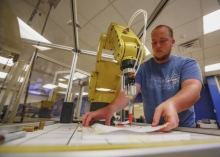
Robots are a way of the future. They can be found inside manufacturing and distribution centers and state-of-the-art factories and at Texas State Technical College.
Students can now enroll in Robotics Technology, one of four new programs being offered at TSTC’s Fort Bend County campus, and learn how to program and operate a fast-growing robotic population.
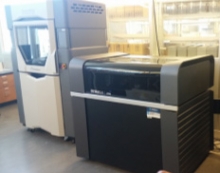
Two 3D printers at the Brown Foundation Institute of Molecular Medicine for the Prevention of Human Diseases are changing the way educators, researchers and students approach a wide variety of challenges inside and outside of labs and classrooms.
Being one of the lightest, most durable materials on the market, the new FDM Nylon12 Carbon Fiber material. Containing 35 percent chopped carbon-fiber by weight, and an ultimate tensile strength on the xz axis of nearly 11,000 psi (76Mpa), FDM Nylon 12CF offers the best stiffness-to-weight ratio among Stratasys FDM thermoplastics, meeting the advanced functional testing.
There is a genuine interest in developing wood-derived graphene materials into electrical conductors. Rice University introduces this ground-breaking research by using the Universal Laser Systems XLS10MWH platform. This XLS laser system and processing conditions are described in detail in the following article.
As 3D printing has become more and more mainstream, the traditional resource and skills barriers for manufacturing are all but vanishing. This trend is changing the very face of design.